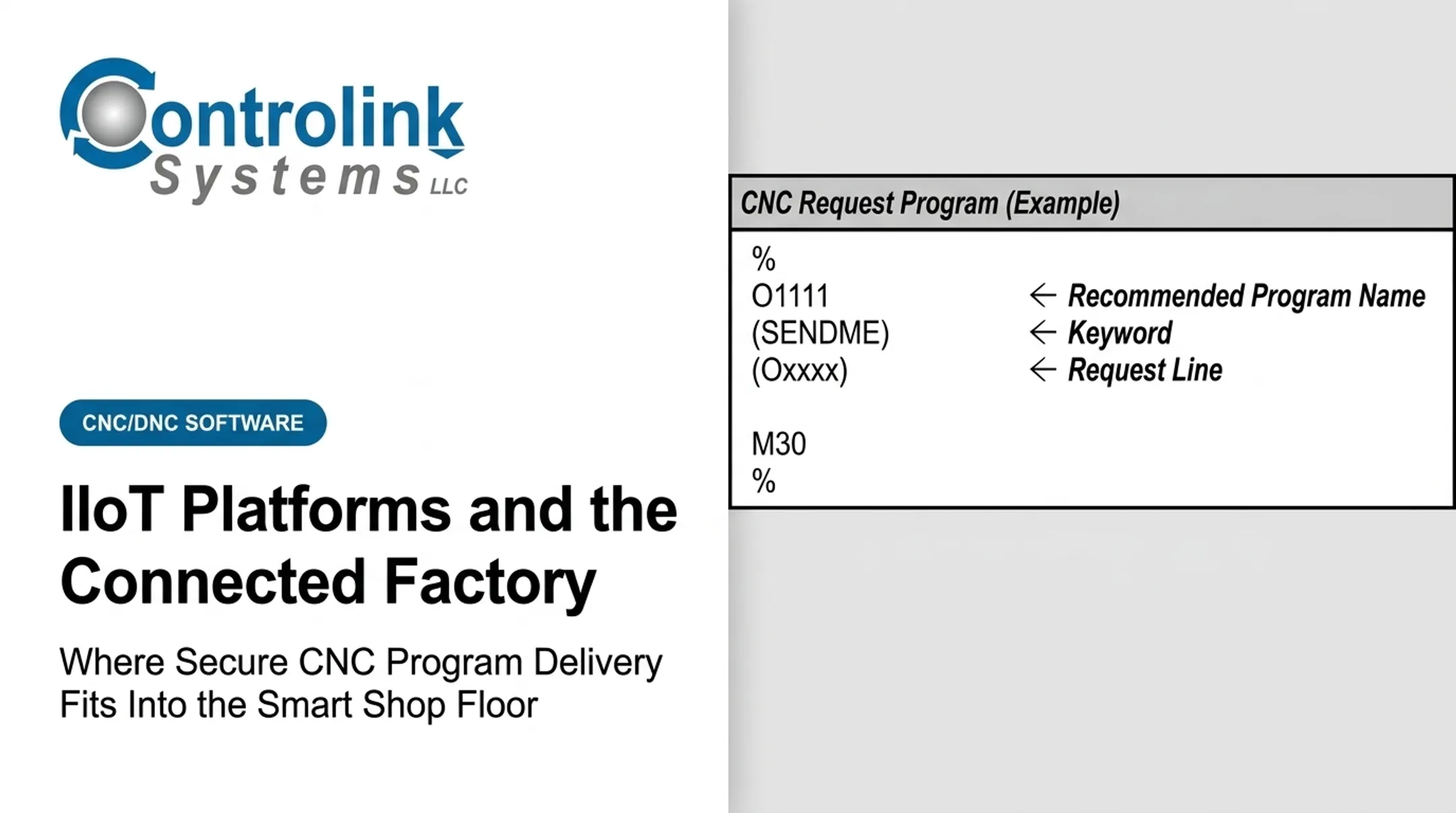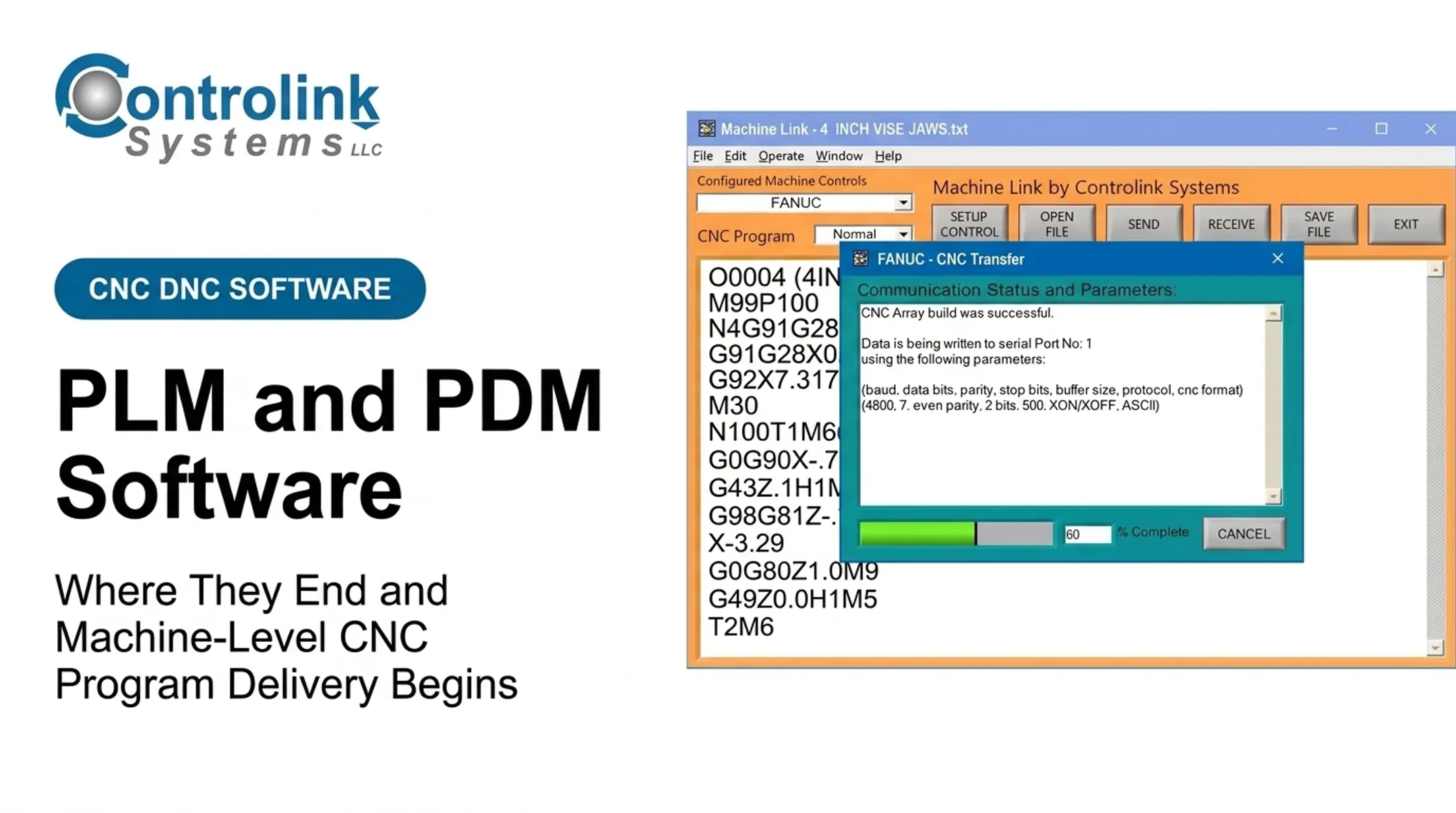

That gap shows up more often than most shops admit. Material lots and finished-part serial numbers get tracked carefully, while the CNC program itself gets treated like an afterthought — a file copied from a shared drive, emailed to an operator, or edited locally with no formal record. That becomes a real problem the moment a stale revision or an unapproved edit reaches a machine.
This article extends conventional supply chain traceability into CNC and DNC file delivery, linking engineering approvals, program revisions, machines, operators, work orders, inspection results, and finished parts into one connected record. We'll define traceability in a defense manufacturing context, explain why CNC programs deserve treatment as controlled production assets, and lay out a phased path to implementation.
Key Takeaways
- Treat every CNC program as a controlled, traceable manufacturing record.
- Link program identity and revision to part numbers, work orders, machines, operators, and inspection evidence.
- Use trace-back and trace-forward to find defects and prove which jobs ran a given revision.
- Build on reliable data capture, role-based controls, machine connectivity, and workflows operators will follow.
What Supply Chain Traceability Means in Defense Manufacturing
GS1 defines traceability as "the ability to track forward the movement through specified stage(s) of the extended supply chain and trace backward the history, application or location of that which is under consideration." That definition matters here because it draws a clear line between knowing where something is and knowing its full history.
Traceability Isn't Visibility or Version Control
Visibility tells you where something is right now, or where it's been recently. Version control tells you which revision is currently approved. Traceability does more: it reconstructs the entire chain of events, connecting who touched what, when, and under whose approval.
A shared folder full of CNC programs, organized neatly by revision number, is not a traceability system. It becomes one only when:
- Approvals are recorded, not assumed
- Every transfer is logged with a timestamp and destination
- Execution events link back to a specific work order
- Changes are captured with a reason and an authorizing party
Internal vs. Chain-Wide Traceability
Internal traceability covers everything happening inside one facility:
- Engineering and production control
- CNC programming and the shop floor
- Inspection, maintenance, and quality records
Chain-wide traceability extends further. It reaches material suppliers, special-process providers, subcontract machine shops, prime contractors, and downstream customers, where data-sharing agreements allow it.
Most defense manufacturers already handle internal traceability reasonably well for materials and finished parts. Extending that same discipline to the CNC program itself is the piece that's usually missing.
Trace-Back and Trace-Forward in a CNC Context
Two workflows do the heavy lifting:
- Trace back — from a nonconforming part to its work order, machine, operator, program revision, the specific transfer event that put it there, tooling and offset records, material lot, and inspection results.
- Trace forward — from a withdrawn or compromised program revision to every machine, job, part, and subcontractor that may have used it.

GS1's framework describes selectable identification levels (product, lot or batch, or serial) rather than a single fixed model. For CNC program traceability, three layers apply:
- Item identity: the program and its revision
- Process history: who approved, transferred, and executed it
- Network relationships: which machines, jobs, and partners touched it
Terminology varies across standards, but the goal stays the same: reconstructing the full story behind a part.
Why Traceability Matters for Defense Manufacturing
Knowing a part was manufactured isn't the same as proving it was manufactured under controlled conditions with approved data. Defense contracts often require the latter.
IAQG's clarification on AS9100:2016 notes that clause 8.5.1 requires documented evidence that production and inspection operations were completed as planned. That typically means identifying the operator and inspector. Clause 8.5.6 requires retained records showing who reviewed and authorized a change. Configuration integrity isn't optional documentation; it's the expectation.
Operational Risks of Incomplete CNC Traceability
Gaps in program traceability create specific, recurring failure modes:
- Outdated programs get selected when nobody can confirm the current revision quickly
- Revised files reach some machines but not others running the same job
- Local edits at the control bypass formal approval entirely
- Programs run on machine configurations they were never validated against
Each of these increases scrap, drives unplanned rework, extends investigation time, and disrupts schedules. When the scope of affected parts is uncertain, teams often over-contain, pulling every similar part or lot rather than the ones actually at risk.
A linked digital record changes that math. Instead of quarantining an entire production run "just in case," quality teams can isolate exactly which parts used a specific program revision, on which machine, during which shift. That is targeted containment instead of a schedule-wide stand-down.

Compliance Is Contract-Specific, Not Universal
Traceability requirements vary by contract, product, process, and customer. Some obligations flow down through quality clauses; others stem from configuration-management expectations built into standards like AS9100.
None of this establishes a blanket legal requirement. Export control designations, controlled unclassified information handling, and specific customer clauses all shift what applies. Legal counsel or a qualified compliance professional should confirm the obligations tied to a specific contract.
Controlink Systems connects CNC/DNC communications and shop-floor systems so manufacturers can use engineering-approved files, reduce avoidable scrap and downtime, and spend less time hunting for which program actually ran on which machine. That is one piece of the traceability puzzle, not a compliance guarantee.
Why Every CNC Program Must Be Part of the Traceability Chain
A CNC program isn't a passive file sitting in storage. It directly controls tool motion, cutting conditions, sequencing, and ultimately the geometry of the finished part. That makes it a production asset in the same sense as a fixture or a gauge. It should be identified, controlled, and tracked accordingly.
At minimum, a program should carry:
- Part number and operation
- Machine or machine class it's approved for
- Revision number and approval status
- Effective date and applicable work order or routing
The exact data set will vary by organization. Rather than chasing a universal standard, document a minimum data set that fits your process and stick to it consistently.
Mapping the Program Lifecycle
A traceable program moves through distinct stages:
- Creation or import
- Engineering review and approval
- Release and distribution
- Machine receipt, operator selection, and execution
- Exception handling
- Revision, supersession, archival, and controlled withdrawal
Each event should capture:
- Timestamp
- User or system identity
- Source and destination
- Program identifier and revision
- Outcome
Connecting the Program to the Broader Manufacturing Record
Picture a nonconforming bracket flagged during final inspection. A quality engineer pulls the work order and identifies the part number, operation, and machine.
From there, a linked record shows which program revision was loaded at the time of the run, when it was transferred from the controlled repository, who approved it, and whether any local edits were logged during that shift. What used to take days of asking around the shop floor becomes a lookup.

That kind of connection requires linking the program to:
- Work order, part, and drawing revision
- Material or lot identifier
- Machine and controller
- Fixture, tooling, and offsets
- Operator and inspection results
- Any related nonconformance record
Bidirectional Controls for CNC File Delivery
Traceability needs to work in both directions:
- Backward: from a completed part to the program and its full approval chain
- Forward: from a superseded or compromised program to every affected machine, job, completed part, and piece of in-process work requiring quarantine
Approved Delivery vs. Uncontrolled File Movement
USB drives, desktop copies, email attachments, local edits, and undocumented operator overrides all create evidence gaps, even when the final file that ran happens to be correct. The problem isn't the outcome; it's the missing proof of how it got there.
This is the exact gap products like Machine Link™ QUICK Serve are built to close. Instead of operators pulling files from a shared folder or USB stick, QUICK Serve continuously monitors each CNC machine for file requests and serves the current engineering-approved version directly to the control.
Edits made at the machine route back to an engineering folder for review before entering the program library. One Controlink customer, Ametek, adopted that workflow specifically because corrected programs sent back from machines weren't reliably making it into formal revision control.
Practical controls worth building around this principle include:
- A single controlled source for program distribution
- Authenticated access to that source
- Machine-specific release rules
- Read-back verification where the control supports it
- Exception logging for anything outside the standard path
- A documented emergency-change procedure
Controlink Systems builds CNC/DNC communications, shop-floor automation, and integrations with SQL databases, PLC hardware, and motion controllers—work that connects program delivery to the rest of the production record. No software configuration by itself satisfies defense compliance requirements. What matters is assessing the specific process, configuring controls correctly, and validating that the integration captures the events that actually matter.
How to Implement CNC Program Traceability
Rolling out CNC program traceability works better as a phased effort than a single overhaul. 1. Start with a risk assessment and process map. Map every point where programs are created, edited, approved, stored, transferred, selected, executed, backed up, or retired. Then prioritize by risk:
- Safety-critical parts and operations
- Contractually important programs
- Complex or high-change jobs
- Machines and programs with defect history 2. Define identifiers and ownership before selecting technology. Set naming and revision conventions for programs, parts, operations, machines, and jobs before you buy tools. Assign ownership across engineering, manufacturing engineering, IT/OT, production control, operators, quality, and maintenance. Build a data dictionary that states:
- Which fields are mandatory
- Which fields are immutable versus editable
- How long each record type must be retained 3. Design the controlled approval and release workflow. Map the path from programmer submission through technical review, quality or engineering approval, release, machine assignment, and operator confirmation. Build in:
- Segregation of duties
- Electronic approvals where practical
- Reason codes for revisions
- A controlled emergency-change path 4. Connect the CNC/DNC layer to the manufacturing record. Machine connectivity, DNC communications, SQL databases, MES or ERP systems, and shop-floor HMIs must exchange the identifiers and events that make traceability real:
- Delivery confirmation
- Machine receipt
- Program selection
- Execution status
- Operator acknowledgements Machine Link™ supports this on compatible CNC machines using standard RS-232 serial communications, which matters for mixed-age equipment. Legacy or disconnected machines may need controlled scanning, offline synchronization, or manual attestation. Not every machine on the floor supports the same protocol. 5. Pilot on one production flow, then scale. Choose a pilot with enough variation in programs, machines, operators, and inspection requirements to expose real integration gaps. Track internal measures such as search time, wrong-revision events, containment speed, and audit retrieval. Do not assume a baseline improvement figure in advance. Document lessons learned before expanding to more machines, sites, or external partners. If your shop sits between paper travelers and full automation, review the program-delivery workflow with a team that specializes in CNC/DNC integration. Controlink Systems works with manufacturers to find where links between engineering, the machine, and the record break down, so you can close those gaps before you scale.

Technology, Data, and Governance Requirements
Technology Layers
A functional traceability setup typically combines several connected layers:
- Controlled program repository
- Identity and access management with audit logging
- Machine connectivity and database integration
- Reporting tools for investigations Pick the identification method from the production environment: barcode, QR, database records, or automated event capture through industrial protocols. Standards such as MTConnect and ISA-95 give common vocabularies for exchanging machine and production data when those interfaces are in play.
Data Integrity and Cybersecurity
CNC program records need the same safeguards as any other sensitive production data:
- Authentication and least-privilege access
- Encryption in transit and at rest where applicable
- Change detection and protected audit records
- Regular backup testing and network segmentation For defense contractors handling covered defense information, DFARS 252.204-7012 requires adequate security aligned with NIST SP 800-171, plus cyber incident reporting to the DoD within 72 hours of discovery. Whether a given CNC program qualifies as covered technical information depends on the contract and data type. Make that call from the clause text, not assumption.
Human Factors and Supplier Exchange
The approved program should be the easiest path for an operator to follow, with documented exceptions only when production truly needs intervention. Close the policy-to-floor gap with:
- Training tied to controlled program use
- Visible program identity and revision data at the control
- Periodic audits that compare floor practice to the digital record For subcontractors and suppliers, define the minimum traceability data they must provide: enough to verify completeness without pulling sensitive technical detail you do not need. Governance should cover data ownership, retention, access permissions, and clear onboarding and offboarding as partners join or leave a program.
Frequently Asked Questions
Is traceability a legal requirement?
It depends on the product, contract, customer, and applicable regulation. Some obligations come from quality-system standards or customer clauses rather than statute. Consult legal counsel or a compliance professional for your specific contract.
What is a traceability system?
A traceability system combines people, processes, identifiers, records, controls, and technology to reconstruct an item's history. In defense machining, that includes CNC program revisions and delivery events tied to production.
What are the two main types of traceability?
Internal traceability covers activity within one organization or facility. Chain-wide traceability extends across suppliers, manufacturers, subcontractors, logistics providers, and customers, based on data-sharing agreements.
What are the three levels of traceability?
Most frameworks cover three layers: item or component identity, process or transaction history, and relationships across the wider supply chain. Exact terms vary by standard, so use the framework your contract or customer references.