
Many manufacturers struggle with this exact gap. The work order says one thing, the machine has been running a different revision for three shifts, and nobody notices until a part fails inspection. Manufacturing execution system (MES) software exists to close that gap.
In plain terms, MES coordinates, records, and improves what happens between enterprise planning and the shop floor. It tracks jobs, resources, and quality in real time, so the plan and the reality stay connected.
This article covers what MES actually does, how CNC program delivery fits into that picture, and a practical framework for choosing (and implementing) the right system for your shop.
Key Takeaways
- MES delivers real-time visibility into production workflows, quality, resources, and traceability.
- MES and DNC solve different problems: MES handles execution context; DNC delivers the correct program to the machine.
- Integration depth, usability, and data governance matter more than feature checklists.
- Match MES choice to your processes, equipment, compliance needs, and measurable goals—not a best-seller list.
What Does MES Software Do?
Think of manufacturing in layers. At the top sits ERP, handling business planning, purchasing, and high-level production orders. At the bottom sit machine controls, PLCs, and sensors doing the physical work. MES sits between them.
The ISA-95 standard formalizes this. It places manufacturing operations management, where MES lives, at Level 3, with business planning and logistics (ERP) at Level 4. The standard focuses heavily on defining the interface between those two levels, which is exactly where most manufacturers run into trouble.
According to NIST, MES uses real-time production data to identify defects, inefficiency, and cost drivers as they happen, not weeks later in a report.
Core Capabilities to Expect
A functional MES should give you:
- Real-time data collection from machines, sensors, operators, and connected systems
- Work-order dispatch and scheduling, including routing and resource allocation
- Quality management, covering nonconformance handling, document control, and version-controlled work instructions
- Product tracking and genealogy, with full WIP visibility and production records
- Performance dashboards tracking throughput, yield, downtime, and OEE
A CNC Machining Example
Picture a released work order for a precision aerospace bracket. A well-integrated MES connects that order to:
- The required material lot and tooling
- Setup instructions and the correct fixture
- Inspection steps tied to that specific operation
- Operator activity and cycle logging
- Final production results, feeding back to ERP
MES vs. Adjacent Systems
| System | Primary Role |
|---|---|
| ERP | Business planning, purchasing, inventory, costing |
| MES | Manufacturing operations, execution, quality, traceability |
| SCADA/HMI/PLC | Equipment monitoring and control at the automation level |
| DNC/CNC communications | Transfer and governance of programs between file servers and machine controls |
MES coordinates information across these layers. It typically doesn't replace any of them.
Where CNC Program Delivery Connects to the Shop Floor
Here's the uncomfortable truth: a perfect production schedule means nothing if the machine loads the wrong program revision. This is where MES and CNC program delivery intersect, and it's one of the most overlooked integration points in shop-floor software.
The End-to-End Workflow
A properly governed program flow looks like this:
CAD/CAM Output → Engineering Approval → Program Storage/Revision Control
       ↓
MES (Order, Operation, Machine, Due Date, Required Checks)
       ↓
DNC/CNC Communications (Program Transfer to Machine Control)
       ↓
Machine Execution + Operator Confirmation
       ↓
Production Feedback (Cycle Status, Quality, Downtime) → MES/ERP
MES and DNC: Complementary, Not Redundant
MES identifies the order, operation, routing, machine, due date, and required checks. DNC software delivers the engineering-approved program to the correct machine and manages the machine communication itself.
According to Modern Machine Shop's coverage of DNC systems, the same connection used to deliver programs can also report machine status and production data back up the chain. That dual role is valuable, but it doesn't mean DNC alone provides MES-level quality, genealogy, or scheduling functionality.

Without this connection, operators fall back on:
- Outdated local files saved to the machine's hard drive
- Informal file sharing over USB or shared drives
- Manual searches across disconnected folders
Any of these can put an unapproved revision into production.
When you're reviewing a connected workflow, check for:
- User permissions and approval status tracking
- Revision history and file naming consistency
- Machine-to-program matching logic
- Audit trails and backup behavior
- Defined edit/exception handling process
How Controlink Fits This Picture
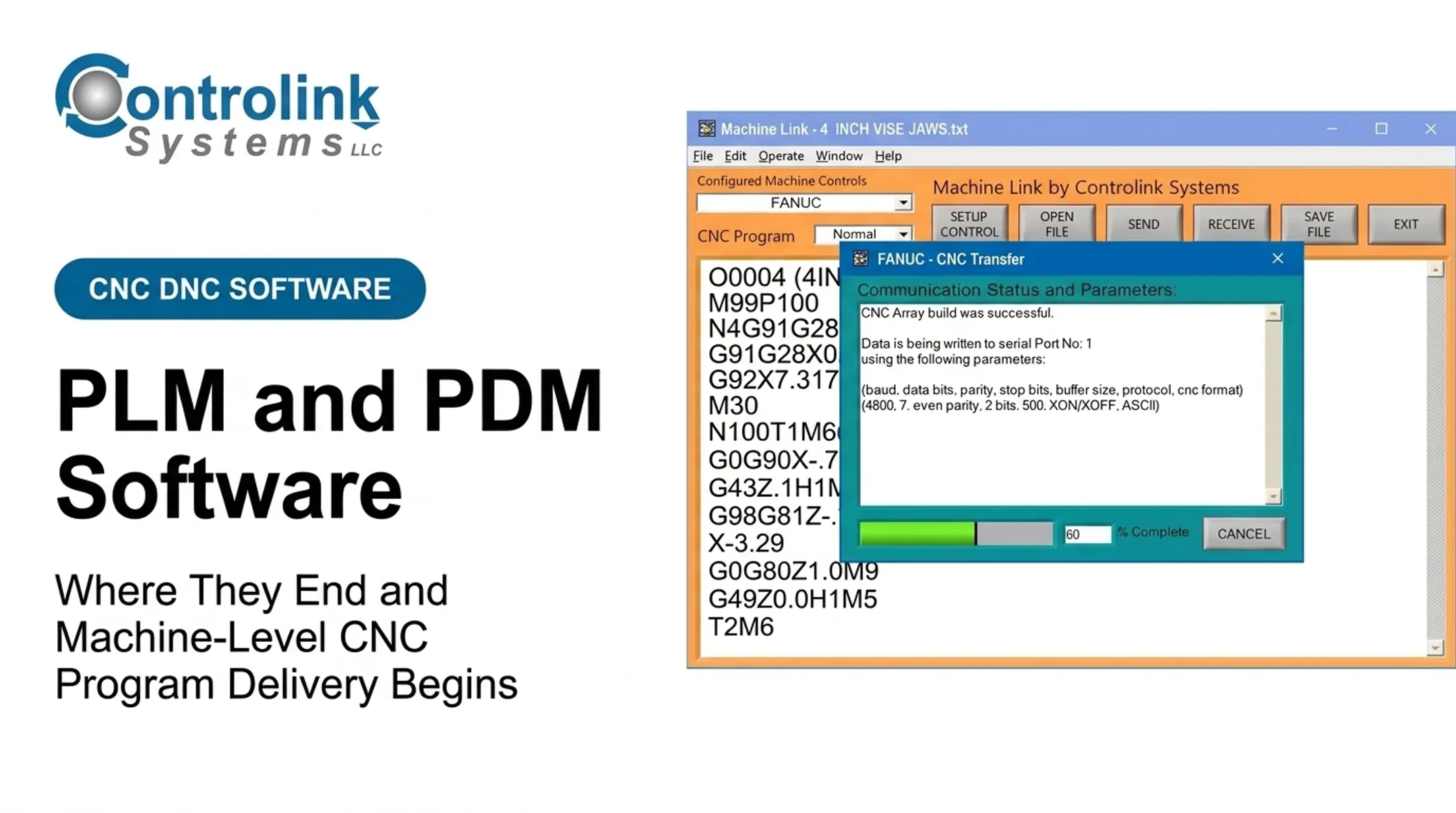
Controlink Systems LLC has focused on CNC/DNC communications and shop-floor automation since 1998. Its Machine Link™ QUICK Serve tool continuously scans machines for remote file requests and serves the latest engineering-approved CNC file directly to the machine tool control, without the operator walking away from the machine.
Program edits made at the machine can be routed back to engineering for review, closing the loop on unauthorized changes before they become a habit. It's a practical example of the last mile between manufacturing software and machine control—without treating DNC as a substitute for MES.
What Benefits Can MES Software Deliver?
The benefits of MES aren't abstract. They show up in specific, measurable ways on the shop floor.
Measurable shop-floor gains include:
- Catch issues in hours instead of monthly reviews when machine and operator data flows automatically
- Support recalls, regulated production, and customer audits with real-time quality records instead of paper logs
- End "which file is current" confusion with centralized, version-controlled instructions and approved CNC programs
Case Study: KLA-Tencor MES Rollout
One of the more documented MES rollouts comes from KLA-Tencor, reported by IndustryWeek. The company needed to integrate manufacturing, supply chain, and quality data, along with detailed test records showing what was tested, when, and by which process.
- Baseline: Fragmented systems, limited visibility into test history
- Intervention: eQuality MES, piloted in 2000 and rolled out globally over the following year
- Result: An 18% productivity gain and a cycle-time improvement of more than 50%
- Limitation: The article doesn't provide a separate numeric baseline for the quality or inventory outcomes it also reports
Results like this vary by scope and starting point, but the pattern (better data visibility, faster cycle times) holds across most documented MES deployments.
How to Choose MES Software
Skip the feature checklist for a minute. Start with what your shop actually needs.
Step 1: Document Your Requirements
Before evaluating any vendor, write down:
- Production types and current machine mix
- Existing workflows and known pain points
- Quality and traceability requirements
- The specific decisions the MES needs to improve
Step 2: Evaluate Functional Fit
Prioritize capabilities tied to your actual goals, not a generic list:
- Production dispatch and scheduling
- Data collection and analytics
- Quality management and genealogy
- Document control
- Maintenance coordination
- Inventory and WIP tracking
Step 3: Assess Integration Depth
A vendor can claim "integrations" without them being useful. Ask specifically:
- Which APIs, industrial protocols, and data models are supported?
- How will legacy CNC machines connect, and what happens with older controls that lack modern interfaces?
- How does the system handle network outages, delayed data, or duplicate records?
Controlink Systems LLC routinely interfaces with SQL databases, PLC hardware, and motion controllers using protocols including CAN, UDS, Modbus, Serial, Profinet, and EtherCAT. That kind of protocol range matters when a shop's machine fleet spans multiple generations of controls.

Step 4: Compare Usability
Different roles need different views:
| Role | Primary Need |
|---|---|
| Operators | Simple, mobile-friendly screens |
| Supervisors | Alerts and schedule visibility |
| Quality teams | Nonconformance workflows |
| IT/Engineering | System configuration and data access |
Step 5: Calculate True Total Cost
License price is one line item. Also budget for:
- Implementation and integration work
- Hardware
- Training
- Ongoing support
Ask any vendor to walk through the assumptions behind their ROI numbers before you sign anything.
Step 6: Validate Before You Commit
Run a proof of concept using a realistic CNC workflow, from program approval through completed production and quality reporting. Reference calls and site visits catch problems that a sales demo never will.
MES Implementation Considerations
Even a well-chosen MES can fail on rollout. A few risks show up repeatedly:
- Poor master data and inconsistent part or machine naming
- Unclear ownership of CNC program approval
- Operator resistance to new reporting requirements
- Excessive customization that turns a configurable product into a maintenance burden
- Weak network infrastructure on the shop floor
Start Small, Then Expand
A phased rollout limits exposure to the risks above. Begin with a clearly bounded production cell. Document baseline metrics before go-live, name specific stakeholders, and define what "success" looks like before you flip the switch.

Involve machinists, supervisors, quality, maintenance, and IT early. A workflow designed without floor input tends to miss how the work actually gets done.
What to Measure After Go-Live
Track outcomes against your documented baseline, not an invented industry target:
- Schedule adherence
- Data completeness and downtime classification
- First-pass quality and scrap/rework rates
- Program-version compliance
- User adoption
When a project needs integration engineering—not just a software license—weigh vendor experience with process monitoring, PLCs, motion controllers, and industrial communication protocols. Controlink Systems works in that space on deployments that extend beyond a simple license purchase.
Frequently Asked Questions
What is MES software used for?
Manufacturers use MES to run production on the shop floor. It covers real-time data collection, work-order dispatch, quality management, traceability, resource coordination, and performance visibility.
How much does MES software cost?
Cost varies widely based on plant scope, number of users and machines, deployment model, integrations, and required training. Evaluate total cost of ownership and request a scoped proposal rather than comparing list prices alone.
What's the difference between ERP and MES?
ERP manages broader business planning like purchasing, inventory, and costing. MES manages detailed manufacturing execution and real-time shop-floor activity. The two systems are complementary and commonly integrated.
Can MES software work with existing CNC machines?
It depends on machine controls, available interfaces, and network conditions. Legacy equipment and CNC/DNC workflows should be validated during a pilot or proof of concept before full rollout.
Does MES replace DNC software?
No. MES and DNC address different responsibilities: MES coordinates production execution, while DNC handles CNC program communication and file delivery. Integration is typically more appropriate than replacement.
What should manufacturers measure after implementing MES?
Track user adoption, data completeness, schedule performance, downtime, quality and scrap rates, traceability records, and approved-program usage. Set targets against your own baseline rather than generic benchmarks.