
That labor gap changes how shops should think about software investments. DNC (Direct Numerical Control) software often gets filed under "file transfer tool," but its real value shows up elsewhere: operator time recovered, scrap avoided from wrong-revision programs, and cleaner records when an auditor or customer asks for proof.
This article walks through a practical way to measure that value, using your own production, labor, quality, and compliance data instead of borrowed industry averages.
Key Takeaways
- Operators pull the correct approved CNC revision every time from a central DNC system.
- Strongest ROI drivers: time saved, scrap and rework avoided, compliance risk reduced.
- Build the model from your baselines: transfer time, file errors, scrap, audits, software cost.
- Keep recovered capacity and avoided risk separate from cash savings for a credible case.
What Is DNC Software (Brief Context)
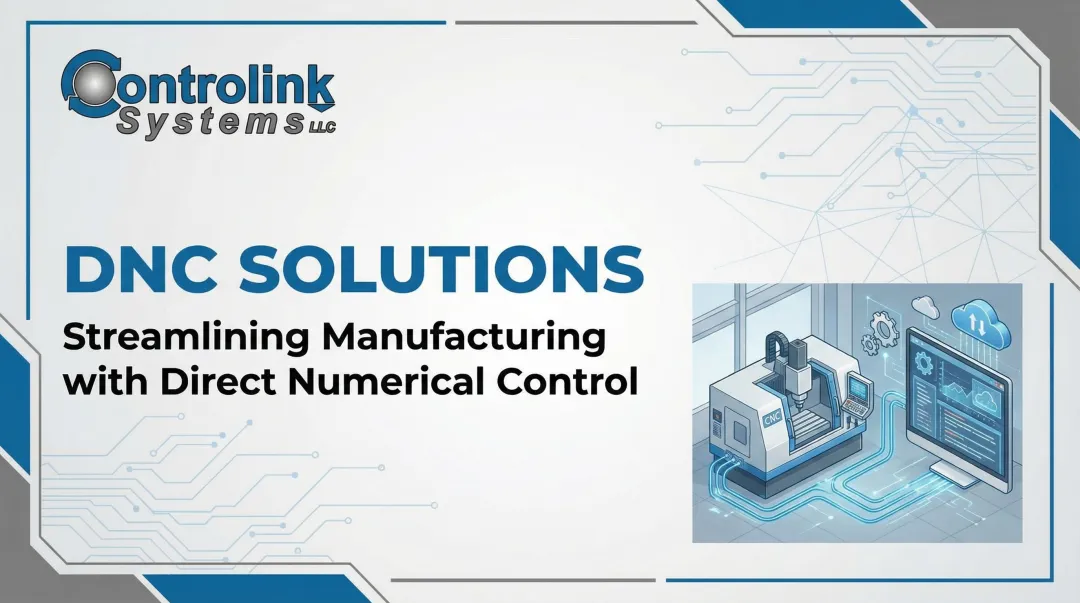
DNC software connects CNC machines to a central computer, server, or database that manages and transmits approved NC programs. It's the layer that decides which file goes to which machine, when, and under whose approval.
Shops feel the lack of that control fastest when they deal with:
- Multiple machines on the floor
- Frequent engineering revisions
- Mixed legacy and modern controls
- Customer or regulator documentation requirements
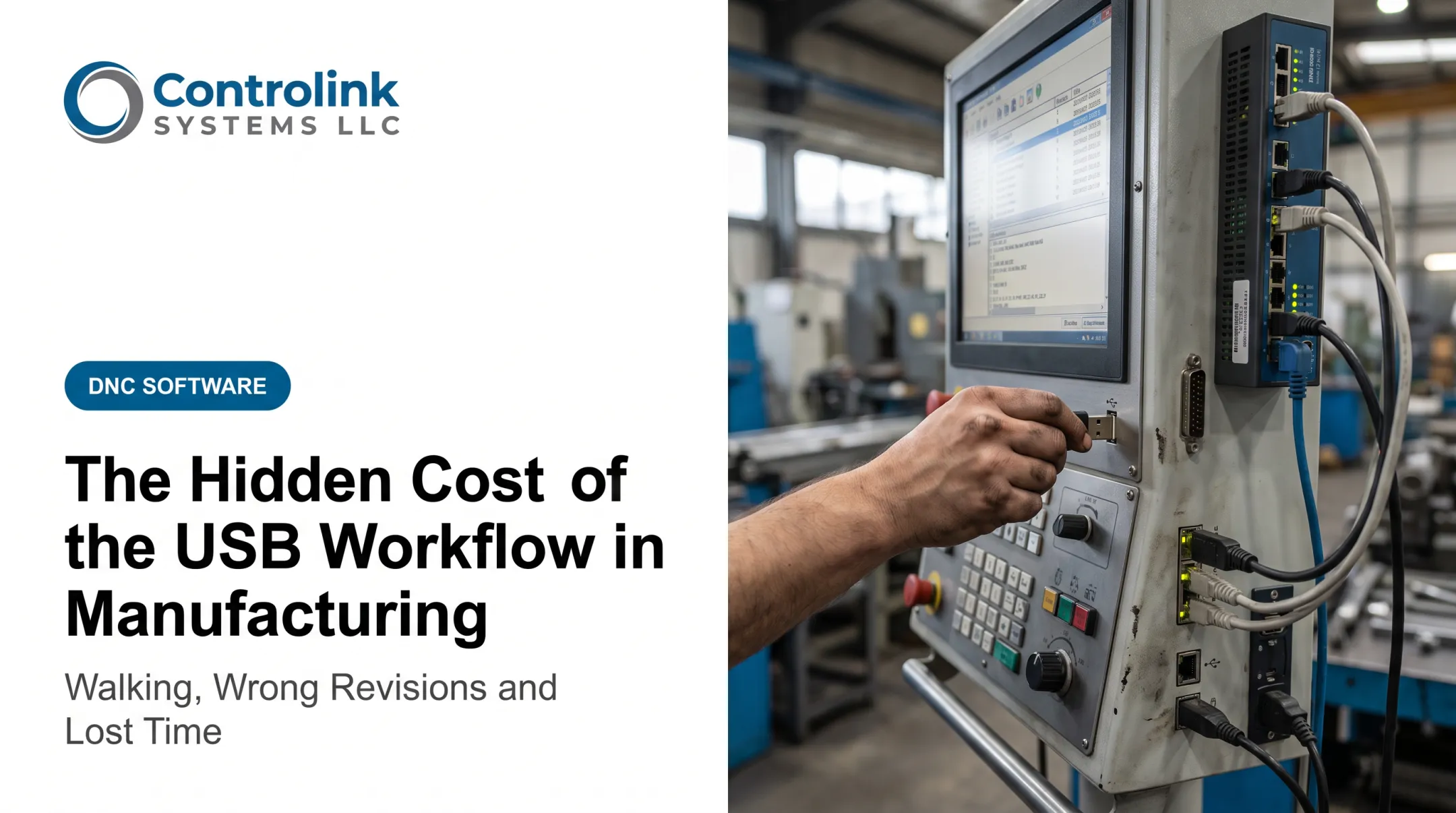
Without a central system, someone has to remember which USB drive holds the current version—or which folder was last updated.
DNC is not the same thing as CNC monitoring. Monitoring software tracks machine status, utilization, and downtime after the fact. DNC controls what program reaches the spindle in the first place. It is a gatekeeper for program accuracy, not just a networked thumb drive.
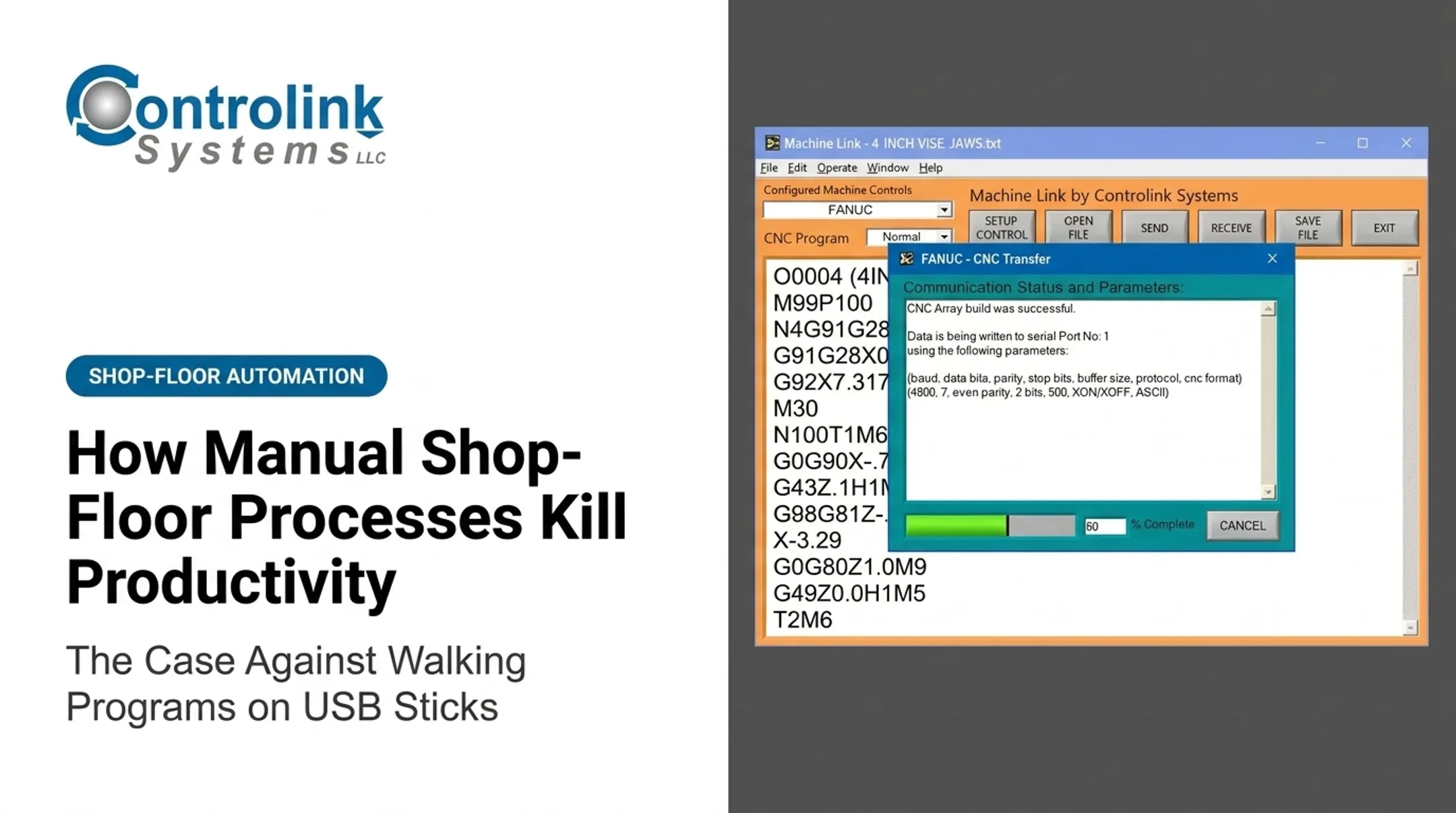
Controlink Systems has built this kind of gatekeeper since 1998. Its Machine Link™ software handles CNC/DNC file transfer over standard RS-232 serial connections, and its QUICK Serve product continuously scans machines for file requests and serves the correct engineering-approved program without the operator leaving the machine.
Key Advantages of DNC Software
Every advantage below should translate into a measurable number, with a baseline, a calculation, and someone accountable for tracking it. Lumping every benefit into "savings" makes a weak business case. Split them instead:
- Direct savings — labor cost avoided from faster transfers
- Avoided costs — scrap, rework, and expedite fees prevented
- Recovered capacity — machine hours freed up for more cutting
- Risk reduction — lower exposure to audit findings or investigation delays
Time Saved in Program Handling
Manual program handling eats time in small increments that add up fast: walking to a computer, searching for the right file, confirming it's the latest revision, and walking back. Centralized search, approval, and retrieval cuts most of that out. At Willard Industries, Doug Davidson said Machine Link™ turned programming tasks that sometimes took a whole day into roughly 10 minutes. At Custom Die and Manufacturing, Gene Newcomb estimated Controlink's DNC software would have saved him more than 40 hours compared to running HyperTerminal and NC Lite on a Fanuc-controlled lathe. Calculate your own number this way:
Minutes saved per transfer × number of transfers per week × labor cost per minute

Then add the harder-to-see value: fewer interruptions for supervisors and programmers who currently get pulled away to help troubleshoot a bad transfer. Track these KPIs before and after implementation:
- Program-transfer time per job
- Machine preparation time
- Walking and waiting time per shift
- Number of manual file-handling steps
- Productive machine hours recovered Downtime is a real cost even outside of file-handling problems. NIST's 2024 manufacturing economy report puts downtime at 8.3% of planned production time, worth $245 billion across discrete manufacturing. That figure isn't a DNC-specific statistic, but it frames how much is at stake when machines sit idle waiting on files or instructions.
Scrap and Rework Avoided Through Revision Control
Running the wrong program revision is one of the most preventable causes of scrap on a shop floor. A controlled repository with approval workflows and machine-level access rules closes that gap. At Combi Packaging Systems, Richard Hughes described how 4-digit Partner mill filenames used to produce a different job than intended on retrieval—a problem the shop fixed by switching to current engineering print numbering. At Timken Company, integrating the ML Send Utility with a corporate database eliminated manual entry of transfer information, removing a step Timken itself described as error-prone. Quantify your baseline by adding up the full cost of a file-related quality event:
- Scrapped material and consumables
- Machine time lost re-running the job
- Tooling wear from the bad run
- Inspection and rework labor
- Expedited replacement production
- Delayed delivery penalties or credits A simple avoided-cost framework:
Avoidable file-related incidents per year × average total cost per incident = estimated avoided cost
Label this an estimate, not a guarantee. ASQ's research on process control notes that failure to control manufacturing processes leads to product recalls, product loss or rework, and reduced customer confidence—the failure mode revision control addresses. Track whether the number moves with:
- First-pass yield
- Scrap rate
- Rework hours
- Percentage of machines confirmed to receive approved revisions
Compliance and Traceability Risk Removed
DNC logs can create a record of who released, approved, transmitted, and used a given program, provided the software is configured to capture that data. That record matters most in sectors where customers or regulators expect proof, not just a promise. Aerospace, medical device, automotive, and export-controlled manufacturers face specific documentation expectations. IAQG's clarification of AS9100 clause 8.5.2 requires organizations to retain documented information verifying that production processes can produce conforming product. That standard doesn't name DNC software specifically. A program's approval history and transfer record can still serve as supporting evidence when tied to the part and job record. Quantify compliance effort, not just risk:
- Hours spent preparing for audits
- Time spent retrieving old records on request
- Investigation time when a nonconformance traces back to "which program made this part"
- Hours spent maintaining manual paper logs Use a risk-adjusted view rather than claiming a guaranteed avoided penalty. Multiply the probability of a finding by its potential impact, then discount by how much of that risk your DNC controls actually address. At Ametek, Steve Araujo described how QUICK Serve holds programs returned from machines in an Engineering folder for review before they enter the library—a workflow that creates a checkpoint an auditor can actually see. KPIs worth tracking:
- Record-retrieval time
- Percentage of programs with a documented approval history
- Audit findings tied to production records
- Instances of undocumented file changes
What Happens When DNC Software Is Missing or Ignored
Without a controlled system, programs live wherever someone last saved them: USB drives, local desktops, sticky notes taped to a control panel. Ownership gets fuzzy fast.
CISA warns that USB drives can carry malware and are easily lost or stolen, exposing unencrypted files to whoever picks them up. Beyond the security angle, there's the everyday operational drag:
- Operators spend time searching for or verifying files instead of running parts
- Machines sit idle waiting on instructions from someone who's busy elsewhere
- Obsolete programs get loaded because nobody flagged the revision as outdated
- Engineering ends up repeating checks that should have happened once
Snavely's Machine ran into this directly. Scott Cooper described a shop floor with 30-plus CNC machines and 10 different control types, where getting the right program to the right machine had become, in his words, an ordeal.
Busche Enterprises faced a similar scale problem, backing up program files across 46 different machine tools by hand.

The risk compounds in shops with:
- Many machines or multiple shifts
- Frequent engineering changes
- Expensive materials and tight tolerances
- Regulated customer requirements
In those environments, proving which program actually produced a specific part can turn into a multi-day investigation instead of a five-minute lookup.
How to Get the Most Value from DNC Software
Getting real ROI out of DNC software starts before installation, not after.
- Document your baseline. Record current transfer steps, average handling time, program-related quality incidents, scrap and rework costs, audit hours, machine count, and current revision practices.
- Set a few KPIs. Assign owners and compare pre- and post-implementation results over a fixed window, such as a full quarter.
- Standardize approval and release rules. Only engineering-approved files should reach production, with a documented process for controlled exceptions.
- Involve every affected team. Operators, programmers, engineering, quality, IT, and finance should all shape the workflow design.
- Confirm fleet compatibility. Check older controls, communication protocols, serial versus Ethernet connections, and any interface hardware you will need.
- Review the business case on a schedule. Include adoption rates, program volume, avoided incidents, and maintenance or training costs in net ROI and payback.

Adoption stays high when the tool is simpler than the workaround it replaces. Mark Ruberg of Jay Tool Manufacturing and Design reported his team was sending and saving programs within five minutes of installing Machine Link™. On the compatibility side, Machine Link™ communicates over standard RS-232 serial and runs on Windows XP and later—useful for shops still running older controls.
Use Controlink Systems' published DNC pricing tiers when you build the cost side of your equation:
| Product | Machines Supported | Price |
|---|---|---|
| Machine Link™ | Configurable, per machine | $195 |
| QUICK Serve | Up to 3 | $1,700 |
| QUICK Serve PLUS | Up to 20 | $2,800 |
| QUICK Serve PRO | Up to 64 | $4,000 |
These are Controlink's published prices, not industry averages—a starting point for payback math, not a guaranteed savings figure. Validate ROI against the baseline and KPIs you set in steps 1 and 2.
Conclusion
DNC software earns its keep by controlling how CNC programs move, and by making the resulting improvements visible in your own numbers. The strongest value shows up in three places:
- Less time spent chasing files
- Fewer scrap and rework events caused by program errors
- Stronger evidence when a customer or auditor asks for proof
None of that requires taking an industry-wide statistic on faith. Build the case from your own transfer times, your own scrap data, and your own audit hours. Then evaluate DNC software as an ongoing operational control, not a one-time file-transfer purchase.
Frequently Asked Questions
What is a DNC system for CNC machines?
A DNC system is a centralized setup that manages and transmits CNC programs from a computer or server to machine tools. It controls access to approved revisions and can record who released, transmitted, or used a given program.
How do you calculate the ROI of DNC software?
Weigh implementation and ownership costs against measurable savings from reduced handling time, avoided scrap and rework, recovered machine capacity, and reduced compliance effort. Base the calculation on your shop's own baseline data, not general industry figures.
Can DNC software reduce CNC scrap?
Yes, when it enforces revision control and distributes only engineering-approved files, it reduces the chance of running an obsolete or incorrect program. Results depend on how well the workflow is adopted and how thoroughly machines are integrated into the system.
How does DNC software support compliance and traceability?
It can create approval histories, revision records, and transfer logs that support faster retrieval of production evidence during an audit or investigation. The depth of that record depends on how the specific software is configured and used.
Does DNC software work with older CNC machines?
Compatibility depends on the machine's control type, available ports, and communication protocol, and may require additional interface hardware. Assess each machine individually rather than assuming fleet-wide compatibility.
What information should manufacturers collect before buying DNC software?
Gather current transfer times, program volume, machine and control types, file-related incident history, scrap and rework costs, audit requirements, and needed user roles. This baseline data makes it possible to measure real ROI after implementation.