
The risk isn't hypothetical. Verizon's 2024 manufacturing snapshot tracked 2,305 security incidents in the sector, with ransomware appearing in 35% of confirmed breaches and stolen credentials in 25%.
Network segmentation for CNC machines means dividing the shop floor into controlled zones, allowing only approved systems and traffic to reach machine tools. This guide is for shop managers, programmers, OT and IT teams, maintenance staff, and cybersecurity leaders who need to protect controllers without stalling production. We'll cover segmentation types, a practical program-delivery flow, implementation tools, common mistakes, and relevant NIST guidance.
Key Takeaways
- Segmentation limits unnecessary CNC access without cutting machines off from systems they still need
- Controlled DNC servers or transfer gateways keep program delivery flowing while firewalls block office, guest, and internet access
- Real protection needs routing, firewalls, permissions, authentication, logging, and documented dependencies—not VLANs alone
- Legacy RS-232 and Ethernet CNCs can share a zone or use separate controlled zones based on risk
- Validate every change with test transfers, revision checks, operator sign-off, and a rollback plan
What Is Network Segmentation for CNC Machines and Why Is It Used?
In a CNC shop, segmentation means placing machine tools, DNC servers, engineering workstations, monitoring systems, business IT, wireless devices, and vendor connections into deliberately controlled zones.
The goal is simple: reduce how many systems can reach a controller, while preserving the communication needed for program transfer, monitoring, and approved maintenance.
Segmentation, Isolation, and Air-Gapping Aren't the Same Thing
These terms get used interchangeably, but they describe different levels of restriction:
| Term | What it means |
|---|---|
| Segmentation | Divides a network into subnetworks, allowing narrowly defined, approved communication between them |
| Isolation | Restricts communication more heavily, often to a single approved path or protocol |
| Air-gapping | Removes routine network connectivity; any transfer requires manual, human-controlled action |
Most CNC environments need segmentation or isolation, not a full air gap. A true air gap makes sense for select high-risk machines, but it also removes the automated program delivery that keeps a shop running efficiently.
Why CNC Environments Need Special Treatment
CNC controllers aren't typical IT endpoints. They often run outdated operating systems, lack modern authentication, and stay in service for 15-20 years. Many can't run antivirus software or accept security patches without voiding a warranty or breaking machine-builder support agreements.
CISA has flagged the core risk directly: insufficient network segmentation allows cyber actors to move laterally from IT systems into OT environments, and between OT systems themselves (CISA OT cybersecurity guidance). On a flat shop-floor network, that path runs straight from a phishing email to a live machine control.

Segmentation addresses more than intrusion risk. It also:
- Reduces the blast radius when one system is compromised
- Simplifies troubleshooting by clarifying which systems should talk to which
- Controls vendor access to only the machines they support
- Protects approved NC-program revisions from unauthorized edits
- Supports audit trails for quality or contractual requirements
How Segmentation Keeps Program Delivery Flowing
A controlled program transfer follows one path:
- Engineering storage sends the file to an approved DNC server or transfer gateway
- The gateway crosses a firewall or controlled routing point
- The file arrives only at the intended CNC machine or machine group
Nothing skips the gateway. Nothing bypasses the firewall.
Define Your Traffic Flows Before You Touch a Config File
Before configuring anything, document every communication flow that needs to exist:
- Program upload and download
- Drip-feed for large programs exceeding controller memory
- Machine status and monitoring data
- Authentication and administration traffic
- Time synchronization and backups
- Vendor remote-support sessions
Least-privilege rules should then restrict each flow by source, destination, protocol, port, direction, time window, and user or service identity where the platform supports it. Don't guess at ports — verify them against your specific controller and DNC platform documentation first.
The Building Blocks
A working segmentation design typically combines:
- A managed switch to create VLANs or subnets
- Inter-zone firewalling to enforce which traffic crosses boundaries
- A DNC server or transfer gateway as the single approved broker for program files
- Access-control lists limiting who and what can initiate a session
- Network monitoring to flag unexpected traffic
VLANs alone create logical separation; they do not enforce security by themselves. Enforcement comes from the firewall rules and access controls layered on top.
A Practical Implementation Sequence
- Inventory every CNC controller, DNC workstation, serial converter, Ethernet interface, monitoring device, wireless adapter, and vendor connection
- Map current traffic and identify the minimum communication each machine actually requires
- Design zones and firewall policies, then pilot on one non-critical machine or cell before a broader rollout
- Test a known-good transfer in both directions where required, confirm file integrity and revision, verify monitoring still works, and document the result

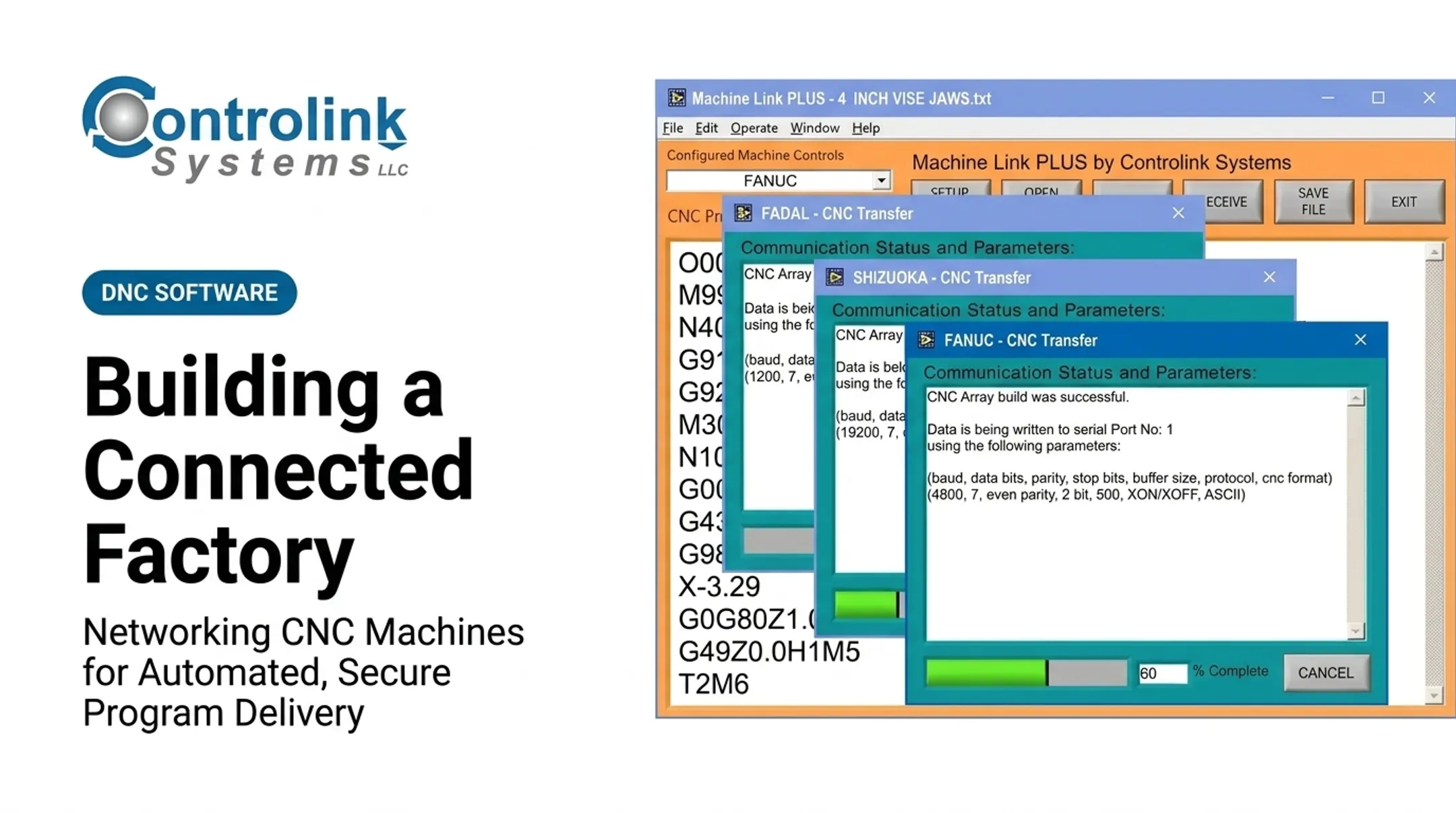
That brokered path is what Controlink Systems LLC has built for machine shops since 1998. Machine Link™ QUICK Serve continuously scans machines for file requests over wired serial or wireless connections and returns the latest engineering-approved file directly to the control. Operators stay at their machines instead of walking to a shared PC.
For shops mixing legacy RS-232 mills with newer Ethernet-enabled equipment, this controlled delivery model fits naturally into a segmented network design.
Where CNC Segmentation Is Applied and What Affects It
Most manufacturing environments end up with some combination of these zones:
- Business IT
- Engineering and programming
- DNC or file-transfer services
- CNC controllers
- PLCs and other OT
- Monitoring systems
- Wireless or IIoT devices
- Guest access
- Temporary vendor access
Common Segmentation Models
| Model | Best fit |
|---|---|
| Single CNC VLAN | Small shops with uniform, lower-risk equipment |
| Cell or machine-family zones | Shops with distinct production lines or varying risk levels |
| Brokered DNC-server model | Shops needing a single controlled path for all program traffic |
| Stricter isolation or air-gapping | High-risk, regulated, or safety-critical equipment |
The right model depends on traffic requirements and risk tolerance, not a one-size-fits-all rule.
Legacy Serial vs. Modern Ethernet Controllers
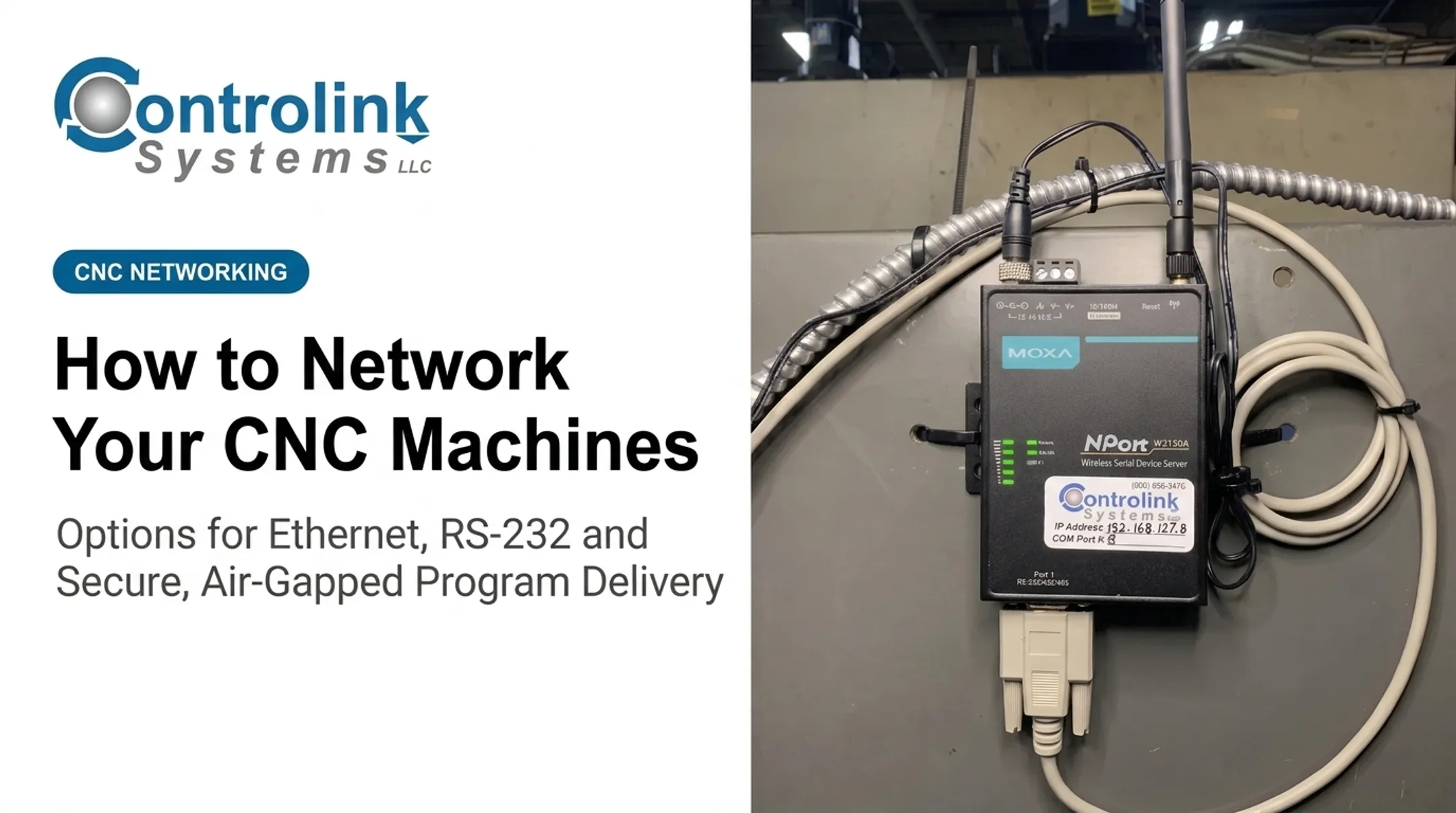
Older RS-232 machines can be protected using serial-to-Ethernet converters or serial device servers placed inside a controlled zone. Those converters bridge RS-232 and Ethernet so you get managed, zone-controlled communication without replacing the controller itself. Modern Ethernet-enabled controllers, by contrast, often need controller-specific firewall rules and authentication configuration.
Factors That Shape the Design
- Controller capability — age, operating system, supported protocols, whether patching is even safe
- Transfer requirements — direction, file sizes, drip-feed needs, acceptable latency
- Cell dependencies — shared tooling, quality systems, PLC and robot links, connections to MES or ERP
- Remote maintenance needs — vendor identity checks, MFA availability, session time limits and logging
- Compliance obligations — CMMC, contractual, or customer requirements specific to your facility (verify current requirements rather than assuming segmentation alone satisfies them)
Document everything before you lock the design:
- Asset inventory
- Network diagram
- IP or serial assignments
- Firewall rules
- Approved data flows
- Machine owners and recovery contacts
Without this record, the next network change someone makes will silently break program delivery—and nobody will know why until a machine sits idle.
Common Issues, Misconceptions, and When Segmentation Is Not Enough
"It's on a VLAN, So It's Secure" Is a Myth
Putting CNC machines on a VLAN creates logical separation. It doesn't automatically secure them. NIST's OT security guidance notes that VLANs can be cost-effective for OT segmentation, but recommends considering physically separate switches for high-criticality devices, including safety systems. A VLAN without inter-zone firewall rules, access controls, and periodic rule review is just an organized flat network.

Operational Mistakes That Undo Good Design
- Allowing all traffic between segments "to make things easier"
- Leaving legacy machines with an open path to the internet
- Sharing one vendor credential across multiple technicians
- Never changing default passwords on switches or gateways
- Permitting direct office-to-controller access for "quick fixes"
- Skipping documentation of why each firewall rule exists
When Segmentation Breaks Program Delivery
After segmentation goes live, the most common failures include:
- Blocked DNC traffic
- Incorrect routes or duplicate IP addresses
- Mismatched serial settings (baud rate, parity, stop bits)
- Rules that allow a transfer one way but block the return acknowledgment
Quick validation checklist:
- Compare the approved traffic map against firewall logs
- Confirm controller and DNC communication settings match
- Send a small, known-good test file
- Verify checksum or revision on the receiving end
- Confirm the correct machine actually received the file
- Keep a rollback procedure ready before touching production
This mirrors standard DNC troubleshooting practice: receiving a file successfully before sending one validates both COM ports and the cable setup. Carry that habit into any segmented network test.
Segmentation Alone Won't Stop Everything
Segmentation doesn't protect against:
- Compromised credentials
- Infected engineering workstations
- Unsafe USB drives
- Unpatched DNC servers
- Malicious program revisions that arrive through an otherwise permitted path
Pair it with strong authentication, role-based permissions, revision control, backups, removable-media procedures, and ongoing monitoring.
Full air-gapping still has a place for select machines with no routine digital exchange needs. But forcing it where it isn't warranted just pushes operators toward unmanaged USB transfers, which is often riskier than the network access it was meant to replace.
Conclusion
Effective CNC segmentation builds controlled communication boundaries around machine tools. The safest practical design protects those tools while preserving an approved, testable path for DNC program delivery, monitoring, and necessary maintenance.
Getting there depends on a handful of ongoing practices:
- Asset discovery and traffic mapping
- Least-privilege access rules
- Legacy-machine planning
- Validation and continuous review
None of it is a one-time project.
If you need mixed CNC machines, DNC systems, and shop-floor tech to stay reachable for program delivery through a network redesign, Controlink Systems LLC has been building these connections since 1998. Reach the team at support@controlinksystems.com or (800) 838-3479 to talk through your setup.
Frequently Asked Questions
How do you implement network segmentation for CNC machines?
Start with a full asset inventory, then map required traffic and design CNC/OT zones with a controlled DNC-server path. Apply firewall and access rules, pilot-test on one machine, and document everything before scaling up.
What are the different types of network segmentation for CNC machines?
Common approaches include VLAN or subnet separation, cell-based or machine-group zoning, and brokered DNC-server or gateway architectures. Stricter isolation or air-gapping fits higher-risk equipment; the right choice depends on traffic needs and risk level.
What tools are used for network segmentation of CNC machines?
Typical tools include managed switches, VLANs, industrial firewalls, access-control lists, secure remote-access software, and network monitoring. Serial-to-Ethernet converters support legacy controllers, and a DNC platform usually brokers program transfers.
What are the NIST guidelines for network segmentation of CNC machines?
NIST SP 800-82 Rev. 3 covers OT segmentation, least privilege, and boundary protection, while CISA's asset inventory guidance addresses lateral-movement risk from flat networks. Check current publication versions before applying requirements to your facility.
Will network segmentation stop CNC program delivery?
Properly designed segmentation should preserve approved DNC transfers through a controlled gateway path. Incorrect firewall rules can block traffic, so map flows carefully, pilot-test transfers, and keep a rollback plan before full rollout.
Can legacy CNC machines be segmented without replacing the controller?
Yes. Serial device servers and serial-to-Ethernet converters let older RS-232 machines sit in a controlled zone with restricted access and firewall rules. This reduces exposure without requiring a controller upgrade.