
That workaround is shadow IT, and it's not confined to office spreadsheets or unsanctioned Slack channels. In a machine shop, it lives in USB drives, personal laptops, texted G-code files, and machine memory nobody's tracking. The 2022 NSTAC IT-OT Convergence Report defines this in OT terms as systems "added and modified without official IT change management control and approval."
These side-channels create cybersecurity, quality, and traceability risks that standard audits routinely miss. Here's how to find them without slowing down production.
Key Takeaways
- Shadow IT usually starts as a workaround for a slow or broken approved process, not misconduct.
- USB drives and informal transfers bypass malware controls, version tracking, and program approvals.
- Fixing it requires discovery, operator buy-in, technical controls, and a faster approved alternative.
- NIST, CISA, and OT-security frameworks offer proven guidance for closing these gaps.
What Shadow IT Looks Like in a CNC Machine Shop
Shadow IT is any hardware, software, storage method, or workflow used without formal approval from IT, OT, engineering, or quality. In practice, it rarely looks like rebellion. It looks like getting the job done.
Common examples on the shop floor:
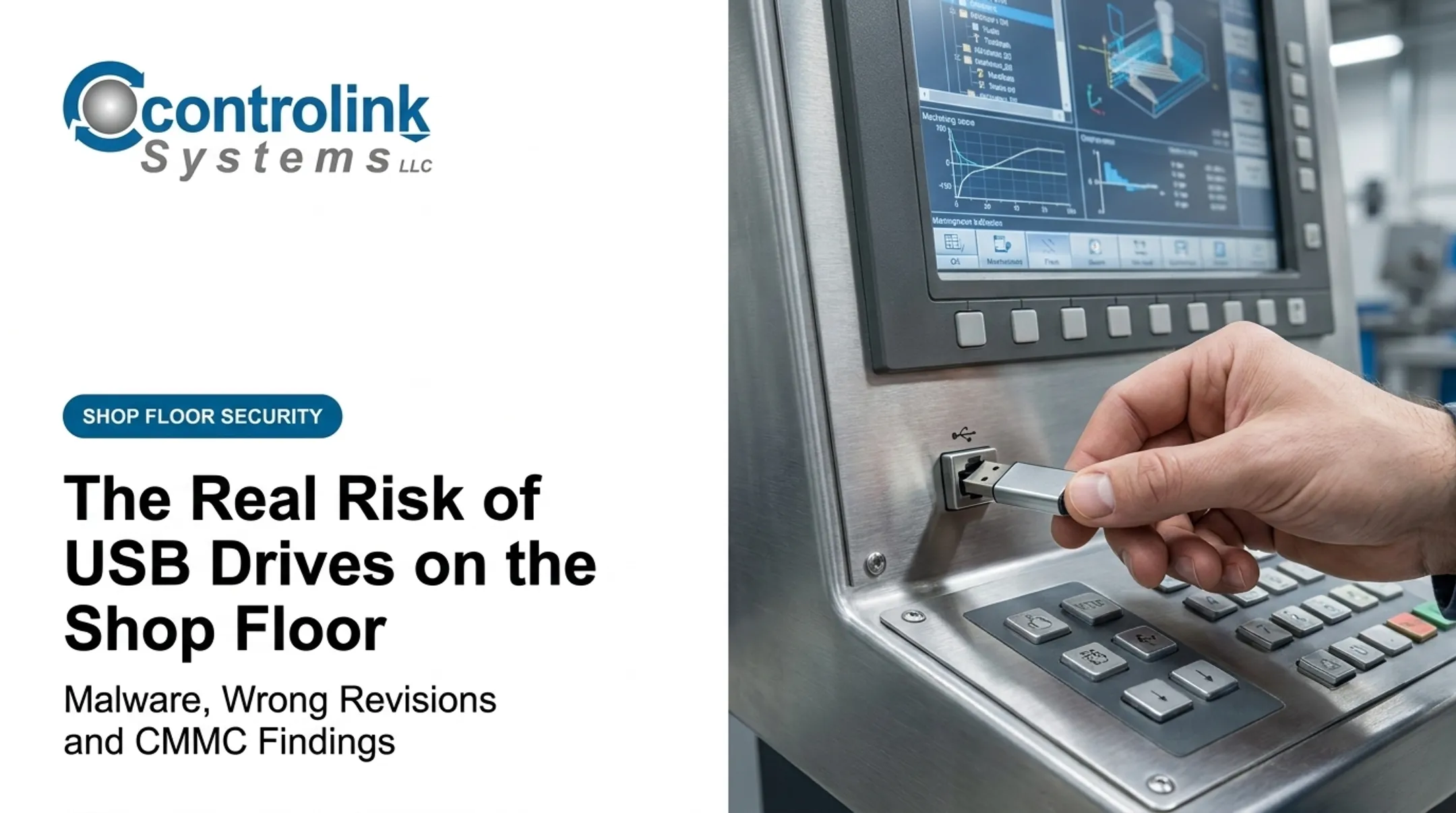
- USB drives carrying CNC programs, offsets, tooling recipes, or inspection files between machines
- Personal or service laptops plugged directly into a controller, PLC, or HMI for a "quick fix"
- Text messages, personal email, or unapproved cloud folders used to move engineering files between shifts
- Programs saved only to a machine control or a desktop folder, never making it into the approved repository
One real-world example: Mike Hamonds at M-Tech Machine Products used to store CNC files on a shop computer and physically walk them to the machine, nicknamed the "Mazak blue toaster," rather than relying on a documented transfer system.
That's the line between an approved exception and shadow IT. A one-time emergency workaround, logged and reviewed, is manageable. The same workaround repeated weekly, with no owner and no record, is shadow IT.
The files riding these side-channels aren't always low-stakes. A USB stick moving a "convenience copy" of a program might also be carrying CAD/CAM output, customer part specs, or proprietary tooling data.
The Hidden Side-Channels Auditors Never See
Trace a CNC file from engineering release to machine execution, and you'll find a dozen points where someone can copy, rename, or quietly modify it. Most audits check the beginning and end of that path. Few check the middle.
Removable Media Nobody's Tracking
Ask a simple question: who supplies the USB drives on your floor? If the answer is "whoever has one," you've already found a gap. Key things to check:
- Are drives shared between operators, or individually issued and logged?
- Is anything scanned before it touches a machine?
- Do operators keep personal "known-good" backups after a job wraps, just in case?
That last habit feels responsible. It's actually a hidden archive of unverified program versions living outside any system of record.
Service Laptops and Legacy Connections
Vendor technicians, controller upgrades, and diagnostic tools all create temporary connections that bypass normal IT review. NIST's Guide to Operational Technology Security flags vendor and integrator maintenance access as a routine but under-controlled entry point into OT systems.
Ask directly:
- "How do you move a new program to this machine?"
- "What happens when the approved system is down?"
- "Where does the last known-good version live?"
The answers to those three questions will surface more shadow IT than a network diagram ever will.
Why a Small Gap Matters: Stuxnet
Stuxnet remains the clearest case of a removable-media side-channel causing real damage. CISA's advisory documents how the malware spread through infected USB devices, network shares, and altered project files, targeting industrial control software directly.
Not every USB transfer is malicious. But every unmanaged one is an open door.

Why Shadow IT Is Dangerous in Manufacturing
Shadow IT risk splits into three buckets: security, program integrity, and traceability. Each one hits differently, but they compound fast.
The Cybersecurity Exposure
Removable media and unmanaged devices are a documented attack path in OT environments. Honeywell's 2022 Industrial Cybersecurity USB Threat Report found that 52% of threats detected were specifically designed to exploit removable media as an entry point, based on Honeywell's own telemetry. Not every shop sees that rate, but the pathway is actively targeted—not theoretical.
Unmanaged devices also make basic hygiene harder:
- Patching and endpoint protection can't reach a device nobody knows exists
- Access controls mean nothing if a laptop connects outside any approval process
- Incident response stalls when investigators don't know what touched the network
Program Integrity: Tampering vs. Confusion
Most incidents aren't sabotage. An operator loads a file that looks right—an older revision, a slightly renamed duplicate, or a version someone edited on the fly without telling engineering.
The result is the same either way: wrong dimensions, wrong feeds and speeds, scrap, tool damage, or a safety incident.
Visibility closes that gap. Machine Link™ QUICK Serve continuously serves the current, engineering-approved program to the control, so operators stop guessing which file on a drive is right. At Sharn Enterprises, that shift cut manual program entry from about 30 minutes per job to seconds, removing the incentive to keep personal shortcuts around.

Quality, Traceability, and the Audit Trail
Undocumented transfers break the chain that quality systems depend on. When a nonconformance investigation or customer audit asks "who approved this revision, and when was it loaded," a USB-based workflow usually has no answer.
At minimum, you need a record of:
- Approver and revision number for the loaded program
- Transfer event, machine, and operator involved
- Job number and effective date of the change
The Cost of Not Knowing
Time lost hunting for the right file, isolating a suspect USB drive, or investigating unexplained scrap adds up in ways most shops never formally track. That's the real cost of shadow IT: not a single dramatic breach, but a slow drain of hours and material on problems that a documented transfer path would have prevented.
Banning USB drives without a fast alternative only pushes the workaround somewhere less visible. Aim for controlled productivity—a path operators will actually use—not a blanket ban nobody follows.
Why Conventional Audits Miss Shop-Floor Shadow IT
A documented USB policy proves you wrote a policy. It doesn't prove operators follow it at 2 a.m. when the approved system is down. That's the gap between policy evidence and operational evidence, and most audits stop at the first one.
Common blind spots:
- Legacy machine controllers absent from the enterprise asset inventory
- Standalone HMIs, vendor laptops, and serial connections nobody logged
- Files copied locally and deleted after use, leaving no trace in central systems
- Shared operator logins that make "who did this" impossible to answer
NIST's OT security guidance recommends unique device identifiers, documented locations, and logs that capture device, timestamp, and user account. Without them, you're auditing the paperwork, not the floor.
Questions That Surface Real Practice
Skip the checklist questions. Ask these instead:
- "How do you move a new program to this machine right now?"
- "What's the backup plan when the approved system is unavailable?"
- "Who's allowed to plug in a laptop or USB device here, and how would we know it happened?"
Frameworks such as ISA/IEC 62443 and NIST SP 800-171r3 (for CUI-handling contractors) are mostly guidance or contract-driven—not universal legal mandates for every shop. The practices they describe still matter on the floor: asset inventories, controlled media, and access logging close the gap audits miss, whether or not a clause requires them.
A Practical Framework to Find and Reduce Shadow IT
Fixing shadow IT starts with discovery, not discipline.
Step 1: Discover Before You Judge
Build a combined inventory of controllers, HMIs, engineering stations, removable media, and vendor access points. Then talk to the people actually moving files. Confidential interviews with machinists and maintenance staff will surface workarounds an asset scan never will, along with the reason each one exists.
Step 2: Build the Golden Path
Operators need one place to find the current, approved program, and a fast way to confirm it's current.
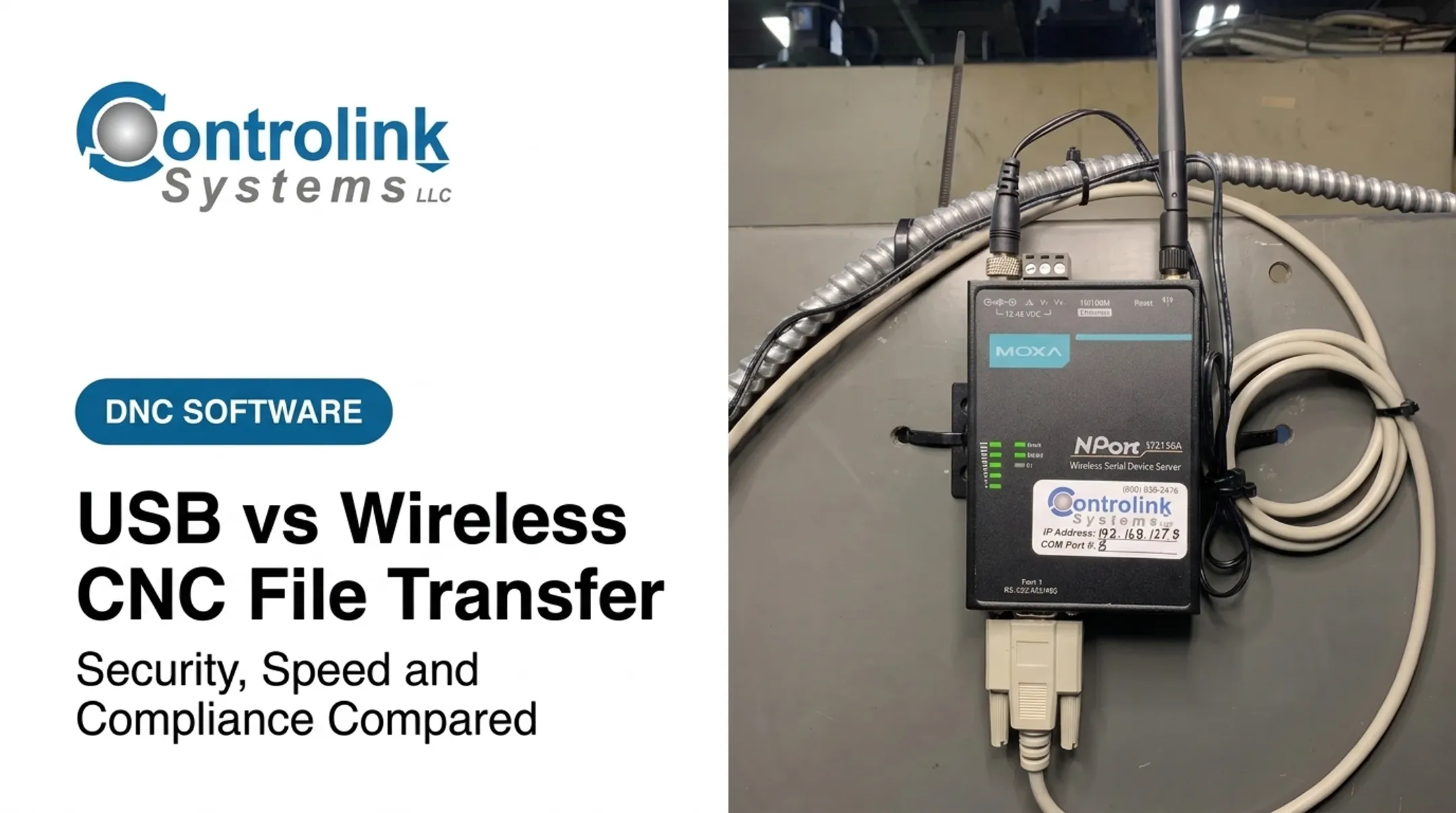
Controlink Systems LLC's Machine Link™ QUICK Serve is built for that path: operators request the latest engineering-approved file straight to the machine control over serial or wireless, and engineering keeps full visibility into what was requested and served.
That model is what shops like Snavely's Machine use after living with the opposite problem—30-plus CNC machines, 10 control types, 40 operators, and loose files scattered across machines and drives—then standardizing transfer under a governed process.
Step 3: Govern Removable Media Proportionately
Where drives are still needed:
- Assign and label organization-owned devices; treat outside media as untrusted
- Scan before and after use; disable autorun
- Log who used which device, on which machine, and when
- Build a fast emergency path so a broken system doesn't force operators back to personal drives
Step 4: Add Visibility Without Adding Friction
Log file transfers, controller connections, and changes to critical programs. Reconcile those logs against job travelers and quality records.
Machine Link™ can generate a program directory listing with file name, size, and last modification date—something concrete auditors can check against actual production records.
Step 5: Sustain It
Keep the framework alive with shared ownership and routine checks:
- Assign ownership across IT, OT, engineering, and quality—not only operators
- Test backup restoration on a set schedule
- Review exceptions regularly and drop controls that add friction without cutting real risk

Frequently Asked Questions
Why do employees use shadow IT?
Approved tools are often slow, unavailable, or incompatible with older controllers. Understanding the specific bottleneck is the first step toward building an alternative people will actually use.
What is shadow IT in manufacturing?
It's any unapproved hardware, software, storage device, or file-transfer method used in production, engineering, or maintenance workflows, from personal USB drives to unlogged service laptops.
Why are USB drives a cybersecurity risk in machine shops?
They can introduce malware, carry outdated or unverified files, and get lost without a trace. Controlled removable-media programs reduce this risk without banning legitimate use outright.
How can auditors detect shadow IT on the shop floor?
Combine physical walkthroughs, operator interviews, asset and data-flow mapping, and comparisons between documented procedures and what actually happens during a busy shift.
How can a machine shop control removable media without slowing production?
Use approved, scanned devices with clear checkout and logging procedures, and build a fast emergency workflow so operators never feel forced back to personal drives.
Should employees be punished for using unauthorized tools or devices?
Investigate intent first. Most cases are good-faith workarounds, not misconduct, and pairing accountability with training and a usable approved system fixes the root cause.