

Introduction
Force plates are precision measurement instruments designed to capture ground reaction forces (GRF) during movement. While commonly associated with sports science, these platforms serve critical roles across biomechanics research, clinical rehabilitation, and industrial product testing.
Unlike a simple scale that only measures static weight, force plates record dynamic forces across multiple axes with millisecond-level precision — revealing how the body generates and absorbs force during everything from walking to explosive jumps.
This guide covers what you need to evaluate or implement force plate technology:
- How the sensors work and what they actually measure
- The differences between single-axis and triaxial systems
- Real-world applications across sports science, clinical settings, and research
- How to choose the right system and extract meaningful data from it
Key Takeaways
- Force plates measure ground reaction forces (GRF) in one to three axes, expressed in Newtons (N)
- Piezoelectric sensors excel at high-impact tasks; strain gauge sensors are better suited for static measurements
- Key metrics: peak force, rate of force development (RFD), impulse, jump height, and bilateral asymmetry
- Applications span athlete testing, clinical gait analysis, balance assessment, and product testing
- Use a minimum 1,000 Hz sampling rate for accurate dynamic movement analysis
What Is a Force Plate?
A force plate is a flat, rigid platform embedded with sensors that record the forces between a person (or object) and the ground during static or dynamic tasks. While sometimes described as a "sophisticated bathroom scale," force plates capture far more detailed data—they measure not just how much force is applied, but how quickly it develops, how long it's sustained, and how it's distributed across different axes.
History and Evolution
The first commercial force plate was introduced by Kistler Instruments in 1969, initially installed at the Laboratory for Experimental Surgery in Davos, Switzerland. Seven years later, AMTI (Advanced Mechanical Technology, Inc.) developed the first strain-gauge force plate in 1976 for clinical gait analysis at Boston Children's Hospital. Throughout the 1970s and 1980s, these systems gained traction in pioneering biomechanics labs at institutions like Shriners Hospitals and the Mayo Clinic.
That early adoption was largely limited to well-funded research institutions. Force plates were heavy, expensive, and required permanent installation in concrete floors — out of reach for most applied settings.
That changed over the past decade, driven by advances in wireless transmission and miniaturized load cell technology. Modern portable systems from manufacturers like Hawkin Dynamics, VALD (ForceDecks), and Bertec now deliver lab-grade accuracy in field settings. Validation studies show less than 1% difference compared to embedded laboratory plates.
Newton's Third Law in Action
Force plates measure reaction forces according to Newton's Third Law: when a subject pushes down on the plate, the plate records the equal and opposite force exerted by the ground. This ground reaction force (GRF) data reveals the mechanics of movement: how explosively an athlete generates force, how symmetrically they load each limb, or how their balance shifts during quiet standing.
How Do Force Plates Work? Sensor Technology and Data Acquisition
Force plates rely on two primary sensor technologies to convert mechanical stress into electrical signals: piezoelectric crystals and strain-gauge load cells. Each offers distinct advantages depending on the testing application.
Piezoelectric vs. Strain Gauge Sensors
Piezoelectric sensors generate an electrical charge when subjected to mechanical stress. Quartz crystals inside the sensor respond instantly to force changes, offering very high natural frequencies (often exceeding 500–1,000 Hz) and superior sensitivity to rapid, high-impact loading. This makes piezoelectric plates ideal for drop jumps, sprint analysis, and other explosive movements where capturing fast force transients is critical.
However, piezoelectric sensors suffer from signal drift during static holds. The electrical charge gradually dissipates over time, causing measurement errors during long-duration tests. They're also highly sensitive to temperature fluctuations, requiring careful environmental control.
Strain-gauge load cells measure the deformation of a metal element under load. As force bends the gauge, its electrical resistance changes proportionally. Strain-gauge systems offer excellent long-term static stability with virtually zero drift, making them the preferred choice for isometric strength tests (like the Isometric Mid-Thigh Pull) and balance assessments where subjects stand still for extended periods.
While historically limited to lower natural frequencies than piezoelectric systems, modern optimized strain-gauge plates now achieve 300–600+ Hz response rates, which covers most dynamic testing applications.
Signal Pathway and Data Acquisition
The measurement process follows a precise sequence:
- Force application → Sensors generate raw electrical signals
- Signal conditioning → Amplification and filtering remove noise
- Analog-to-digital conversion → Continuous signals become discrete data points
- Data acquisition system (DAQ) → High-speed hardware captures digitized signals
- Software processing → Real-time display, analysis, and metric calculation
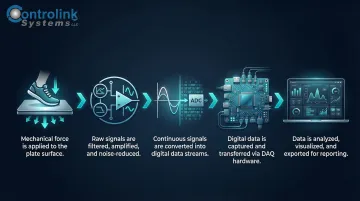
The quality and sampling rate of the DAQ system directly affects measurement accuracy. Platforms built on National Instruments (NI) hardware are well-suited to force plate applications, given their precision and high-frequency signal capture capabilities.
Sampling Rate Requirements
Force plate data for dynamic tasks should be sampled at 1,000 Hz minimum. Lower sampling rates violate the Nyquist theorem, causing aliasing errors that miss peak force values and distort force-time curves.
Task-specific requirements vary:
- Isometric tests (IMTP, static holds): 50–200 Hz sufficient
- Vertical jumps (CMJ, squat jump): 200 Hz captures basic metrics, but 1,000 Hz reveals nuanced force-time characteristics
- High-impact tasks (drop jumps, sprinting): 1,000–2,000 Hz required to capture rapid impact transients
Research shows that while peak force remains accurate down to 20 Hz, Rate of Force Development (RFD) degrades significantly below 500 Hz, with errors exceeding 15% at lower sampling rates.
Sensor Configurations and Axes
Single-axis (1D) force plates measure only vertical force (Fz). This covers most jump testing, isometric strength assessments, and basic balance evaluations. Vertical force is the dominant vector in virtually all human movements. During running, for example, peak vertical GRF reaches 2.0–2.9x body weight, while horizontal shear forces are roughly 10 times smaller.
Triaxial (3D) force plates measure forces in three directions:
- Fz (vertical)
- Fx (anterior-posterior)
- Fy (medial-lateral)
They also capture three rotational moments (Mx, My, Mz). This full six-axis measurement is required for gait analysis, cutting movements, and sprint acceleration analysis — as well as inverse dynamics calculations that determine joint torques and powers.
Budget consideration: Single-axis plates cost significantly less than triaxial systems and cover roughly 80% of sports performance applications. Clinical gait labs and biomechanics research requiring full kinetic analysis are the primary cases where triaxial systems earn their higher cost.
What Do Force Plates Measure? Key Metrics and Outputs
Ground Reaction Force (GRF)
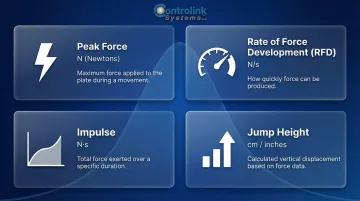
GRF is the force the surface exerts back on the body, expressed in Newtons (N). The force-time curve—force plotted over time—is the foundational output from which all derivative metrics are calculated.
Typical GRF values:
- Walking: 1.0–1.5x body weight
- Running: 2.0–2.9x body weight
- Jump landings: 7.5–9.9x body weight during impact phase
Peak Force and Rate of Force Development (RFD)
Peak force is the maximum GRF recorded during a movement. While useful, it represents only a single instant and doesn't reveal how quickly that force was generated.
Rate of Force Development (RFD) describes how rapidly force is produced, expressed in Newtons per second (N/s). RFD is calculated as ΔForce/ΔTime over specific time windows (such as 0–50 ms, 0–100 ms, 0–200 ms).
Sporting tasks like sprinting ground contact and clinical tasks like preventing a fall occur in under 200 ms. That time constraint makes RFD functionally more important than maximal strength for many real-world performance and safety applications.
Impulse
Impulse is the time-integral of force (the area under the force-time curve), measured in Newton-seconds (N·s). By the impulse-momentum theorem, net impulse equals the change in momentum, which means impulse directly determines outcomes like jump height.
Impulse is also superior to peak force for comparing athletes across different body masses — it accounts for both force magnitude and duration. An athlete generating moderate force over a longer window can achieve greater impulse than one who produces a brief, high peak force.
Balance and Symmetry Metrics
Center of Pressure (COP) is the spatial point (X, Y coordinates) where the total GRF vector is concentrated. During quiet standing, force plates track COP movement to quantify postural sway—the gold standard for assessing balance stability.
Systematic reviews confirm that COP metrics (specifically sway area per unit time and anteroposterior mean velocity) effectively differentiate elderly individuals at high fall risk from those with normal balance.
When using bilateral force plate setups (two plates, one per foot), each limb's force contribution is measured independently. This reveals left-right asymmetries relevant to injury screening and rehabilitation monitoring. Key clinical threshold to know:
- Interlimb asymmetries >10–15% during vertical jumps indicate incomplete rehabilitation and should delay return-to-sport clearance after ACL reconstruction
Body Weight Measurement
Force plates determine precise body weight by averaging the force signal during quiet standing before a test. This baseline measurement is essential for normalizing other metrics — for example, calculating relative peak force or converting impulse to jump height.
Force Plate Applications: Where and Why They're Used
Sports Performance and Athlete Testing
Vertical jump testing (countermovement jump, squat jump, drop jump) assesses lower-body power, explosive strength, and neuromuscular readiness. Force plate-derived jump height is more accurate than jump mat estimates because it accounts for the full force-time curve rather than just flight time. Research shows jump mats systematically overestimate height by 1.06–4.5 cm on average.
Force plates also monitor athlete fatigue and readiness throughout a training season. While jump height may remain stable under fatigue, certain force-time metrics are highly sensitive indicators of neuromuscular and metabolic fatigue:
- Eccentric duration
- Concentric impulse
- Flight-time to contraction-time ratio
Surveys show 83% of elite UK sports practitioners use athlete monitoring systems, with force plates being a primary tool at the Australian Institute of Sport and NCAA Division-I universities.
Clinical and Rehabilitation Settings
Gait analysis uses force plates embedded flush in a walkway to capture how each foot loads and unloads during walking or running. This provides objective data on abnormal gait patterns linked to injury, neurological conditions (cerebral palsy, spina bifida), or post-surgical recovery (total knee/hip replacement). Instrumented gait analysis is considered the standard of expert care in clinical biomechanics.
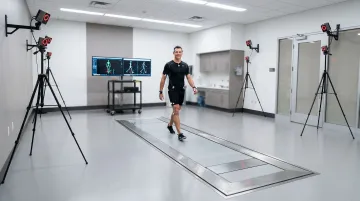
Balance and postural sway assessment involves standing quietly on a force plate while COP movement is tracked. This quantifies postural stability and is used for fall risk assessment in elderly populations and return-to-sport testing after lower-limb injuries.
Research and Industrial Testing
Force plates support biomechanics research and product testing where precise load measurement under dynamic conditions is required:
- Footwear testing: ISO 13287 uses force platforms to measure slip resistance coefficients
- Prosthetics evaluation: ISO 10328 specifies structural testing procedures simulating peak GRF during walking
- Ergonomics studies: Organizations like NIOSH use force plates to evaluate biomechanical demands of manual material handling and lifting tasks
Force Plates vs. Jump Mats and Pressure Plates
Jump Mats
Jump mats estimate jump height from flight time only, using the formula: height = (flight time² × gravity) / 8. This method assumes the athlete's center of mass is identical at takeoff and landing—an assumption that breaks down when athletes bend their knees or plantarflex their ankles on landing.
Key limitations:
- Cannot measure force, RFD, impulse, or asymmetry
- Systematically overestimate jump height by 1.06–4.5 cm on average (with individual errors up to 7.2 cm)
- Provide no insight into how the jump was performed—only the outcome
- Cannot distinguish between jump strategies, making fatigue monitoring unreliable
Jump mats have a place in low-budget screening, but their data is not interchangeable with force plate measurements — substituting one for the other in longitudinal monitoring will introduce systematic error.
Pressure Plates
Where jump mats limit you by what they measure, pressure plates limit you by scale. They map pressure distribution across a surface — useful for foot pressure mapping, insole design, and identifying localized high-pressure zones in diabetic foot care — but they don't capture whole-body force.
Key differences from force plates:
- Measure pressure distribution across foot segments, not total force magnitude
- Cannot measure horizontal shear forces or rotational moments
- Insufficient for inverse dynamics or joint-level kinetic calculations
- Not suitable for jump testing, athletic power assessment, or whole-body movement analysis
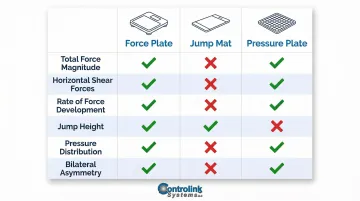
For clinical applications like gait analysis or diabetic foot screening, pressure plates are the right tool. For performance testing or research requiring kinetic data, a force plate is the only option that covers the full measurement scope.
Frequently Asked Questions
What do force plates measure?
Force plates measure ground reaction forces (GRF)—the forces a surface exerts on the body—in one to three axes (vertical, lateral, horizontal), expressed in Newtons. From the raw force-time signal, a wide range of derived metrics including peak force, impulse, RFD, jump height, and bilateral asymmetry can be calculated.
Do force plates measure weight?
Yes, force plates measure body weight by averaging the force signal during quiet standing before a test. This baseline weight is used to normalize other force metrics (e.g., relative peak force) and is essential for calculating jump height from impulse data.
Can force plates measure balance?
Force plates measure the center of pressure (COP) movement during standing tasks, which quantifies postural sway and balance stability. This is clinically used for fall risk screening, neurological assessment, and return-to-sport testing after lower-limb injuries.
What is a force plate for gait analysis?
In gait analysis, force plates (typically embedded flush in a walkway) record the GRF profile of each foot strike during walking or running. This allows clinicians and researchers to identify abnormal loading patterns, asymmetries, and joint loading characteristics linked to pathology or injury.
Are force plates accurate?
Commercially validated force plates are accurate when properly calibrated, with performance depending on sensor technology, sampling rate, and routine verification against known reference weights. Drift over time and cross-system inconsistencies are the primary concerns to monitor.
Are force plates worth it?
For elite sport, clinical rehabilitation, or research settings, force plates provide data depth that jump mats and pressure plates cannot match. Single-axis systems offer strong value for jump testing and isometric work; triaxial plates are better justified in gait labs and biomechanics research where the higher cost aligns with broader testing needs.