
For U.S. CNC machine shops, aerospace and defense suppliers, and any facility handling CUI or customer-controlled engineering data, this isn't a paperwork problem. It's an accountability problem. When a customer or assessor asks who requested a program, who approved the revision, and where the file actually went, "we think it worked" isn't an answer.
A manufacturing audit trail for CNC program control is a chronological, attributable record of every request, authorization, transfer, and delivery event tied to a controlled file. Done right, it reconstructs the full chain from request to verified delivery, without turning every machine status ping into a compliance event.
This article breaks down what belongs in that log, how the request-to-delivery chain works, and where scan-event logging supports CMMC-related evidence rather than replacing it.
Key Takeaways
- Capture every CNC program action—request, approval, retrieval, transfer, receipt, rejection, or resend—with synchronized timestamps.
- Keep controlled-record audit events separate from machine telemetry and material traceability data.
- Log successes and failures alike, including denials, checksum mismatches, and interrupted transfers.
- Use the log for CMMC evidence—it doesn't replace access control, configuration management, or a formal assessment.
What Is a CNC Program Audit-Trail Process, and Why Is It Used for CMMC Readiness?
A CNC program audit trail links a specific request to an approved program version, then records the controlled delivery of that file to an identified machine or endpoint. In plain terms, it proves the right person received the right engineering-approved file, through an authorized path, at a documented time—with the outcome kept for later review. The record is not that a machine ran a job; it is that a named requester received a specific revision, by a defined route, and what happened next.
Three Records That Often Get Confused
| Record Type | What It Answers |
|---|---|
| Audit trail | Who requested, approved, transferred, or rejected a controlled file, and when |
| Operational history | What the machine or process actually did during a run |
| Traceability | Which materials, lots, equipment, and results connect to a finished part |
These overlap in a shop, but they aren't interchangeable. A machine's run log proves cycle time and spindle load. It doesn't prove who approved the program loaded into it.
How This Supports CMMC-Related Evidence
The DoD's CMMC Model Overview Version 2.13 groups audit-related requirements under the Audit and Accountability (AU) domain, alongside Access Control, Configuration Management, Media Protection, and Incident Response. AU practices cover system auditing, user accountability, audit correlation, and authoritative time sourcing.
A CNC scan-event log can feed evidence into several of those practices at once:
- A request record supports user accountability
- A transfer record supports audit correlation
- A synchronized timestamp supports the authoritative time-source practice
Logs alone are not compliance. NIST SP 800-171A assessment objectives require defined retention, a defined review process, and records kept "as defined"—not one universal retention period or logging architecture. Confirm current CMMC and NIST SP 800-171 expectations with your assessor before treating any single log design as enough on its own.
How CNC Scan-Event Logging Works: From Program Request to Verified Delivery
The end-to-end flow looks similar whether it's a manual pull or an automated push. A machinist or system requests a program, identity and entitlement are validated, the approved revision is selected, the file transfers, the destination confirms receipt, and the full sequence is preserved as linked events.
Step 1: Capture the CNC Program Request
Every request needs its own record before anything gets approved or moved. That means capturing:
- Unique request or transaction ID
- Requester identity and workstation or terminal
- Machine destination and job/work-order reference
- Program identifier and requested revision
- Request timestamp and outcome
Denied, cancelled, duplicate, or incomplete requests belong in the log too. If the record only shows completed transfers, an investigator can't tell the difference between "nobody tried" and "someone tried and got blocked."
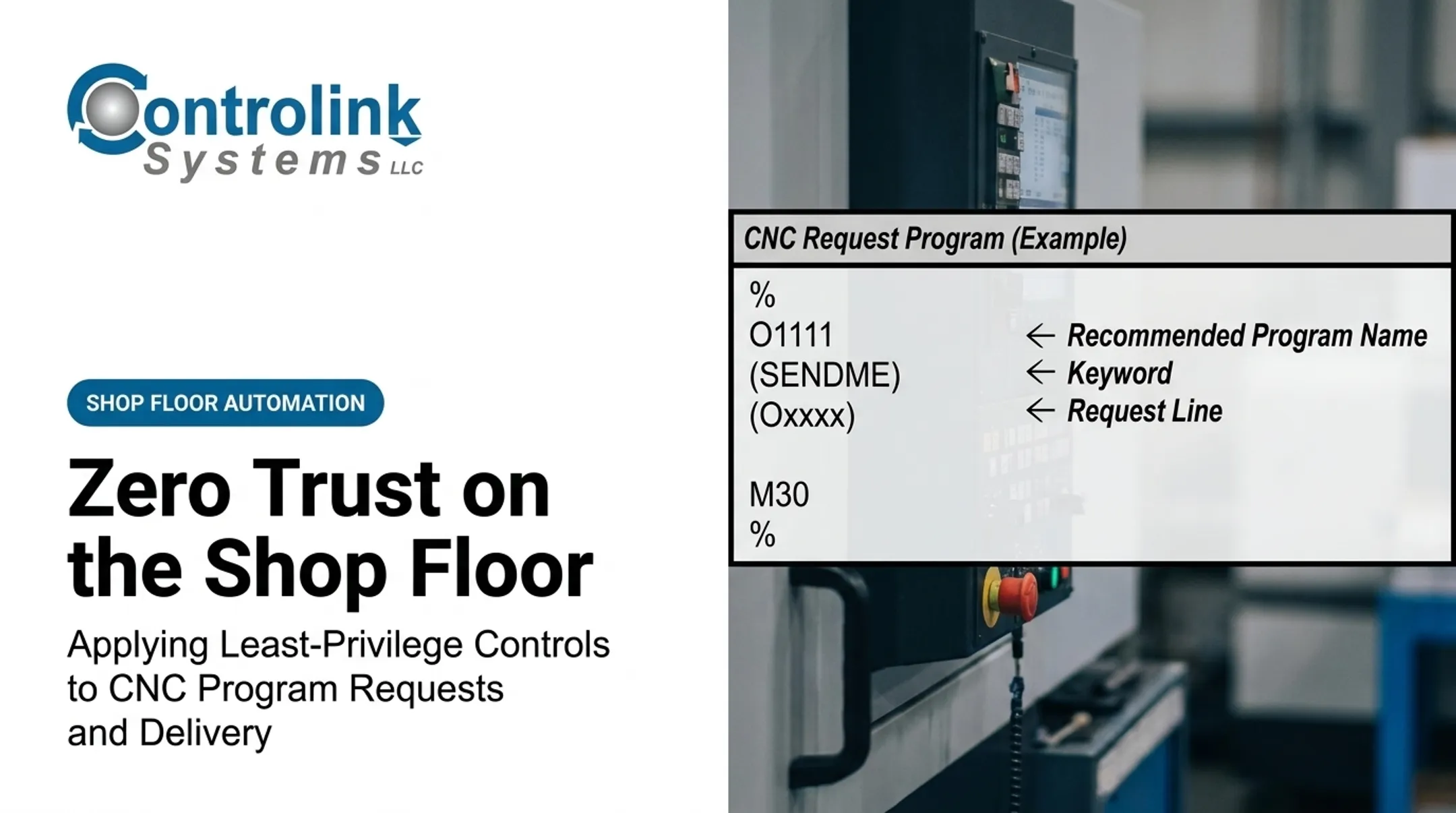
Machine Link™ QUICK Serve, for example, captures the request itself through a CNC Request Program the operator triggers from the machine control, so the request enters the system before any file moves.
Step 2: Validate Authorization and the Approved Version
Once a request lands, the system needs to confirm two things: is this person authorized, and is this the current, approved revision? That validation record should capture:
- Authorization decision and approving role
- Applicable access group
- Engineering approval reference
- File revision and file location
- Method used to confirm the program is current
Version control here typically relies on a documented checksum or hash comparison between the requested file and the source-of-truth copy. The specific algorithm and retention period should match your organization's documented configuration management process, not a generic default pulled from a vendor manual.
Step 3: Transfer and Deliver the Program
This is where most of the risk sits, because it's the step many shops still handle with a walk across the floor and a USB stick. A complete transfer record captures:
- Source system and destination machine or controller
- Transfer start and completion timestamps
- Transfer method or protocol
- File size or integrity result, where applicable
- Success, failure, rejection, or retry status
Exceptions matter as much as successes. Log each of these as its own event, linked back to the original request ID:
- Destination unavailable
- Communication timeout
- Version mismatch
- Unauthorized destination
- Interrupted transfer
- Manual override
- Failed delivery acknowledgment
That linkage is what makes reconstruction possible. An investigator should be able to move from request, to approval, to file selection, to transfer, to receipt, to any resend, without relying on screenshots, email threads, or handwritten shift notes.

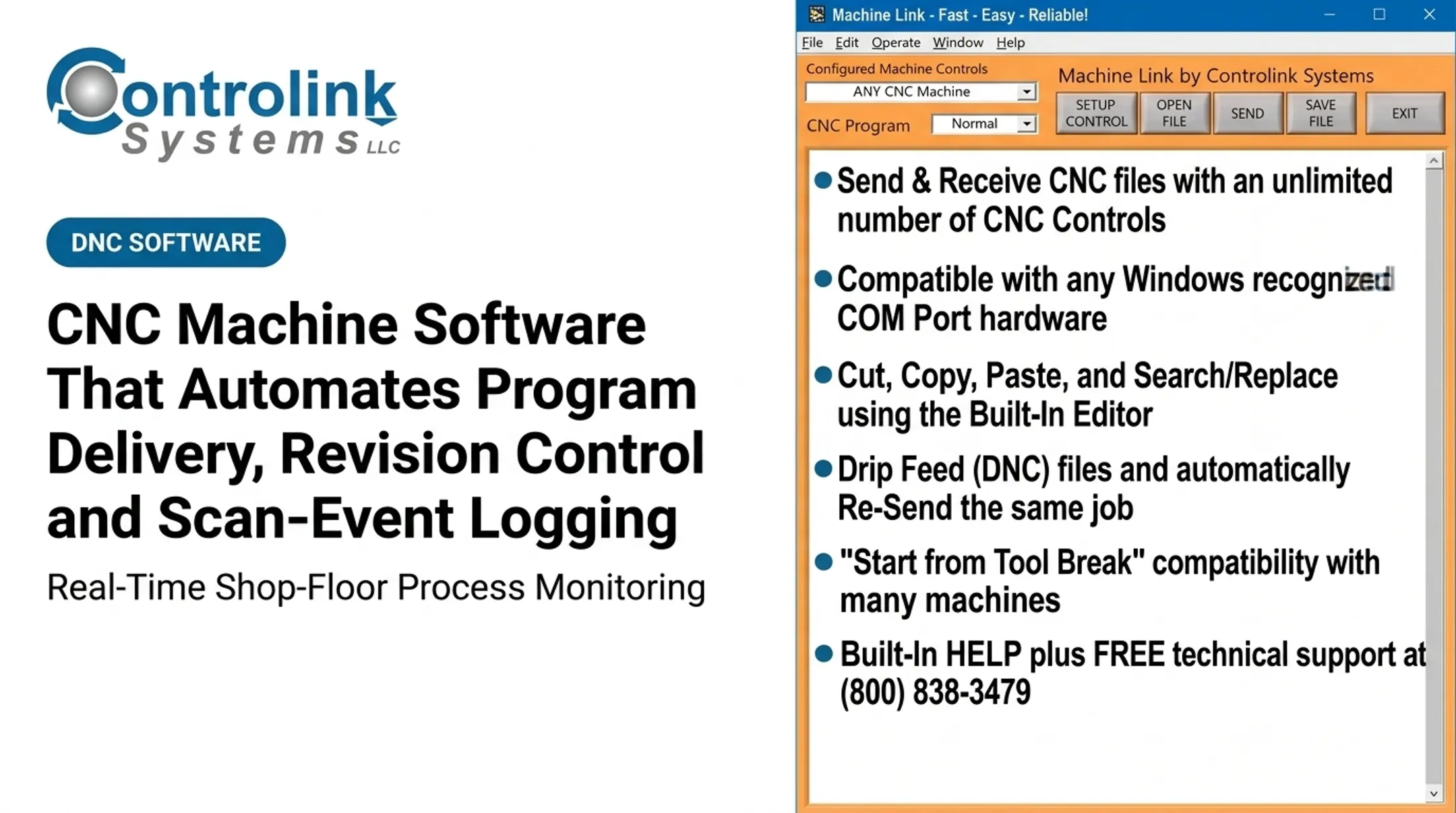
Controlink Systems LLC has built CNC/DNC communication software since 1998, including Machine Link™ QUICK Serve, which monitors machine controls for file requests and serves the current engineering-approved program directly to the control.
A DNC communication layer can connect those requests and transfers into an audit-log repository, but only when the design is validated against your facility's security boundary, access model, and applicable CMMC requirements. A communication layer isn't a compliance program by itself—it's infrastructure that has to sit inside one.
Where CNC Scan-Event Logs Apply and What Affects Their Reliability
Systems That Generate or Consume These Records
Scan-event logs don't live in one place. They typically draw from:
- Engineering or CAM repositories
- DNC servers and CNC controllers
- Shop-floor terminals and MES/job-management systems
- Identity providers and approval workflows
- Security-monitoring platforms
Logging matters at every point in the file's life:
- Creation and revision approval
- Request, authorization, and transfer
- Machine receipt and execution handoff
- Correction, withdrawal, and re-release
- Incident investigation
Miss one of these points, and the chain has a gap an investigator can't close later.
What Makes an Event Reviewable
| Category | What It Captures |
|---|---|
| Who | Named user or service identity, role, initiating endpoint |
| What | Action, program identifier, revision, destination, result |
| When/Where | Synchronized timestamp, source, destination, system context |
| Under what authority | Job reference, approval record, reason code, change ticket |
| Integrity | Event ID, related request ID, hash/checksum result, tamper protection |
NIST SP 800-53's audit-record structure treats event type, time, source, outcome, and the identity tied to the event as the baseline. That's the minimum that makes a record usable during review.
What Weakens the Trail
A handful of common conditions break reconstruction:
- Unsynchronized clocks across systems
- Shared operator accounts instead of individual logins
- Offline machines or legacy controllers with no acknowledgment capability
- Direct USB transfers that bypass the logged path
- Duplicated program names across jobs
- Excessive administrator privileges and inconsistent retention across systems
Retention periods and logging architecture should follow your organization's documented CMMC, NIST, contractual, and customer requirements, not a single number applied across every system. A shop running defense contracts may face different retention obligations than one running commercial automotive work. Check the governing contract language before setting policy.

Common Issues, Misconceptions, and When Scan-Event Logging Is Not Enough
A full machine-history report or production log doesn't prove who accessed, approved, or changed a CNC program. It proves what the machine did during a run. Those two record types need to stay connected, but they aren't substitutes for each other.
Two extremes cause the most trouble:
- Logging everything: dumping every status signal, heartbeat, and sensor blip into the compliance trail until reviewers drown in noise
- Logging only success: capturing completed transfers while skipping denials, failed transfers, and overrides—the events investigations need most
Some situations need compensating controls, not just better logging. CISA's guidance on industrial control system vulnerabilities flags weak auditing as a common gap in legacy-inherited systems, often forcing workaround monitoring instead of native logs.
Typical gaps include:
- Legacy controllers that can't generate delivery acknowledgments
- Offline transfers with no network path to the log repository
- Shared operator accounts covering multiple machinists
- Repositories sitting outside the defined CUI boundary
- Admins who control both delivery and the audit record (no separation of duties)
None of these automatically disqualify you. Each still needs a documented compensating control and a conversation with your CMMC professional or assessor before you treat the log as evidence.
Conclusion
A CNC program audit trail is a linked, attributable record of request, authorization, approved revision, transfer, receipt, and exception events—built as a controlled chain, not a machine activity log renamed for compliance. For U.S. manufacturers handling CUI or customer-controlled engineering data, that chain protects program files, shortens investigations, and keeps CMMC-relevant evidence in one place instead of screenshots and shift notes. Focus the design on three practices:
- Define event scope deliberately (what you capture, and why)
- Protect records from unauthorized edits
- Test reconstruction of a real request-to-delivery transaction If you are connecting shop-floor systems to controlled program workflows, partner with a CNC/DNC automation provider such as Controlink Systems LLC that understands both the machine path and the record-keeping side of that chain.
Frequently Asked Questions
What should be included in a manufacturing audit trail?
A complete manufacturing audit trail should capture:
- User or system identity and the action taken
- Timestamp, source, and destination
- Program identifier and revision
- Authorization context, result, and any exceptions
- Linked transaction ID plus integrity evidence (record not altered)
Can you give an example of a manufacturing audit trail?
A machinist requests a program at the machine control. The system validates the revision against engineering approval, transfers the file to the named machine, and logs receipt confirmation. Any denial or failed transfer is stored as its own linked event.
What is a manufacturing audit?
A manufacturing audit is a broader review of processes, controls, records, and compliance across a facility. A CNC program audit trail is narrower: it's the specific evidence trail showing who accessed, approved, and received controlled program files.