This guide provides a definitive resource for understanding what M Series offers, how the families differ, and how to choose the correct device for your application. We'll cover the technical architecture, compare M Series to both E Series and X Series generations, and provide practical selection criteria based on real-world deployment scenarios.
M Series devices (NI 62xx) represent National Instruments' second-generation multifunction data acquisition hardware, featuring up to 80 analog input channels, 16-bit or 18-bit resolution, sampling rates up to 1.25 MS/s, 32-bit counters at 80 MHz, correlated digital I/O, and comprehensive NI-DAQmx software support across PCI, PCIe, PXI, PXIe, and USB platforms.
TLDR: Key Takeaways
- M Series (NI 62xx) devices combine analog input, analog output, digital I/O, and counter/timers on one module, available for PCI, PCIe, PXI, PXIe, and USB platforms
- Five families span the lineup—Low-Cost (622x), Bus-Powered USB, High-Speed (625x), High-Accuracy (628x), and Industrial—covering everything from general-purpose bench use to isolated industrial environments
- M Series improved over E Series with 16/18-bit ADCs, six DMA channels, 32-bit counters at 80 MHz, and Phase-Lock Loop clock synchronization
- All devices run on NI-DAQmx driver software (v7.4+), compatible with LabVIEW, LabWindows/CVI, ANSI C, and Visual Basic .NET
What Is NI M Series DAQ?
NI M Series (model numbers NI 62xx) is National Instruments' second-generation multifunction I/O data acquisition product line. Rather than running separate instruments, a single M Series module handles the work of an oscilloscope, DMM, arbitrary waveform generator, high-speed digital I/O device, and counter/timer in one plug-in card or USB device.
Core Architecture: DAQ-STC2 Timing Engine
Each M Series device is built around the DAQ-STC2 (also known as DAQ-6202) timing and controller ASIC. This single chip provides independent FIFO buffers for analog input, analog output, digital I/O, and counters — plus flexible trigger modes, RTSI bus support, and a Phase-Lock Loop (PLL) for multi-device synchronization.
The DAQ-STC2 is a direct upgrade over the DAQ-STC used in legacy E Series devices. Key improvements include deeper counter depth, a faster timebase, and dedicated DMA channels for every I/O type.
The DAQ-STC2 delivers:
- Six independent DMA channels for AI, AO, Counter 0, Counter 1, DI, and DO
- 80 MHz timebase for counter/timer operations (versus 20 MHz in E Series)
- 32-bit counter depth (versus 24-bit in E Series)
- PLL-based clock synchronization for sub-microsecond multi-device timing
DAQ System Context and Signal Flow
Understanding where the M Series device sits in the full signal chain helps clarify how these specs translate to real-world performance. A typical system follows this path:
- Sensors and transducers measure physical phenomena (temperature, pressure, strain, voltage)
- Signal conditioning (SCXI or SCC accessories) amplifies, filters, or isolates signals
- M Series device digitizes conditioned signals via the NI-PGIA and ADC
- NI-DAQmx driver software transfers data to the host PC via DMA
- User application (LabVIEW, C, Python, etc.) processes and displays data
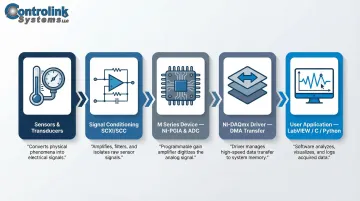
M Series devices connect to signal conditioning accessories via 68-pin VHDCI or 37-pin DSUB connectors. Adapter cables maintain backward compatibility with most E Series accessories, so upgrading from E Series hardware doesn't require rewiring existing setups.
M Series Device Families: 622x, 625x, and 628x
M Series devices are organized into five product families, each optimized for specific application requirements. The table below summarizes key specifications across families.
| Family | AI Speed | Resolution | AO Speed/Resolution | DIO Rate | Platforms | Signal Conditioning |
|---|---|---|---|---|---|---|
| NI 622x (Low-Cost) | Up to 250 kS/s | 16-bit | 833 kS/s / 16-bit | 1 MHz correlated | PCI, PXI, USB | SCXI, SCC |
| Bus-Powered USB | Up to 250 kS/s | 16-bit | 833 kS/s / 16-bit | 1 MHz correlated | USB | SCC |
| NI 625x (High-Speed) | Up to 1.25 MS/s | 16-bit | 2.8 MS/s / 16-bit | 10 MHz (PCI/PXI), 1 MHz (USB) | PCI, PCIe, PXI, PXIe, USB | SCXI, SCC |
| NI 628x (High-Accuracy) | Up to 625 kS/s | 18-bit | Programmable offset/reference | 10 MHz | PCI, PXI | SCXI, SCC |
| Industrial M Series | Up to 250 kS/s | 16-bit | 833 kS/s / 16-bit | 1 MHz | PCI, PXI | Built-in isolation |
NI 622x (Low-Cost) Family
The NI 622x family provides cost-effective multifunction I/O for general lab and test applications. Models include the NI 6220, 6221, and 6224, available in PCI, PXI, and USB form factors with screw terminal and BNC connector options.
Specifications at a glance:
- 250 kS/s sampling at 16-bit resolution
- 8 or 16 analog input channels (single connector)
- 2 analog output channels at 833 kS/s/16-bit
- 24 digital I/O lines, software-timed or correlated up to 1 MHz
- 2 × 32-bit counters at 80 MHz
A strong fit for production test, general lab measurements, and educational applications where budget is the primary constraint.
NI 625x (High-Speed) Family
Where the 622x tops out at 250 kS/s, the NI 625x pushes aggregate sampling to 1.25 MS/s at 16-bit — a 5× throughput increase suited for dynamic signal analysis and high-channel-count scanning. Key models are the NI 6250, 6251, 6254, 6255, and 6259.
Specifications at a glance:
- 1.25 MS/s aggregate sampling at 16-bit resolution
- Up to 80 analog input channels on dual-connector devices
- Up to 4 analog output channels at 2.8 MS/s/16-bit; per-channel output reference programmable to ±10V, ±5V, or external (APFI)
- Correlated DIO up to 10 MHz on PCI/PXI, 1 MHz on USB
- Input ranges down to ±100 mV; 2 × 32-bit counters at 80 MHz
Best suited for dynamic signal acquisition, multichannel scanning, and functional test requiring high data throughput.
NI 628x (High-Accuracy) Family
The NI 628x family offers 18-bit ADC resolution with programmable low-pass filters and per-channel AO offset/reference control — the right choice when 16-bit is not enough.
- 18-bit ADC resolution (versus 16-bit across other M Series families)
- 625 kS/s sampling rate at full 18-bit depth
- 40 kHz cutoff programmable low-pass filters to reject high-frequency noise
- Per-channel AO offset and reference programmability for tighter output accuracy
- Resolution down to 0.80 µV at the ±100 mV input range
- PCI and PXI platforms only
Key model numbers: NI 6280, 6281, 6284, 6289
The table below illustrates the accuracy advantage of 18-bit resolution across common input ranges:
| Input Range | NI 622x (16-bit) | NI 625x (16-bit) | NI 628x (18-bit) |
|---|---|---|---|
| ±10 V | 320 µV | 320 µV | 80.1 µV |
| ±5 V | 160 µV | 160 µV | 40.1 µV |
| ±1 V | 32 µV | 32 µV | 8.01 µV |
| ±200 mV | 6.4 µV | 6.4 µV | 1.60 µV |
| ±100 mV | N/A | 3.2 µV | 0.80 µV |
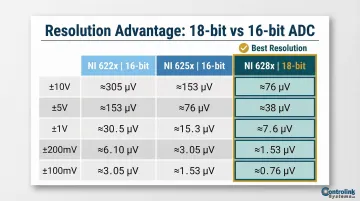
The 628x is the right pick for sensor calibration, smart meter validation, and precision metrology tasks where DMM-class accuracy is required.
Industrial M Series Variants
Industrial M Series devices target high-voltage environments where ground loops and common-mode voltages would damage standard DAQ hardware.
- 60 VDC continuous bank isolation; up to 1,400 Vrms channel-to-bus isolation
- 24V digital I/O levels alongside TTL/CMOS
- 250 kS/s sampling at 16-bit resolution
- PCI/PXI form factors only
These devices are designed for power electronics testing, motor drive validation, and industrial automation setups requiring direct connection to 24V pumps, valves, and motors.
Core Technical Capabilities of M Series Devices
Analog Input Subsystem
NI-PGIA: Programmable Gain Instrumentation Amplifier
The NI-PGIA is the key to M Series analog input accuracy. This custom instrumentation amplifier enables per-channel input range programming (DIFF, RSE, or NRSE modes). It minimizes settling times during high-speed multichannel scanning and delivers true 16-bit or 18-bit resolution at maximum scan rates.
Multichannel scanning best practices:
- Use low-impedance sources (<1 kΩ) to prevent charge injection
- Use short shielded twisted-pair cables (≤2 m) to minimize noise pickup
- Avoid scanning from large to small input ranges consecutively (allows settling time)
- Insert grounded channels between dissimilar-range channels to prevent ghosting
Analog Input Timing Engine
M Series devices use a dual-clock architecture for analog input timing:
- AI Sample Clock (ai/SampleClock): Controls the inter-sample period (the rate at which a full scan of all channels is initiated)
- AI Convert Clock (ai/ConvertClock): Controls the per-channel conversion within each sample, enabling interval sampling that approximates simultaneous sampling
This architecture allows NI-DAQmx to automatically insert 10 µs of padding between channel conversions, providing adequate settling time to eliminate crosstalk and ghosting when scanning high-impedance sources.
Triggering modes available:
- Start Trigger: Post-triggered acquisition (start on trigger, then acquire N samples)
- Reference Trigger: Pre-triggered/post-triggered acquisition (acquire buffer before and after trigger)
- Pause Trigger: Pause acquisition when trigger is active, resume when inactive
Most devices support both digital (PFI/RTSI) and analog (APFI terminals) trigger sources.
AI FIFO Buffer Architecture
The large onboard FIFO prevents data loss during DMA transfers. The onboard FIFO supports two acquisition modes:
- Finite mode: Acquire a fixed number of samples, then stop
- Continuous mode: Circular-buffered acquisition for indefinite streaming
Use hardware-timed acquisitions for precise, high-speed sampling (controlled by onboard clocks). Use software-timed acquisitions for low-speed, on-demand measurements where timing precision is not critical.
Beyond analog input, M Series devices offer equally capable digital I/O and counter/timer subsystems for synchronization, event detection, and motion feedback.
Digital I/O and Counters
Digital I/O Capabilities
M Series digital I/O provides up to 48 lines of bidirectional DIO:
- Port 0: 32 dedicated DIO lines
- Ports 1 and 2: 16 PFI lines usable as DIO
- Hardware-timed correlated DIO: Up to 10 MHz on PCI/PXI (1 MHz on USB)
- DI change detection: Interrupt-driven applications triggered by state changes
- Programmable power-up states: Define default DIO states on device initialization
- Overvoltage protection: ±20V overvoltage and overcurrent protection (improvement over E Series)
Digital waveform acquisition uses the DI Sample Clock (shared with AI or AO sample clocks for synchronization). Digital waveform generation uses the DO Sample Clock, so analog and digital channels can be clocked from the same source for precise, synchronized operation.
32-Bit Counter/Timers at 80 MHz
M Series devices include two 32-bit counter/timers running at an 80 MHz timebase. The 32-bit depth (versus 24-bit in E Series) and 80 MHz timebase (versus 20 MHz in E Series) extend both measurement range and resolution.
Counter/timer capabilities:
- Edge counting: Rising or falling edges; useful for pulse totalization and event frequency
- Pulse-width measurement: High or low pulse widths down to 12.5 ns resolution at 80 MHz
- Period/semi-period measurement: Full or half-period; suited for low-frequency signals where frequency counting is impractical
- Frequency measurement: Four methods (one-counter, averaged, two-counter high-frequency, large-range reciprocal)
- Position measurement: X1/X2/X4 quadrature encoders and two-pulse encoders
- Pulse generation: Generate single pulses with programmable width and delay
- Pulse train generation: Generate continuous pulse trains with programmable frequency and duty cycle
- Equivalent-time sampling (ETS): Sample high-frequency signals using undersampling techniques
Programmable debouncing filters: Counter inputs feature selectable debouncing durations of 125 ns, 6.425 µs, or 2.56 ms to eliminate mechanical switch bounce.
NI M Series vs. E Series vs. X Series: A Direct Comparison
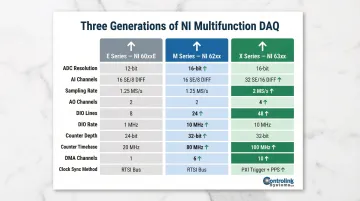
National Instruments has produced three major generations of multifunction DAQ hardware: E Series (NI 60xxE), M Series (NI 62xx), and X Series (NI 63xx). The table below provides a side-by-side comparison of key specifications.
| Feature | E Series (NI 60xxE) | M Series (NI 62xx) | X Series (NI 63xx) |
|---|---|---|---|
| ADC Resolution | 12-bit or 16-bit | 16-bit or 18-bit | 16-bit |
| AI Channels | 8 to 64 | 8 to 80 | 8 to 32 |
| Sampling Rate | Up to 1.25 MS/s | Up to 1.25 MS/s | Up to 2 MS/s |
| AO Channels | 0 to 2 | 0 to 4 | 0 to 4 |
| AO Update Rate | Up to 1 MS/s | Up to 2.8 MS/s | Up to 2.8 MS/s |
| DIO Lines | 8 to 32 | 24 to 48 | 24 to 32 |
| DIO Rate | Up to 1 MHz | Up to 10 MHz | Up to 10 MHz |
| Counter/Timers | 2, 24-bit | 2, 32-bit | 4, 32-bit |
| Counter Timebase | 20 MHz | 80 MHz | 100 MHz |
| DMA Channels | 1 to 3 | 6 | 8 |
| Clock Sync Method | External reference | PLL-based | PLL-based |
| Connector Type | 68-pin SCSI-II | 68-pin VHDCI | 68-pin VHDCI |
M Series Advantages Over E Series
M Series devices deliver substantial improvements over E Series:
- Larger AI/AO FIFO buffers prevent data loss during high-speed streaming
- 4–6 DMA channels (versus 1–3 in E Series) enable simultaneous AI, AO, DI, DO, and two counter operations
- NI-TIO counter features including quadrature encoding and two-edge separation
- 16 PFI lines (versus 10 in E Series) provide more flexible routing and triggering
- Debouncing filters eliminate mechanical switch bounce on counter inputs
- Improved digital I/O protection (±20V overvoltage/overcurrent versus ±5V in E Series)
- Per-channel AO reference and offset on 628x accuracy boards
- PLL-based clock synchronization for multi-device timed operations
The 68-pin VHDCI connector replaces the SCSI-II connector used in E Series, but maintains pin-mapping compatibility. Existing E Series accessories work with adapter cables—no rewiring required. Two pin differences require attention:
- PFI 0: On E Series, PFI 0 serves as both analog and digital trigger input. On M Series, PFI 0 is digital-only; analog triggers use dedicated APFI 0 or APFI 1 inputs.
- PFI 15: Maps to digital ground (D GND) on E Series, but is a functional PFI line on M Series.
X Series Advantages Over M Series
For applications requiring maximum performance, X Series (NI 63xx) builds on M Series with:
- 4 counter/timers (versus 2 in M Series), each with buffered output capability
- 100 MHz timebase (versus 80 MHz in M Series)
- Retriggerable tasks on all subsystems (M Series supports retriggerable counter tasks only)
- Dedicated sample clock for DIO subsystem (M Series requires sharing from another subsystem)
- Simultaneous sampling on select boards (all channels sampled at the same instant)
- Higher PCI Express/PXI Express throughput for demanding streaming applications
X Series uses the same NI-DAQmx driver and maintains a similar programming model, simplifying migration from M Series.
Platform and Bus Availability
Beyond performance specs, your choice of bus and form factor affects how M Series devices integrate into your system. M Series devices come in 32-bit PCI, PCIe, PXI, PXIe, and USB 1.1/2.0 form factors.
USB variants support 4 NI Signal Stream channels for high-throughput operation but do not support RTSI (use PFI bus instead for synchronization).
PXI deployments unlock additional synchronization capabilities:
- PXI_CLK10 backplane clock enables multi-device synchronization without external cabling
- PXI trigger lines map directly to RTSI 0–7
- PXI_STAR trigger supports Star Trigger controller setups for sub-nanosecond synchronization
Software and NI-DAQmx Integration
All M Series devices require the NI-DAQmx driver (minimum version varies by model: NI-DAQmx 7.4 for most PCI/PXI 622x/625x/628x devices, 8.x for USB variants). NI-DAQmx provides a unified API across LabVIEW, LabWindows/CVI, Measurement Studio (.NET), and ANSI C.
E Series supports the legacy Traditional NI-DAQ driver, but M Series and X Series are NI-DAQmx only. Budget software engineering time when upgrading legacy E Series systems — older Traditional NI-DAQ code will not compile or run on M Series hardware.
Data Transfer Methods
Three data transfer methods are available:
- DMA (default on PCI/PXI): Six dedicated scatter-gather controllers for AI, AO, Counter 0, Counter 1, DI, DO. Maximizes bus bandwidth and minimizes CPU overhead.
- IRQ (interrupt-driven): Higher CPU overhead, suitable for lower-speed applications or when DMA channels are exhausted.
- Programmed I/O (on-demand): Used for single-point operations where timing precision is not required.
For USB devices, NI Signal Stream (USB bulk transfer without microcontroller intervention) replaces DMA for up to 4 simultaneous channels.
Multi-Device Synchronization Using RTSI and PLL
To synchronize multiple M Series devices:
- One device acts as initiator and exports its 10 MHz reference clock
- All target devices PLL their internal 80 MHz timebase to this common reference
- A shared start trigger via RTSI/PFI line ensures simultaneous operation
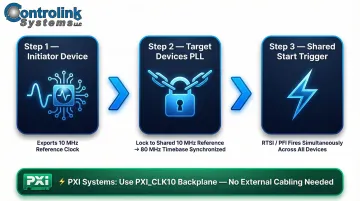
On PXI platforms, devices leverage the PXI_CLK10 backplane clock for synchronization without external cabling.
Controlink Systems has been integrating M Series DAQ hardware into manufacturing and test systems since 2000 — including multi-device synchronization setups for process monitoring, EOL testing, and vibration analysis. If your application requires custom integration support, the team at Controlink Systems is available at (800) 838-3479.
Choosing the Right M Series Device for Your Application
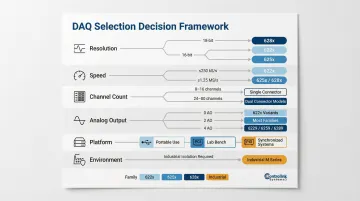
Use this decision framework to select the appropriate M Series device:
1. Resolution:
- 18-bit needed: Select NI 628x family (0.80 µV resolution at ±100 mV range)
- 16-bit sufficient: Consider NI 622x or NI 625x
2. Speed:
- General lab use (up to 250 kS/s): NI 622x
- Dynamic signal analysis (up to 1.25 MS/s): NI 625x or NI 628x
3. Channel count:
- Single connector (8–16 channels): NI 622x, 625x, or 628x single connector
- High channel count (24–80 channels): NI 6224, 6225, 6254, 6255, 6259, 6289
4. Analog output:
- No AO: NI 622x 0-AO variants
- 2 AO channels: Most families
- 4 AO channels: NI 6229, 6259, 6289
5. Platform:
- Portable/field use: USB
- Lab chassis: PCI/PCIe
- Synchronized multi-instrument: PXI/PXIe
6. Environment:
- Industrial with isolation: Industrial M Series (60 VDC bank isolation, 24V DIO)
Signal Conditioning Decisions
Most M Series devices connect directly to voltage signals, but sensors like thermocouples, RTDs, and strain gauges need extra conditioning first. For those inputs, pair M Series with the appropriate front-end module:
- SCXI: Large systems, up to 3,072 channels
- SCC: Portable, up to 16 AI channels
Use shielded SHC68-68-EPM cables for best EMC performance.
The scenarios below show how different M Series families handle real measurement challenges across common industries.
Real-World Application Scenarios
NI 622x — General Production Test: A mid-size machine shop monitors spindle load, coolant pressure, and tool wear across multiple CNC machines using the NI 6221 (16 AI, 2 AO, 24 DIO). At 250 kS/s and 16-bit resolution, it delivers the precision process monitoring needs without the cost of a higher-speed device.
NI 628x — Precision Calibration: When a calibration lab needs DMM-class accuracy for validating smart meters and precision sensors, the NI 6281 delivers. Its 18-bit resolution (0.80 µV at ±100 mV) and programmable 40 kHz low-pass filter eliminate high-frequency noise that would compromise metrology results.
Industrial M Series — Motor Drive Testing: High-voltage environments demand isolation. An automotive supplier testing electric motor drives uses the Industrial NI 6233 — its 60 VDC bank isolation and 24V digital I/O allow direct connection to high-voltage circuits without ground loops or PC damage.
NI 625x — Dynamic Signal Acquisition: Transient vibrations during a washing machine spin cycle are short-lived and easy to miss. A vibration analysis lab pairs the NI 6259 (32 AI, 1.25 MS/s) with accelerometers to capture those events reliably, feeding product development for quieter appliances.
Frequently Asked Questions
What is NI M Series data acquisition?
NI M Series (NI 62xx) is a multifunction DAQ product line from National Instruments combining analog input, analog output, digital I/O, and counter/timer functions on a single device. Driven by the NI-DAQmx software driver, M Series devices are available in PCI, PCIe, PXI, PXIe, and USB form factors.
What is the difference between NI M Series and E Series DAQ devices?
M Series offers 16/18-bit ADCs (versus 12/16-bit in E Series), up to 6 DMA channels (versus 1–3), 32-bit counters at 80 MHz (versus 24-bit at 20 MHz), correlated digital I/O, PLL clock synchronization, and improved digital I/O protection. M Series maintains backward accessory compatibility via adapter cables.
What is the difference between NI M Series and X Series DAQ devices?
X Series (NI 63xx) builds on M Series with several key upgrades:
- 4 counter/timers (versus 2) with a 100 MHz timebase (versus 80 MHz)
- Retriggerable tasks on all subsystems and a dedicated DIO clock source
- Simultaneous sampling on select boards
- Higher streaming throughput over PCIe/PXIe buses
Can NI M Series devices replace existing E Series devices without rewiring?
M Series retains the same 68-pin signal mapping as E Series (with minor exceptions for PFI 0 and PFI 15), so existing terminal blocks and accessories reuse with low-cost adapter cables — no rewiring needed. Software code may need minor updates to account for NI-DAQmx API differences.
What software is required to use NI M Series DAQ devices?
M Series devices require the NI-DAQmx driver (version 7.4 or later depending on model) and work with LabVIEW, LabWindows/CVI, Measurement Studio (.NET/C#/VB), and ANSI C. Traditional NI-DAQ (Legacy) is not supported.
Which NI M Series device should I choose for high-accuracy measurements?
The NI 628x family (NI 6280, 6281, 6284, 6289) delivers the highest accuracy with 18-bit ADC resolution and resolutions as fine as 0.80 µV at the ±100 mV range. These boards also include programmable low-pass filters and per-channel AO offset/reference control. Available in PCI and PXI form factors only.