
Nothing catches it. The part passes visual inspection. Three weeks later, a customer audit asks which program produced a batch of parts, and nobody can answer with certainty.
That gap between "approved in the system" and "running on the machine" is where scrap, downtime, and failed audits actually originate. Document control software and CNC revision control both claim to close it, but they operate at different links in the chain.
Manufacturers chasing reliable first-time machining need to understand where one system's job ends and the other's begins, rather than picking a tool based on repository features alone.
Key Takeaways
- Document control software owns lifecycle, review, approval, permissions, and audit evidence for controlled records.
- CNC revision control tracks program identity, machine compatibility, shop-floor distribution, and proof of what actually ran.
- A repository marked "approved" doesn't confirm the file reached the correct machine.
- Connecting engineering approval to CNC/DNC transfer closes the traceability gap.
- Score either system by outcomes: fewer wrong-program errors, less manual file handling, lower scrap and downtime.
Document Control Software vs CNC Revision Control: Quick Comparison
These two categories often get lumped together because both involve "version control." In practice, they control different halves of the same problem.
| Aspect | Document Control Software | CNC Revision Control |
|---|---|---|
| Core purpose | Manages drawings, specs, work instructions, inspection records, setup sheets, and CNC files as controlled records | Treats NC programs and machining data as executable, machine-ready assets |
| Primary control point | Creation, review, approval, access, revision history, retention, audit trails | Program selection, machine targeting, transfer, local access, controlled edits |
| Approval vs. execution | Establishes that a reviewer approved a specific file | Ensures the approved file (not an outdated local copy) reaches the machine |
| Scope and connectivity | Integrates with ERP, PLM, QMS, CAD, cloud storage | Connects to CNC controls, DNC servers, shop-floor terminals, machine protocols |
| Evidence captured | Metadata, timestamps, approvals, permissions, revision history | Transfer logs, machine associations, operator actions, and execution feedback |
The pattern is consistent across every row: document control software proves what was approved. CNC revision control has to prove what was run. Those are not the same claim, and treating them as interchangeable is how outdated programs end up in spindles.
What Are Document Control Software and CNC Revision Control?
What Is Document Control Software?
Document control software is a centralized system for creating, reviewing, approving, distributing, revising, securing, and archiving controlled documents. In a machine shop, it can serve as a single source of truth for drawings, CNC programs, setup instructions, tooling data, and inspection plans.
ISO 9001:2015 requires organizations to control this kind of documented information, distinguishing between records that support process operation and records retained as evidence that a process was carried out as planned. Core software capabilities typically include:
- Role-based permissions by job title or location
- Predefined review and approval workflows
- Revision history showing who changed what and when
- Check-in/check-out controls (an implementation choice, not a universal requirement)
- Audit trails, search, and metadata tagging
- Retention rules and automatic archiving of superseded versions
Done well, this reduces conflicting file versions, speeds up approvals, and makes audit prep less painful. Here's the catch: a document marked "approved" in a repository doesn't by itself prove that revision was transferred to a specific machine and used in production. That's a separate control problem entirely.
Picture a typical engineering-change workflow. A revised drawing, tool list, setup sheet, and CNC program all move through review and sign-off before release. Quality and compliance teams later pull that revision history to investigate a nonconforming part. They also use it to show an auditor exactly which instructions were active on a given date.
That's genuinely valuable. It's also where the trail often goes cold, because the approval record sits in one system while the machine sits somewhere else entirely.
What Is CNC Revision Control?
CNC revision control is the controlled identification, storage, review, distribution, and use of NC programs and related machining files across CNC equipment. NC programs need this specialized layer. Syntax, machine make and model, controller type, post-processor, tooling, workholding, offsets, and material assumptions all determine whether a file is actually safe to run.
Modern Machine Shop notes that the core requirement of Direct Numerical Control is simply getting the program to the machine without interruption or data loss. That sounds basic. It's also the exact step where floppy disks, USB drives, and shared network folders routinely fail.
The practical workflow runs in sequence:
- Engineering approves and releases the master program
- The system selects the target machine based on part, controller, and setup
- The program transfers through a controlled channel, not a loose file copy
- The operator retrieves and verifies the program before cycle start
- Any edit made at the machine gets logged and routed back for review
- The revision used gets recorded against the production run

That distinction between the master program and a machine-local copy matters more than it sounds. A local copy can carry a quick offset tweak nobody documented. Modern Machine Shop's guidance on program verification points out that any program modified since its last run, or any engineering change, needs re-verification before it's trusted again.
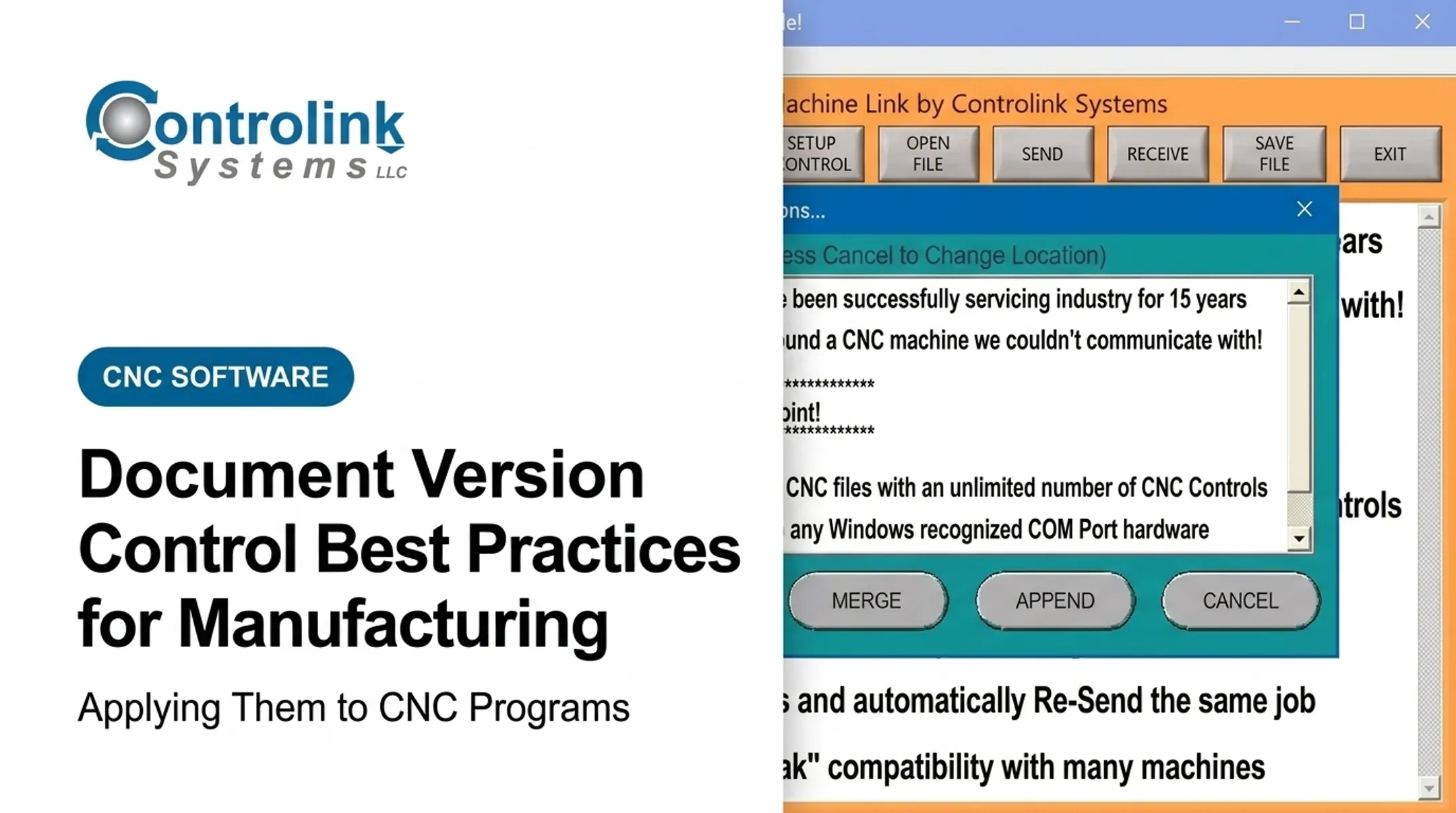
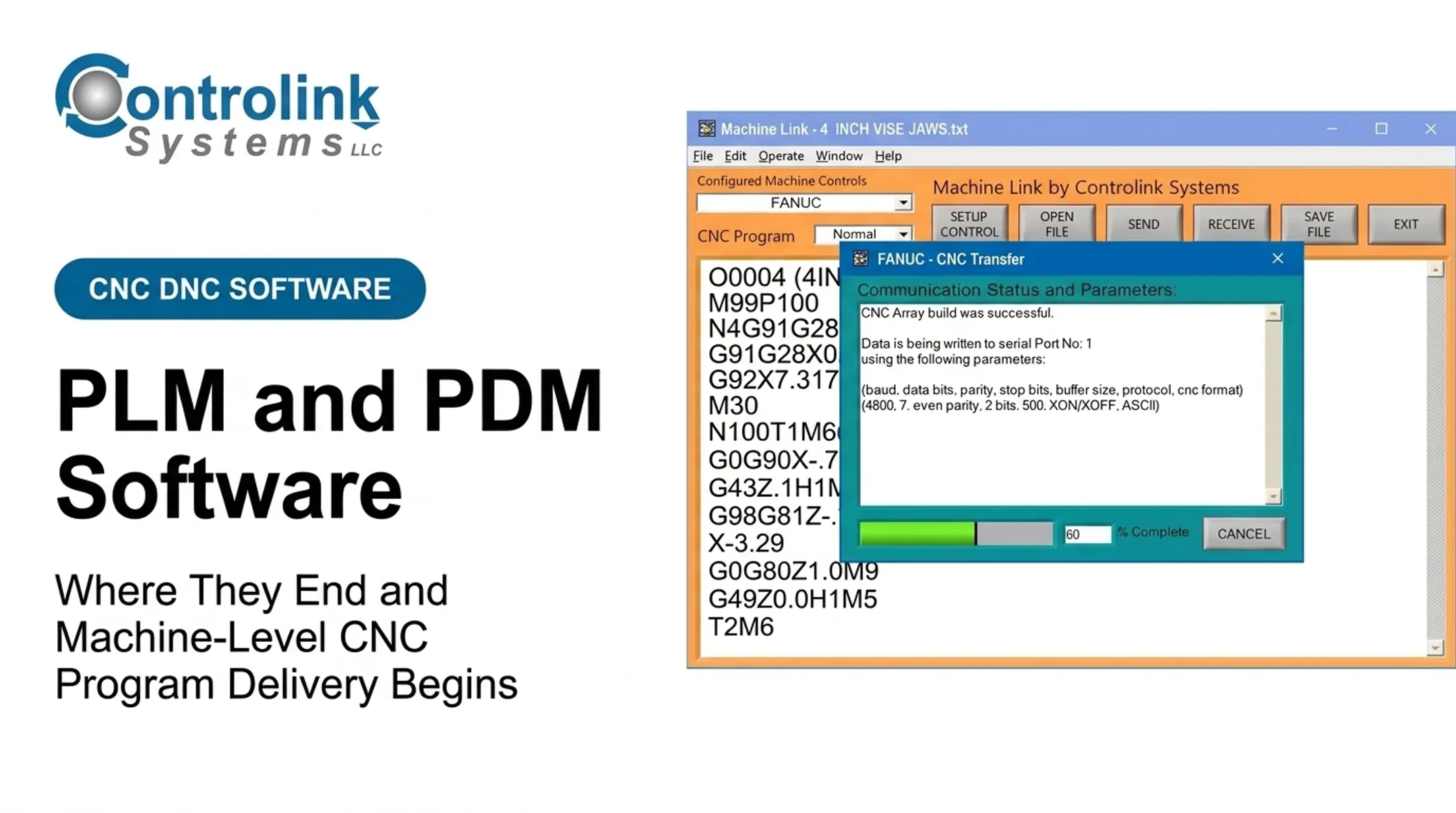
Controlink Systems LLC's Machine Link™ QUICK Serve, for example, continuously monitors machines for file requests and serves the latest engineering-approved file directly to the control. Any machine-side edits route back to engineering before they become the new baseline.
Consider a shop running the same part family across machines from different manufacturers. Each control needs its own compatible version of that program. Without a system enforcing machine-specific targeting, it's only a matter of time before the wrong post-processed file lands on the wrong control.
Snavely's Machine in Wabash, Indiana runs more than 30 CNC machine tools across 10 different control types with 40 operators. Getting the right program to the right machine was a persistent headache, one that's common at any shop past a handful of machines and controllers.
Operators, programmers, and supervisors also need clear rules for how released, superseded, and locally modified programs get treated day to day. Otherwise "the file that worked last time" becomes the unofficial standard, whether or not it matches the approved revision.
What Is Better: Document Control Software or CNC Revision Control?
Neither category replaces the other, because they control different stages of the same chain. Picking one over the other misses the point entirely.
Choose document control software when the core problem is enterprise-wide governance: formal approvals, compliance evidence, retention schedules, and cross-functional collaboration between engineering, quality, and management.
Choose CNC revision control when the core problem is getting the correct released program to the correct machine, managing shop-floor copies, and recording machine-facing activity that document repositories simply don't touch.
Choose an integrated approach when you need both: formal engineering sign-off and proof that the sign-off actually reached the spindle. This is where most manufacturing shops end up after they've been burned by an outdated program.

When evaluating a combined workflow, weigh these criteria:
- Machine and controller compatibility across your fleet
- Secure, role-based user access
- Approval gates before a file becomes available for transfer
- Program comparison and rollback capability
- Confirmed transfer receipt, not just a "sent" status
- Offline/local behavior when the network drops
- Audit logs that connect back to ERP, PLM, or QMS records
Before trusting any workflow, run through this checklist:
- Identify the current approved revision
- Associate it with the intended machine and part number
- Transmit it through a controlled channel, not a manual file copy
- Confirm receipt or availability at the control
- Record any authorized edit made at the machine
- Retain evidence of exactly what was run
Controlink Systems LLC has spent over 25 years building the CNC/DNC and shop-floor automation layer that connects engineering approval to machine execution. Tools like Machine Link™, Machine Link™ QUICK Serve, and PDADNC™ link systems together instead of leaving that handoff to chance.
If you're mapping this path for your own shop, walk through where your current workflow breaks down and close that gap before the next outdated program reaches a spindle.
Real World Examples
The Timken Company's Canton Industrial Bearing division ran hardturning lathes in its Special Grinding Department on an older workflow. Operators pulled program numbers from a legacy database, typed them in by hand, and moved them on floppy disks.
Disks got lost. Disks got damaged. Nobody had a clean answer for which revision ran on a given shift.
Controlink Systems LLC built its ML Send Utility into Timken's existing corporate database. The database passed the CNC filename and target control on the command line, and the utility handled the transfer in one click—no manual retyping.
Timken published the results in its internal Timken Exchange newsletter in August 2000. The write-up credited the software with less operational time and fewer errors between computers and machine controllers.

Snavely's Machine faced a related problem at larger scale:
- 30-plus machines on the floor
- 10 different control types
- 40 operators loading programs
- No reliable way to guarantee the right program hit the right control every time
Different shops. Same exposure: approval upstream still left transfer and revision identity loose at the machine.
Shared takeaway: Centralized approval matters, but it does not remove production risk on its own. That risk drops only when the approved revision is controlled at the machine interface.
If uncontrolled transfers, mismatched revisions, or weak shop-floor traceability sound familiar, Controlink Systems LLC helps manufacturers tighten CNC/DNC communication and system integration. Call (800) 838-3479 or email support@controlinksystems.com to talk through your setup.
Conclusion
Document control software governs the lifecycle and authorization of controlled information. CNC revision control governs the path and use of executable programs once they leave the engineering system and head for the machine. Each layer owns a different job, and shops need both to keep only approved programs on the machine.
Shops with the fewest outdated-program errors, the cleanest traceability, and the lowest scrap and downtime connect both halves:
- Formal approval at the engineering source
- Controlled delivery to the machine
- A documented handoff between the two
Frequently Asked Questions
What are the top 3 version control tools?
There's no universal top-three list. The relevant categories are manufacturing document control platforms, source-code tools like Git, and CNC/DNC systems. Evaluate options on machine connectivity and auditability, not general popularity.
Is Git a centralized or distributed version control system?
Git is a distributed version control system. That said, source-code concepts like commit history don't translate to machine communication, CNC compatibility, or proof of what actually ran on a shop-floor control.
What is the difference between document control software and CNC revision control?
Document control governs approval and lifecycle management for records. CNC revision control extends that control to program distribution, machine targeting, and confirmed production use at the control itself.
Can document control software guarantee that the approved CNC program reaches the machine?
It can establish the approved source of truth, but it can't confirm delivery on its own. You need a machine-connected transfer, access, and confirmation workflow to verify the file actually reached and ran on the intended control.
How do you make sure a CNC machine is using the latest approved program?
Use unique program IDs, controlled distribution to the target machine, and restricted local access. Handle superseded files clearly, and keep a transfer record of which revision was sent and used.
What features should manufacturers look for in CNC revision control software?
Prioritize controller compatibility, reliable DNC communication, role-based access, and revision history with rollback. Also look for program comparison, machine selection logic, audit trails, and an operator interface that needs little training.