Introduction
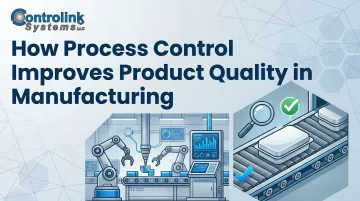
In manufacturing, small process deviations compound fast. A temperature shift of a few degrees, unnoticed tool wear, or loading an outdated CNC program can turn into hundreds of scrapped parts, rejected batches, and frustrated customers. Most manufacturers know what good quality control looks like on paper. The harder problem is closing the gap between what engineering specifies and what actually gets produced on the floor.
What follows is a breakdown of how process control directly improves product quality — through specific, measurable advantages. Real-time monitoring, reduced scrap, and faster corrective action all translate into bottom-line results, and this article shows exactly how.
Key Takeaways
- Process control monitors and adjusts manufacturing variables in real time, keeping output within quality limits
- It moves quality assurance from reactive inspection to proactive prevention — catching problems before they reach the part
- Results include fewer defects, lower scrap costs, faster deviation response, and consistent output across runs
- Without it, manufacturers discover defects after the damage is done — not before
- Even small gains in process stability add up to measurable reductions in waste, unplanned downtime, and customer complaints
What Is Process Control in Manufacturing?
Process control is the practice of monitoring, measuring, and adjusting production variables to keep them within specification throughout a manufacturing run. It operates in-process—between raw material input and finished product output—distinct from end-of-line inspection that only catches problems after they've occurred.
Those variables span a wide range depending on the operation:
- Temperature and pressure in heat treatment or molding
- Spindle speed, feed rate, and depth of cut on CNC machines
- Tooling wear indicators and offset values
- CNC program file versions loaded at each machine
According to NIST's definition, "Process Control is the active changing of the process based on the results of process monitoring. Once the process monitoring tools have detected an out-of-control situation, the person responsible for the process makes a change to bring the process back into control."
The goal is consistent, predictable product quality that meets customer specifications and reduces the cost of failure. That outcome depends on three things working together: real-time monitoring systems, clear operator feedback, and automated adjustments that catch drift before it becomes scrap.
Key Advantages of Process Control for Product Quality
The advantages below are grounded in operational impact—the kind manufacturers track in scrap rates, rework hours, defect PPM, and customer returns—not abstract theory.
Advantage 1: Consistent Output Through Real-Time Process Monitoring
Process control enables manufacturers to monitor critical variables—tool wear, spindle load, cycle time deviations, feed rates, environmental conditions—in real time rather than discovering problems at final inspection.
How real-time monitoring creates a feedback loop:
- When a variable drifts toward the edge of its acceptable range, operators or automated systems receive alerts
- Corrections happen before a single nonconforming part is produced
- One out-of-spec tool or program error doesn't become 500 scrapped parts
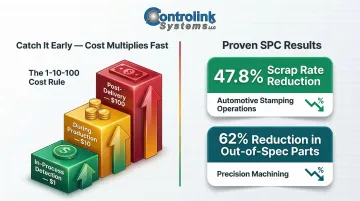
The 1-10-100 rule demonstrates the financial impact: if catching a defect in-process costs $1, detecting it during production costs $10, and finding it post-delivery costs $100. Catching drift early prevents defects from multiplying across entire production runs.
Research shows the impact is measurable. Integrating digital Statistical Process Control with real-time quality forecasting in automotive stamping achieved a 47.8% scrap rate reduction—from 0.81% to 0.42%. In precision machining, SPC monitoring of critical dimensions reduced out-of-spec parts by 62%.
Consistency is what customers actually buy. Process control is the mechanism that delivers it reliably, run after run.
KPIs impacted:
- Defects per million opportunities (DPMO)
- First-pass yield rate
- In-process rejection rate
- Customer return rate
This matters most in high-volume production runs, tight-tolerance machining environments, and facilities running multiple concurrent jobs where drift in one machine impacts overall throughput.
Advantage 2: Reduced Scrap and Rework Costs
Scrap and rework are among the most significant hidden costs in manufacturing. Most facilities track them, but few systematically address their root cause: uncontrolled process variables.
Process control reduces scrap by ensuring operators work with correct, engineering-approved parameters and files—preventing waste from wrong setups, outdated programs, or unchecked tool conditions. Controlink Systems' DNC software directly addresses this by ensuring machinists load the latest approved CNC programs, eliminating one of the most common sources of scrap in CNC environments.
According to the American Society for Quality, quality-related costs reach 15–20% of sales revenue, with some organizations hitting 40% of total operations. Scrap and rework cost manufacturers up to 2.2% of annual revenue.
Scrap isn't just wasted material—it's wasted machine time, labor, and energy. In CNC shops specifically, improper tool setup or offset errors cause catastrophic crashes and entire batches to go out of tolerance.
When scrap rates drop:
- Manufacturers price more competitively
- Capacity increases without capital investment
- On-time delivery improves
KPIs impacted:
- Scrap rate (%)
- Cost of poor quality (COPQ)
- Rework hours per shift
- Material utilization rate
This advantage is most acute in high-material-cost environments (aerospace, medical, precision machining), facilities running complex multi-step processes, and shops where program version errors or setup mistakes recur.
Advantage 3: Faster Detection and Corrective Action
No process control system eliminates all variation. What they do is shrink the gap between when a problem starts and when it gets corrected—and that gap determines how much damage a defect actually causes.
Automated process monitoring generates actionable alerts and data logs that allow quality engineers and operators to trace a deviation to its source quickly. Compare that to batch-end inspection, where root cause analysis can consume hours—or days—after defective parts are already produced.
Speed of response directly multiplies quality outcomes. A problem caught in the first 10 minutes of a shift has a fraction of the impact of one caught at end-of-shift inspection. Research on Mean Time To Detect (MTTD) showed that machine-learning-augmented observability reduced MTTD by 93–98%—from 45–60 minutes down to 1–3 minutes.
Faster corrective action also limits exposure to regulatory non-compliance in industries like medical devices and aerospace, where traceability and response documentation are required. FDA 21 CFR Part 820, ISO 13485, AS9100D, and IATF 16949 all mandate monitoring and measurement of production processes to verify capability and demonstrate control.
KPIs impacted:
- Mean time to detect (MTTD)
- Mean time to repair/correct (MTTR)
- Nonconformance report (NCR) cycle time
- Audit finding closure rate
This is especially critical in regulated industries (medical, aerospace, automotive), high-mix low-volume environments where variation is more likely, and facilities with limited quality inspection headcount who need systems to extend their coverage.
What Happens When Process Control Is Missing or Ignored
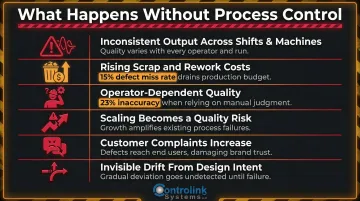
In shops without process control, quality issues are discovered late—at final inspection, at the customer, or after a warranty claim—forcing costly reactive responses rather than early preventive ones.
The compounding consequences of absent process control:
- Output varies across shifts, operators, and machines—with no systematic way to identify why
- Scrap and rework volumes climb steadily, eroding margins—manual inspection misses 15% of defects on average due to fatigue and subjectivity
- Quality becomes operator-dependent—results shift with individual skill and habit rather than controlled parameters. Operator errors account for 23% of quality control inaccuracies
- Scaling production or onboarding new operators becomes a quality risk, not just a training challenge
- Customer complaints and returns increase, eroding relationships that took years to build
- Invisible drift compounds the damage—minor, uncoordinated changes across systems gradually push products away from design intent until something fails in the field
How to Get the Most Value from Process Control
Process control delivers increasing value when applied consistently, not just during audits or when problems arise. Start with the highest-risk or highest-scrap processes rather than trying to control everything at once.
Data from monitoring systems is only useful when it's acted upon:
- Establish clear response thresholds (control limits)
- Assign ownership for corrections
- Review process data regularly to identify trends before they become defects
- Use control charts and SPC methods to distinguish normal variation from special causes
Linking CNC program management, machine monitoring, and end-of-line testing creates a connected quality loop — one where a problem caught at the machine never makes it to final inspection. Controlink Systems builds exactly these connections: integrating shop-floor automation, DNC communications, and process monitoring so manufacturers have visibility and control from program loading through finished-part verification.
Top-performing manufacturers maintain defect rates under 50 PPM; the industry average ranges from 100–500 PPM. Closing that gap requires consistent process control — not occasional fixes, but disciplined monitoring and response embedded into daily operations.
Conclusion
Process control delivers on the metrics that matter most: fewer defects, less scrap, and faster response when something drifts out of spec. These gains don't appear in isolation — controlling one variable tightens tolerance on the next, and the improvements build on each other over time.
A shop that monitors and adjusts its processes consistently today builds the operational foundation for reliable quality tomorrow. Manufacturers who treat process control as an ongoing discipline — not a periodic initiative — are the ones who stop reacting to problems and start preventing them.
Frequently Asked Questions
How does process control improve product quality in manufacturing?
Process control keeps production variables within defined limits through real-time monitoring and feedback, preventing defects from forming rather than catching them after the fact. This results in more consistent output, lower scrap, and fewer customer returns.
Why is quality control an important part of the production process?
Quality control ensures products meet specifications before reaching the customer, reducing the cost of failures, protecting brand reputation, and enabling compliance with industry standards and regulations. It's the last line of defense before products ship.
What are the key principles of quality control in manufacturing?
The core pillars are: defining measurable quality standards, monitoring processes against those standards, detecting and correcting deviations quickly, and continuously improving based on data.
What is the difference between process control and quality control?
Process control focuses on managing inputs and variables during production to prevent defects, while quality control traditionally inspects outputs after production. Process control is proactive; quality control is often reactive.
What are common process control methods used in manufacturing?
Common methods include Statistical Process Control (SPC), control charts, automated machine monitoring, DNC/CNC program management, and end-of-line testing systems. These tools help manufacturers detect and correct deviations before defects occur.
How does statistical process control (SPC) help reduce defects?
SPC uses data from production to identify when a process is trending out of its acceptable range before defects occur, enabling operators to intervene early.