](https://file-host.link/website/controlinksystems-yad4cm/assets/blog-images/777c5f2c-921e-42ca-9c55-e2c456f7d300/1789738888478135_8612aa1ec1a44451846f63940b68ed6f/2x_360.webp)
Most machine shops don't realize how many systems touch that file before it ever reaches the spindle. Engineering workstations, CAD/CAM systems, file shares, DNC software, shop-floor terminals, CNC controllers, and the business network all sit on the same path. Every connection point is a place where something can go wrong, accidentally or otherwise.
This article makes one central argument: treat CNC program delivery as a controlled security boundary. That means governing it with identity checks, approval gates, integrity verification, network segmentation, monitoring, and recovery planning, the same way industrial control system security works in larger facilities.
Key Takeaways
- Treat CNC programs as operational instructions that need file-level protection.
- Apply SCADA and ICS security principles in shops of any size, even without a full SCADA platform.
- Verify sender identity, approved revision, destination machine, and retained evidence at delivery.
- Stage controls in order: visibility, access control, segmentation, integrity checks, monitoring, recovery.
What OT, ICS, and SCADA Mean in a CNC Machine Shop
These terms get thrown around loosely, so let's ground them.
Operational technology (OT) covers systems that monitor or influence physical operations. The Cybersecurity and Infrastructure Security Agency (CISA) describes industrial control systems and OT as "the systems and devices that interact with the physical environment," and it names Critical Manufacturing as one of the sectors that depend on them.
CNC equipment, controllers, HMIs, sensors, PLCs, and shop-floor automation all fit inside that definition.
Industrial control systems (ICS) are the hardware, software, networks, and controls used to run an industrial process. A machine shop doesn't need a SCADA platform to have an ICS. A CNC controller, its programmable logic, and the software feeding it programs already qualify as control system components.
Where SCADA Fits (And Where It Doesn't)
SCADA is a specific type of ICS focused on supervisory monitoring, data acquisition, alarms, and centralized control, typically across dispersed equipment. If your shop uses a system to monitor machine status or utilization across the floor, that's your SCADA layer.
It is separate from the path that delivers the CNC program to the controller. That path—engineering file to approved program to DNC transfer to machine controller—is the instruction pipeline, and it is the focus here. It needs its own security treatment whether or not a formal SCADA system sits above it.
Why CNC Program Delivery Is a Security Boundary
A boundary is a crossing point. Here, it is where an engineering-approved digital instruction leaves the office environment and enters an operational one.
On one side, you have CAD/CAM workstations, programming systems, document repositories, and file servers. On the other, you have DNC software, shop-floor computers, removable media, CNC controllers, HMIs, and the network gear connecting them. Each side operates under different trust assumptions, and the crossing point is where those assumptions can break down.

A mistake or compromise anywhere along that path can affect:
- Program integrity (wrong revision, altered code, corrupted transfer)
- Production availability (machine downtime, blocked transfers)
- Part quality and scrap rates
- Worker safety in extreme cases
- Confidentiality of proprietary geometry or process data
An accidental overwrite and deliberately altered G-code are different threats, but both exploit the same weak point: an uncontrolled handoff.
NIST's Guide to Operational Technology (OT) Security states that unauthorized changes to programmed instructions can cause equipment damage, premature process shutdown, or disabled control equipment. That risk applies directly to a CNC controller running a modified toolpath—not only to power grids or large process plants.
A properly designed boundary answers five questions every time:
- Who approved this program?
- Who released it for delivery?
- Which revision was sent?
- Which machine received it?
- Did the transfer succeed, and did the resulting job match expectations?
Any controls you build also have to fit production realities:
- Legacy controllers that cannot run modern agents
- Narrow downtime windows for changes and testing
- Shared shop-floor workstations
- A hard rule that security tooling cannot interrupt machine operation
Threats and Failure Modes in the CNC Program-Delivery Path
Most shops don't get hit by exotic malware. They get hit by ordinary gaps that nobody closed.
Unauthorized Access
- Shared logins on the DNC PC
- Former employees who still have network credentials
- Unattended shop-floor terminals anyone can walk up to
- Remote-access accounts with weak or no authentication
Any of these lets someone reach systems that feed programs directly to a controller.
Integrity Threats
- Wrong revision sent to the machine
- Altered G-code, whether malicious or accidental
- Overwritten files with no version history
- A valid program delivered to the wrong machine or material setup
Malware and Removable Media
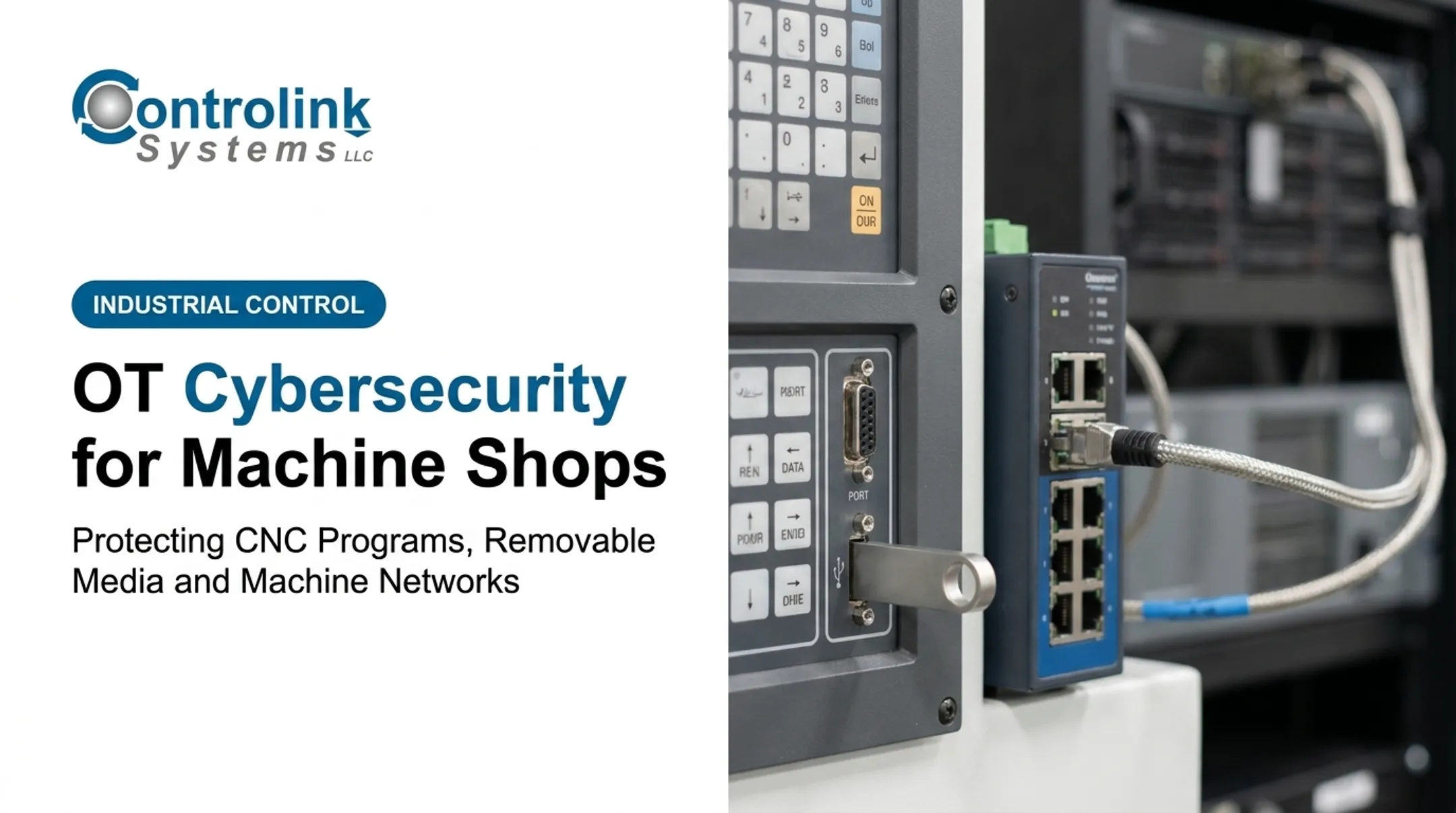
USB drives remain one of the simplest ways to introduce malicious files onto a system connected to production equipment. An infected engineering laptop plugged into a shop-floor PC can move malware straight into the delivery path.
Flat Networks and IT/OT Convergence
A compromised office workstation on the same flat network as your DNC server or shop-floor PCs gives an attacker a direct route to production systems.
CISA's 2025 OT asset inventory guidance flags the same recurring gaps across OT environments: outdated software, weak authentication, insufficient segmentation, and insecure remote access. Machine shops are not exempt from any of them.
Availability and Recovery Gaps
Ransomware doesn't need to target CNC controllers directly. It just needs to lock up the file server holding your approved programs or knock out the DNC service. Without tested backups, that outage stretches from hours into days.

Designing a Controlled Security Boundary for CNC Program Delivery
Building this boundary is a design exercise, not a single tool purchase.
Start With Asset Inventory and Data Flow
Before changing anything, document every system that creates, approves, stores, transfers, receives, modifies, or executes CNC programs. Include machine models, controller types, communication protocols, and any removable-media workflows still in use. You can't secure what you haven't mapped.
Separate Trust Zones
Create distinct zones so a breach in one area cannot freely reach the machines:
- Enterprise IT
- Engineering
- Program approval and storage
- DNC or transfer services
- Shop-floor workstations
- CNC equipment
Firewalls, VLANs, and industrial DMZs limit how far an intruder can move once they're inside one zone.
Apply Identity and Least Privilege
- Separate roles for programming, approval, release, operators, maintenance, and administration
- Avoid shared logins wherever individual accountability matters
- Restrict each account to only the access its function requires
Protect Program Integrity
Treat the program file as a controlled artifact from storage through delivery:
- Controlled repositories with revision history and approval status (no more "which file is the real one")
- Checksums or hashes, where feasible, to confirm a file hasn't changed in transit
- Malware scanning at safe inspection points, plus hard rejection of unapproved files—especially from removable media
Control Machine and Destination Authorization
Block open-ended send-anywhere delivery. Before a program reaches a machine, the process should:
- Validate the intended controller
- Confirm tooling and setup context
- Verify the revision is the currently approved one
Define Logging and Monitoring
Log every delivery event with enough detail to reconstruct what happened:
- User identity and timestamp
- Source and destination machine
- File or revision identifier
- Approval record
- Transfer result
- Any exception or override
These logs support quality investigations as much as incident response.
Secure CNC Program-Delivery Workflow
Here's what the boundary looks like as an actual sequence of steps, from engineering to spindle.
Engineering and programming. Establish naming conventions, revision control, and secure storage. Inspect files for malware before they're marked ready. Keep work-in-progress files separate from released production programs.
Approval and release gate. Someone with engineering, quality, or production authority confirms the program, revision, machine destination, and setup requirements before it's released for delivery. No release, no transfer.
Controlled transfer. The DNC or delivery system authenticates the user, verifies their authorization, validates the destination machine, and logs the transfer. This replaces uncontrolled email attachments and ad hoc USB exchanges.
Shop-floor verification. Before full production, the operator confirms program identity, revision, machine assignment, and setup documentation, running first-piece inspection where required.
Exception handling. Urgent edits, offline controllers, and emergency changes still need documented authorization, temporary access, and a post-change reconciliation with the approved repository. Skip this step and your "exception" becomes the new undocumented baseline.

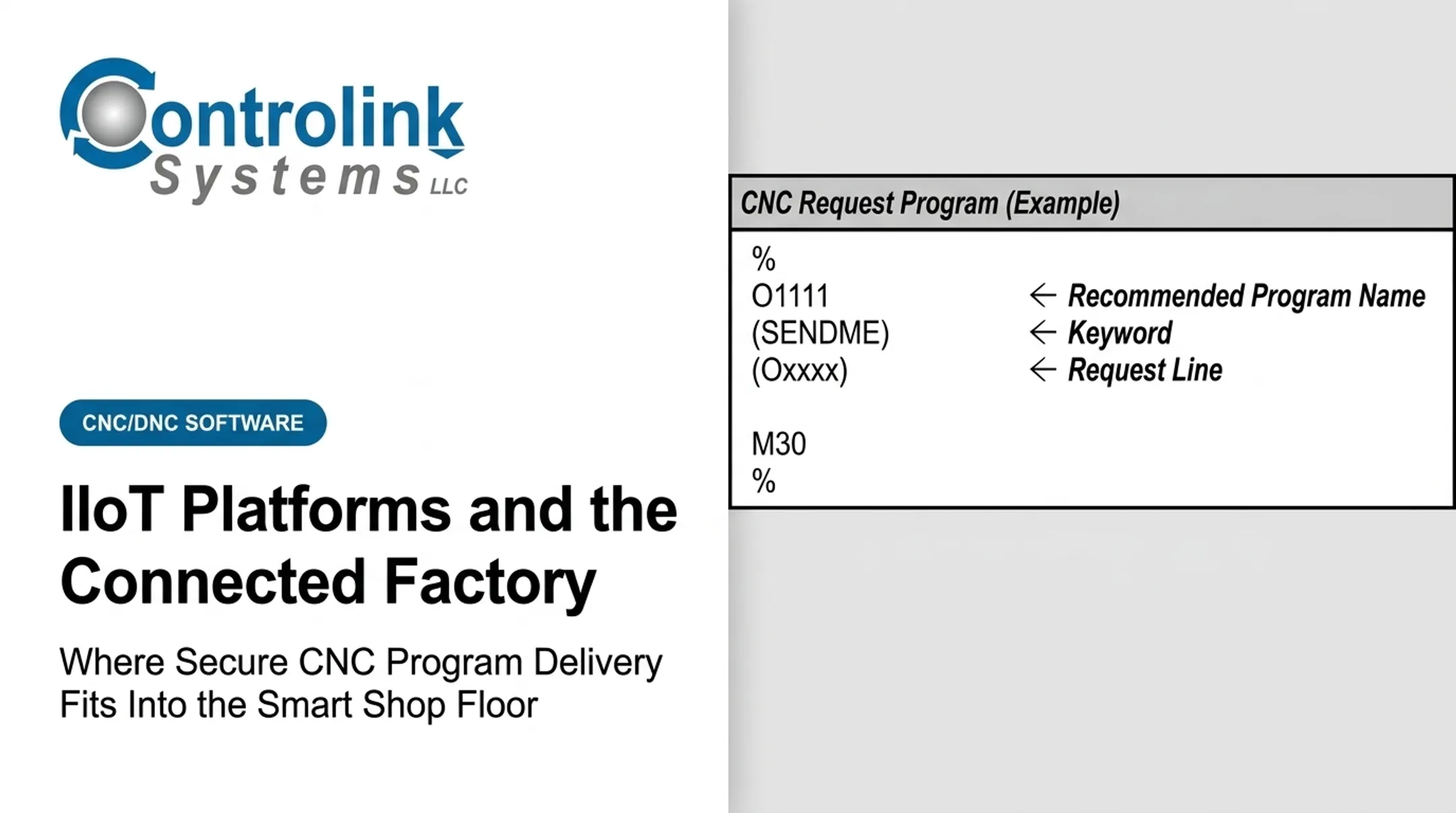
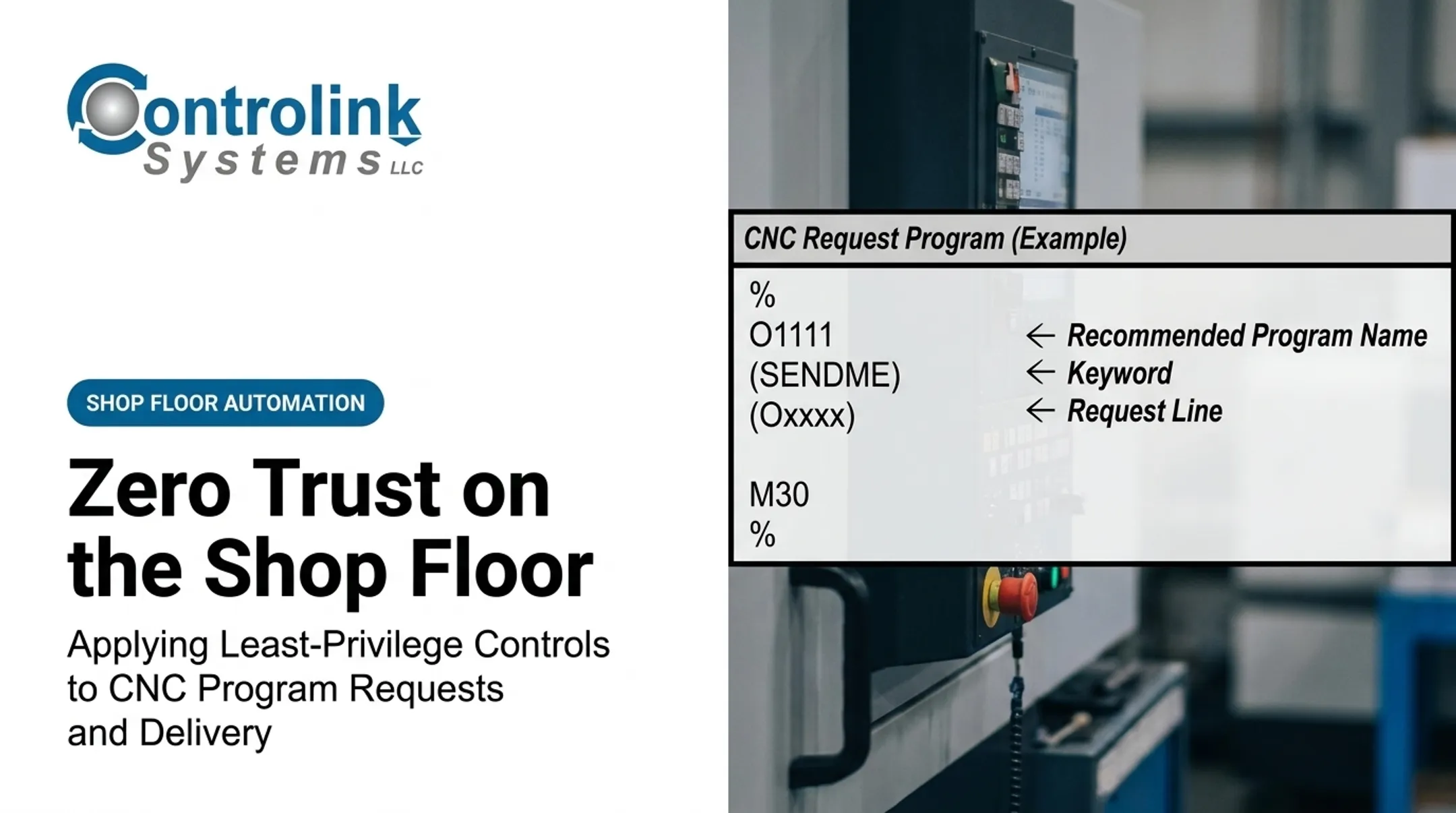
This is close to how shops using Controlink Systems' DNC software already operate in practice. Machine Link™ QUICK Serve, for instance, lets machinists request the latest engineering-approved file directly from the machine control rather than pulling a file from a local drive.
Edits made at the machine route back to engineering for review before becoming the source for the next download. That builds an approval checkpoint into the normal workflow instead of bolting one on afterward.
Machine Link™ QUICK Serve connects engineering, approved program repositories, and shop-floor systems into a more consistent delivery path. It doesn't replace your cybersecurity policy. The shop still owns the approvals, the access rules, and the accountability behind them.
Implementation Roadmap and Governance
Don't try to fix everything at once. Sequence it.
Stage 1: Inventory and stabilize
- Map the full CNC program path
- Identify your highest-consequence machines and critical files
- Remove unnecessary access immediately
- Secure and test backups
- Document current transfer methods, including any remaining removable-media use
Stage 2: Assign ownership
| Function | Typical Owner |
|---|---|
| Program approval | Engineering / Quality |
| Account management | IT / OT |
| Network segmentation | IT / OT / Cybersecurity |
| Incident escalation | Cybersecurity / Management |
| Recovery testing | IT / Production |
Stage 3: Align with recognized guidance
NIST SP 800-82 Rev. 3 (Guide to Operational Technology Security) and the ISA/IEC 62443 series provide the segmentation, least-privilege, and integrity frameworks referenced throughout this article. CISA's manufacturing-sector guidance adds sector-specific context.
Check for current editions before treating any standard as final, since these documents get revised.
Stage 4: Set review cycles
Revisit these on a fixed schedule, not just after something breaks:
- User access
- Machine inventories
- Firewall rules
- Program repositories
- Backup recoverability
- Remote access
- Incident response
Stage 5: Measure what actually matters
Track the signals that show control is holding:
- Unauthorized-transfer attempts
- Unresolved exceptions
- Stale accounts still holding access
- Backup restoration test results
- Completion rates for access or revision reviews
Skip made-up percentage targets. Measure what actually moves risk.
Frequently Asked Questions
What is ICS in security?
Industrial Control Systems (ICS) security protects the hardware, software, networks, and controls used to operate or monitor industrial processes. In a machine shop, that includes CNC controllers, DNC software, and the shop-floor systems that feed them instructions.
What is the difference between OT and IoT?
Operational Technology (OT) influences or monitors physical industrial processes, like a CNC controller executing a toolpath. The Internet of Things (IoT) connects devices for sensing, communication, or data exchange. In modern manufacturing, the two often overlap.
Is a CNC machine part of an ICS?
A CNC machine and its controller can function as part of an ICS when they control a physical production process. The exact classification depends on the surrounding architecture, including what systems feed it programs and monitor its status.
How do you securely transfer CNC programs?
Use approved repositories with revision control, role-based access, and destination validation before any file moves. Prefer controlled DNC transfer over email or USB, and add malware inspection, transfer logging, operator verification at the machine, and protected offline backups.
Why should CNC program delivery be treated as a security boundary?
Because the file crossing that boundary directly controls physical machine behavior. Protecting it means protecting integrity, authorization, traceability, availability, and your ability to recover if something goes wrong.