Introduction
Even a high-quality DAQ system will drift. Component aging, temperature swings, and electrical wear gradually push readings outside acceptable tolerance bands—often before anyone notices.
Data Acquisition (DAQ) devices convert real-world physical signals—voltage, temperature, pressure, strain—into the digital data that drives process control, quality decisions, and test validation. When those readings are off, everything downstream is compromised.
Uncalibrated DAQ hardware introduces silent measurement drift that accumulates gradually. The consequences are tangible: failed quality audits, scrapped parts, incorrect process control decisions, and costly production errors. ADCs, amplifiers, and reference circuits all degrade over time—pushing measurements outside the tolerances your process depends on.
This guide covers:
- Why calibration matters for measurement integrity
- The three main calibration types: self, external, and software/channel
- Warning signs your DAQ needs recalibration
- Step-by-step calibration procedures
- Recommended schedules based on environment and compliance requirements
Key Takeaways
- DAQ calibration corrects measurement drift caused by component aging, temperature changes, and electrical wear
- Three calibration types address different error sources: self-calibration (internal reference), external calibration (traceable standards), and channel calibration (sensor/signal chain errors)
- Watch for inconsistent readings, rising noise floors, or outputs that no longer match a known reference signal
- Calibration frequency ranges from daily self-cal before critical sessions to annual external calibration for standard environments
- NI DAQ systems handle calibration through NI-DAQmx drivers and the DAQ Assistant Channel Calibration Wizard
Why DAQ Calibration Matters
What Calibration Actually Does
Calibration adjusts a DAQ device's internal correction coefficients or applies compensation so that measured values align with known physical references—voltage standards, temperature references, or precision resistors. It's not a one-time setup; it's ongoing maintenance that accounts for the inevitable drift of electronic components.
How Electronic Components Age
Electronic components degrade over time. ADCs (Analog-to-Digital Converters), amplifiers, and reference circuits shift their characteristics due to:
- Temperature cycling during operation
- Electrical stress from continuous use
- Component aging at the molecular level
- Environmental factors like humidity and vibration
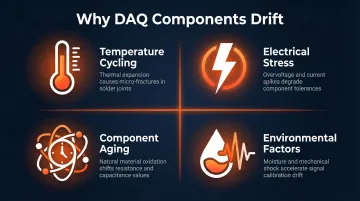
This drift accumulates silently. A DAQ device that was accurate at installation may read 0.5% high after a year—enough to pass defective parts or reject good ones.
Impact on Manufacturing Quality
An uncalibrated DAQ feeding a process control or end-of-line test system creates a cascade of problems:
- Defective parts pass inspection when measurements read optimistically
- Good parts are rejected when measurements read pessimistically
- Scrap rates increase as process control drifts out of spec
- Customer returns spike when defects escape to the field
Research shows that uncalibrated equipment leads to inaccurate results, production downtime, and costly rework, making regular calibration one of the lowest-cost quality controls available.
Regulatory and Standards Compliance
Regulated industries require traceable calibration records to satisfy audit requirements:
- ISO 9001 (Clause 7.1.5): Requires measuring equipment to be calibrated, verified, identified, and safeguarded against known references
- AS9100: Builds on ISO 9001 for aerospace—requires a documented calibration register with visual status identification on each instrument
- FDA 21 CFR 820.72: Requires documented calibration procedures with traceability to national or international standards for medical device manufacturers
- FDA 21 CFR Part 11: Governs the trustworthiness of electronic records and signatures used to document calibration activities
A failed calibration audit doesn't just trigger a finding—it can freeze production until corrective action is verified and closed.
Types of DAQ Calibration
DAQ calibration isn't a single action. Different calibration types address different sources of error across hardware, firmware, and the full signal chain.
Self-Calibration
Self-calibration (also called internal calibration) uses the device's own internal reference circuits to update correction coefficients. The DAQmx driver routes a known, temperature-protected internal reference voltage to all channels, compares readings to expected values, and adjusts coefficients stored in the device's EEPROM. The process takes seconds and requires no external equipment.
It's best used to compensate for short-term temperature drift — run it before a critical measurement session or when ambient temperature shifts by more than 1°C. Key practical notes:
- Takes seconds with no external equipment required
- Corrects for temperature-induced drift, not long-term reference degradation
- Does not produce NIST-traceable certificates — self-cal alone won't satisfy ISO or FDA compliance requirements because the internal reference voltage itself can drift over time
External Calibration
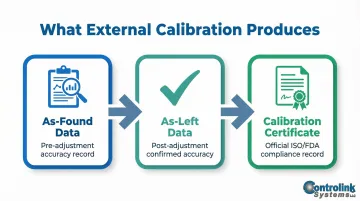
External calibration is a comprehensive metrology lab procedure where a certified technician applies precision reference signals to the DAQ's inputs and adjusts the device's calibration constants against a traceable standard (for example, a NIST-traceable voltage source). This process generates two key data sets:
- As-Found data — accuracy recorded before any adjustment
- As-Left data — accuracy confirmed after adjustment
- Calibration certificate — the official compliance record for ISO, FDA, or customer audits
The 4-to-1 calibration rule: The reference standard used should have uncertainty at least four times better than the DAQ's specified accuracy. This Test Accuracy Ratio (TAR) guideline originated from MIL-STD-45662A and ANSI/NCSL Z540-1, though modern ISO/IEC 17025 standards now emphasize comprehensive measurement uncertainty budgets.
NI DAQ hardware — supplied and supported by NI Partner Network members like Controlink Systems — supports external calibration tracking through NI-MAX (Measurement & Automation Explorer). NI-MAX displays the Calibration Date and Calibration Due Date directly in the System Settings tab.
Software/Channel Calibration
Channel (software) calibration applies a correction polynomial or scaling table on top of hardware calibration to account for sensor characteristics, cable losses, and signal conditioning errors. The NI DAQ Assistant Channel Calibration Wizard uses linear interpolation or forward polynomials to convert electrical values into accurate physical values.
Hardware calibration only corrects errors within the DAQ device itself — it can't account for what happens upstream. Any time a sensor is part of the signal chain, you need channel calibration to close the accuracy loop. This applies to thermocouples, strain gauges, accelerometers, and pressure transducers alike.
Here's how it works in practice:
- Open the NI DAQ Assistant Channel Calibration Wizard
- Enter the Reference (true) value alongside the Uncalibrated (measured) reading
- Repeat across the measurement range to build a calibration table
- NI-DAQmx stores the correction per virtual channel and applies it dynamically at the task level — the device's EEPROM remains untouched
Signs Your DAQ Device Needs Recalibration
Calibration errors rarely announce themselves. Most show up as subtle drift, odd channel readings, or measurements that just don't match expectations—until they become a real problem. Knowing the warning signs early saves you from bad data and failed tests.
Measurement Drift or Inconsistency
The symptom: Readings slowly trend away from expected values, or differ from a secondary reference meter measuring the same signal.
Typical drift magnitude: NI specifies that accuracy is valid for a specific time period following external calibration. For example, the NI USB-6218 maintains warranted accuracy for 1 year within 10°C of the last external calibration temperature. The NI 9205 maintains accuracy for 2 years within 70°C of the last calibration.
Channel-to-channel inconsistency: When multiple channels read the same physical input but report different values, internal reference drift is likely.
Increased Noise, Offset, or Gain Errors
Three error types signal that recalibration is overdue:
- Offset errors: A fixed shift across all readings, such as a 0 V input that consistently reads +5 mV, pointing to internal reference drift
- Gain errors: Readings that scale incorrectly across the input range—accurate at 1 V but 2% high at 10 V—indicating amplifier drift
- Elevated noise floor: Erratic readings or a raised baseline suggest shielding, grounding, or reference circuits have degraded
Calibration Expiration or Environmental Events
Calibration expiration: Every DAQ device has a manufacturer-specified calibration interval. Once the expiration date (visible in NI-MAX or via the CalibrationExpirationDate API) is exceeded, the device's specified accuracy is no longer guaranteed, even if readings appear normal.
Environmental triggers that mandate immediate recalibration:
- Significant temperature or humidity excursion beyond rated conditions
- Physical shock or drop
- Exposure to strong electromagnetic interference
- Repair or firmware update
Any one of these conditions is enough to invalidate your last calibration—don't wait for the scheduled interval if an environmental event has occurred.
How to Calibrate a DAQ Device
Each DAQ calibration method — self-calibration, external calibration, and channel/software calibration — serves a different purpose. The steps below walk through each procedure in sequence, from the quickest internal adjustment to a fully traceable lab workflow.
Pre-Calibration Setup
Before any calibration:
- Allow adequate warm-up time per manufacturer spec (typically 10-15 minutes)
- Stabilize the environment (temperature, humidity)
- Gather required reference standards (precision calibrators, voltage sources)
- Document the as-found state before making adjustments
Self-Calibration Procedure
Use self-calibration for routine interval checks or after the device has been moved or exposed to temperature changes. No external equipment is needed.
- Open NI-MAX and navigate to
Devices and Interfaces - Right-click the target DAQ device and select Self-Calibrate
- Alternatively, execute programmatically using the
DAQmx Self Calibrate VIin LabVIEW - Log the date and result for internal records
The device internally measures its reference and updates coefficients.
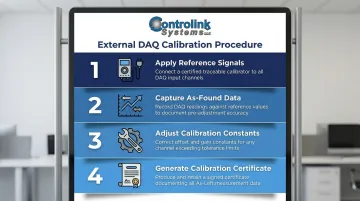
External Calibration Procedure
When compliance, audit requirements, or measurement drift demand traceable documentation, external calibration is required.
- Apply traceable reference signals from a precision calibrator (e.g., Fluke 5700A) to the DAQ's analog input channels across its full measurement range
- Compare DAQ readings to reference values to generate "As-Found" data
- If deviations exceed allowable tolerance, adjust calibration constants using NI Calibration Executive or send the device to a certified calibration lab
- Generate and retain the calibration certificate with "As-Left" data, uncertainty statements, and traceability information
Channel/Software Calibration Procedure
When the error source extends beyond the DAQ hardware itself — including the sensor and full signal chain — use the NI DAQ Assistant Channel Calibration Wizard.
- Launch the DAQ Assistant and select the Calibration tab
- Click Calibrate to launch the Channel Calibration Wizard
- Enter the "Reference" (true) value and wait for the "Uncalibrated" value to stabilize
- Click Commit Calibration Value to record the data point
- Repeat for multiple points across the measurement range to build a calibration table
- Click Enable Calibration and set an expiration date
- Optionally generate an HTML calibration report
This corrects for the entire signal chain, including the sensor.
DAQ Calibration Schedule
There is no universal interval. Calibration frequency depends on manufacturer recommendations, compliance requirements, measurement criticality, and operating environment — and getting it wrong in a regulated setting carries real consequences.
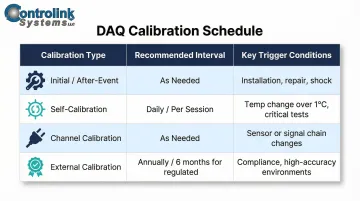
General Calibration Frequency Reference
| Calibration Type | Interval | Trigger Conditions |
|---|---|---|
| Initial / After-Event | As needed | Installation, firmware or hardware repair, physical shock, or environmental excursion beyond rated limits |
| Self-Calibration | Daily or per session | Temperature change >1°C; before any critical test or high-precision continuous monitoring session |
| Software / Channel Calibration | As needed | Sensor replacement, cable swap, or any change to signal conditioning hardware in the signal chain |
| External Calibration | Annually (standard environments) | Calendar-based; shorten to 6 months or quarterly for high-accuracy, safety-critical, or regulated applications (NI DAQ hardware default: 1 year) |
High-Duty-Cycle and Harsh-Environment Adjustments
Shorten external calibration intervals when:
- Continuous vibration is present — machining floors and test stands accelerate mechanical wear
- Operating temperatures drift more than ±10°C from the original calibration temperature
- The device runs 24/7 in manufacturing process monitoring roles
- Industry regulations (aerospace, medical devices, automotive) mandate quarterly or semi-annual intervals
ISO/IEC 17025 and ILAC G24 guidance states that calibration intervals should be determined dynamically based on measurement uncertainty requirements, risk of exceeding maximum permissible errors, equipment wear, and environmental conditions.
Document all calibration events in a log to support audit trails and compliance reviews.
Conclusion
DAQ calibration is not optional maintenance—it is the mechanism that keeps every measurement, test decision, and process control action grounded in physical reality. Without it, measurement drift accumulates undetected, leading to defective product escapes, failed audits, and costly rework.
A structured approach combining all three calibration layers protects both data integrity and compliance standing:
- Self-calibration compensates for short-term temperature drift between scheduled intervals
- External calibration provides traceable verification against national standards
- Channel calibration corrects for sensor and signal conditioning errors that hardware calibration cannot address
Controlink Systems, as an NI Partner Network member since 2000, helps manufacturing and research teams select, deploy, and maintain NI DAQ systems with calibration workflows built in from day one. Contact Controlink at (800) 838-3479 or support@controlinksystems.com to discuss your DAQ calibration needs.
Frequently Asked Questions
What is the 4 to 1 calibration rule?
The 4-to-1 rule (also called the Test Accuracy Ratio or TUR) requires the calibration standard's uncertainty to be at least four times smaller than the tolerance of the device under calibration. This ensures the standard's own error does not meaningfully inflate the calibration uncertainty, though modern standards like ISO/IEC 17025 now focus on comprehensive uncertainty budgets rather than rigid ratios.
What are the 5 requirements for calibration standard?
A valid calibration standard must satisfy five criteria:
- Traceability to a national or international measurement standard, such as NIST
- Documented measurement uncertainty at each step of the traceability chain
- Stability over time with planned maintenance and periodic verification
- Adequate resolution and accuracy for the device being calibrated
- A valid calibration certificate from an ISO 17025 accredited laboratory
What is the difference between self-calibration and external calibration for DAQ devices?
Self-calibration uses the device's own internal reference to update correction coefficients quickly without external equipment, compensating for short-term drift. External calibration uses traceable precision reference sources applied by a certified technician to verify and adjust the device against an independent standard—only external calibration produces a traceable certificate required for compliance.
How often should a DAQ device be calibrated?
Most manufacturers recommend annual external calibration for standard environments, with self-calibration performed before critical sessions. Regulated industries (aerospace, medical, automotive) may require 6-month or quarterly intervals. Any significant environmental event—shock, temperature excursion, or repair—should trigger an unscheduled calibration.
What happens if a DAQ device is not calibrated regularly?
Measurement drift accumulates silently, producing inaccurate data, failed quality audits, increased scrap, and potential ISO non-compliance—all without any error messages from the device. The hardware keeps reporting values; those values just no longer reflect physical reality.
What is channel calibration and when is it needed?
Channel calibration applies a correction table to a virtual channel to compensate for sensor, cable, and signal conditioning errors that hardware calibration cannot address. It is needed whenever a sensor is part of the measurement chain, because hardware calibration only corrects the DAQ module's internal circuitry.