
Introduction
A machinist grabs a program off a shared network drive. It looks right. But is it the version engineering approved last week, or the one an operator tweaked three shifts ago?
That question sits at the center of CMMC traceability. For CNC shops working defense contracts, traceability means proving who touched a controlled file, what changed, when it moved, and which version actually ran on the machine.
U.S. machine shops, aerospace and defense suppliers, manufacturing engineers, quality teams, and IT/OT leaders handling Federal Contract Information (FCI) or Controlled Unclassified Information (CUI) face that risk every shift. A weak program trail creates both a cybersecurity gap and a production problem.
This article walks through what traceability actually requires, why defense manufacturing depends on it, and how to build an evidence trail from engineering release through machine use and retained records.
Key Takeaways
- CMMC traceability is a defensible, auditable chain of program custody—not a backup folder.
- CNC programs, setup sheets, and inspection data fall into CMMC scope when they touch FCI or CUI.
- An auditable program trail requires controlled release, role-based access, secure transfer, and machine-level accountability.
- CNC/DNC software can support the workflow; your organization still owns the compliance outcome.
What CMMC Traceability Means for CNC Manufacturers
People often confuse three separate things: CMMC compliance, general cybersecurity audit evidence, and manufacturing traceability. They overlap, but they're not the same.
CMMC focuses on protecting information systems. Manufacturing traceability focuses on reconstructing how a specific part got made. A CNC program trail sits at the intersection of both.
Why CNC Programs Carry Compliance Weight
A CNC program isn't just G-code. It can encode dimensions, tolerances, tooling instructions, and material callouts pulled straight from a defense drawing or specification. If that source data is CUI, the program derived from it likely inherits that status.
The Evidence Chain You Should Be Able to Reconstruct
A defensible trail connects these points:
- Source revision - which drawing or model version fed the program
- CAM/post-processing activity - who generated the toolpath and when
- Approval - who reviewed and released it
- Transfer event - how it reached the shop floor
- Machine and operator - who ran it, and where
- Resulting record - the inspection or production data tied back to that run
CMMC organizes this protection into three levels, per the CMMC Model Overview from the DoD CIO:
- Level 1 — FCI; 15 safeguarding requirements from FAR 52.204-21
- Level 2 — CUI; 110 requirements from NIST SP 800-171 Rev. 2
- Level 3 — adds 24 advanced requirements from NIST SP 800-172
The control families that usually matter for a CNC program trail are access control, identification and authentication, audit and accountability, configuration management, and system and communications protection. Confirm exact control language against current official sources before you map it to your environment.
CMMC does not mandate a specific CNC or DNC product. You choose the tools. The assessor cares whether your controls work inside your defined scope.
Why an Auditable CNC Program Trail Is Used in Defense Manufacturing
Uncontrolled file copies create two kinds of risk at once. An operator might run an outdated revision without realizing it. Or an unauthorized edit slips onto a machine through a USB stick nobody logged. Both scenarios produce scrap, rework, or worse: a nonconforming part that ships.
What This Solves on the Shop Floor
Traceability isn't only a security requirement. It's a production discipline that:
- Reduces scrap by confirming machinists run the engineering-approved file
- Cuts rework tied to revision mix-ups
- Keeps multiple machines and shifts on the same version
- Creates a record you can hand a customer after a nonconformance
What Assessors and Customers Actually Need
When a defense customer or C3PAO assessor asks questions, they generally want proof of four things:
- Who was authorized to touch the data
- Whether changes went through approval
- Whether transfers were protected in transit
- Whether you can produce records after the fact Not every CNC shop needs Level 2. Your obligation depends on the contract, the information type, and your defined system boundary. A shop handling only FCI faces different requirements than one processing CUI. Check your actual contract language before assuming which level applies. DFARS 252.204-7012 also requires rapid incident reporting (within 72 hours of discovery) plus preservation of affected system images for at least 90 days, according to the current DFARS 252.204-7012 clause on Acquisition.gov. That preservation window is why program-level logging matters: you may need to reconstruct events well after they happened. Confirm current clause status and rollout timing through official DoD and acquisition sources. Implementation dates and phase transitions have shifted before, so treat primary government sources—not secondary articles—as your compliance reference.

How to Build an Auditable CNC Program Trail
Building this trail is less about buying a tool and more about mapping a process, then finding tools that support it.
Step 1: Map Where the Data Lives
Identify every system that creates, stores, transmits, or deletes drawings, CAM data, CNC programs, setup sheets, and inspection results. Flag which of those systems touch FCI or CUI. You can't protect what you haven't found.
Step 2: Establish a Single Source of Truth
Define naming conventions, revision identifiers, and approval states for released programs. Decide how superseded files get quarantined instead of just sitting in a folder next to the current version. Ambiguity here is where most trails break down.
Step 3: Document the Approval Workflow
Engineering, manufacturing engineering, quality, and production each play a role. Require evidence of review before a program becomes available for machine use, and preserve that approval decision alongside the revision it applies to.
Step 4: Control the Transfer to the Shop Floor
Compare approved transfer methods against risky shortcuts:
| Transfer Method | Traceability Risk |
|---|---|
| Managed DNC/network transfer | Low — logged, timestamped, tied to a user |
| Removable media | High — hard to audit, easy to lose track of |
| Email attachment | High — bypasses release control entirely |
| Unmanaged file share | Moderate to high — no access accountability |
Step 5: Capture Machine-Use and Change Evidence
Where it's technically and operationally realistic, log machine identity, workstation, user identity, transfer result, and any local edits or offset changes. Link that record to inspection or nonconformance data.
One caution: don't promise logs your system can't actually produce. Legacy controllers and offline machines often can't generate the same evidence as networked equipment, and an assessor will notice the gap faster than you'd like.
Step 6: Retain and Review the Evidence
Assign someone to review logs on a schedule, define how anomalies get investigated, and confirm backups are actually protected, not just copied.
The CMMC Assessment Guide for Level 2 points to a specific expectation here: individual users must be uniquely and traceably tied to their actions. Shared logins undermine this at the root.

CNC Program Lifecycle Example
Here's a hypothetical walkthrough (not an actual customer engagement) showing how the pieces connect:
- Engineering releases Revision C of a part program tied to an approved drawing revision.
- Quality reviews and signs off before the file moves into the released-program library.
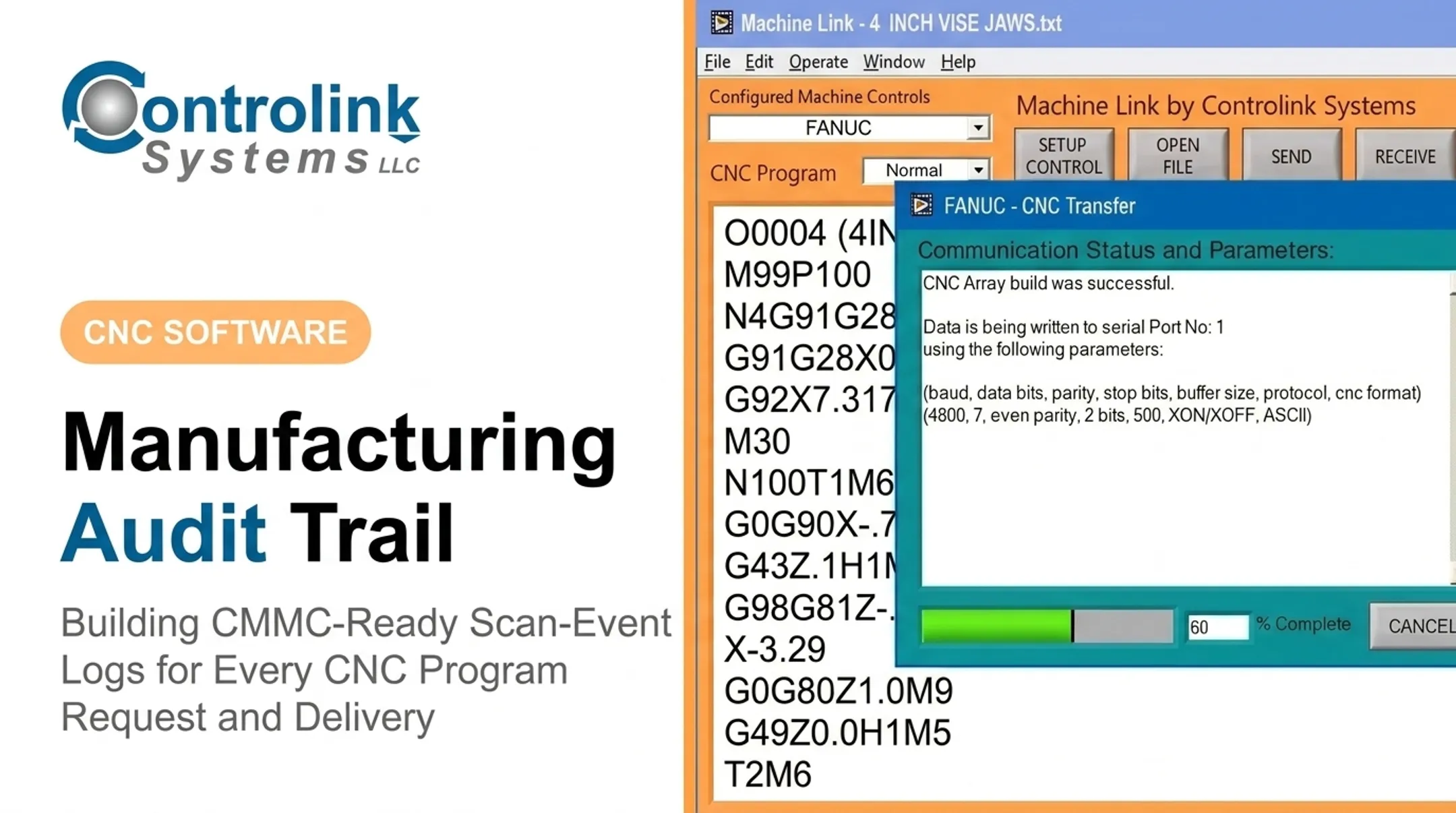
- A DNC transfer sends Revision C to Machine 4, logging the timestamp, operator ID, and file checksum.
- The operator runs the program; any local offset adjustment gets recorded separately from the program file itself.
- First-piece inspection results get logged and linked back to Revision C and Machine 4.
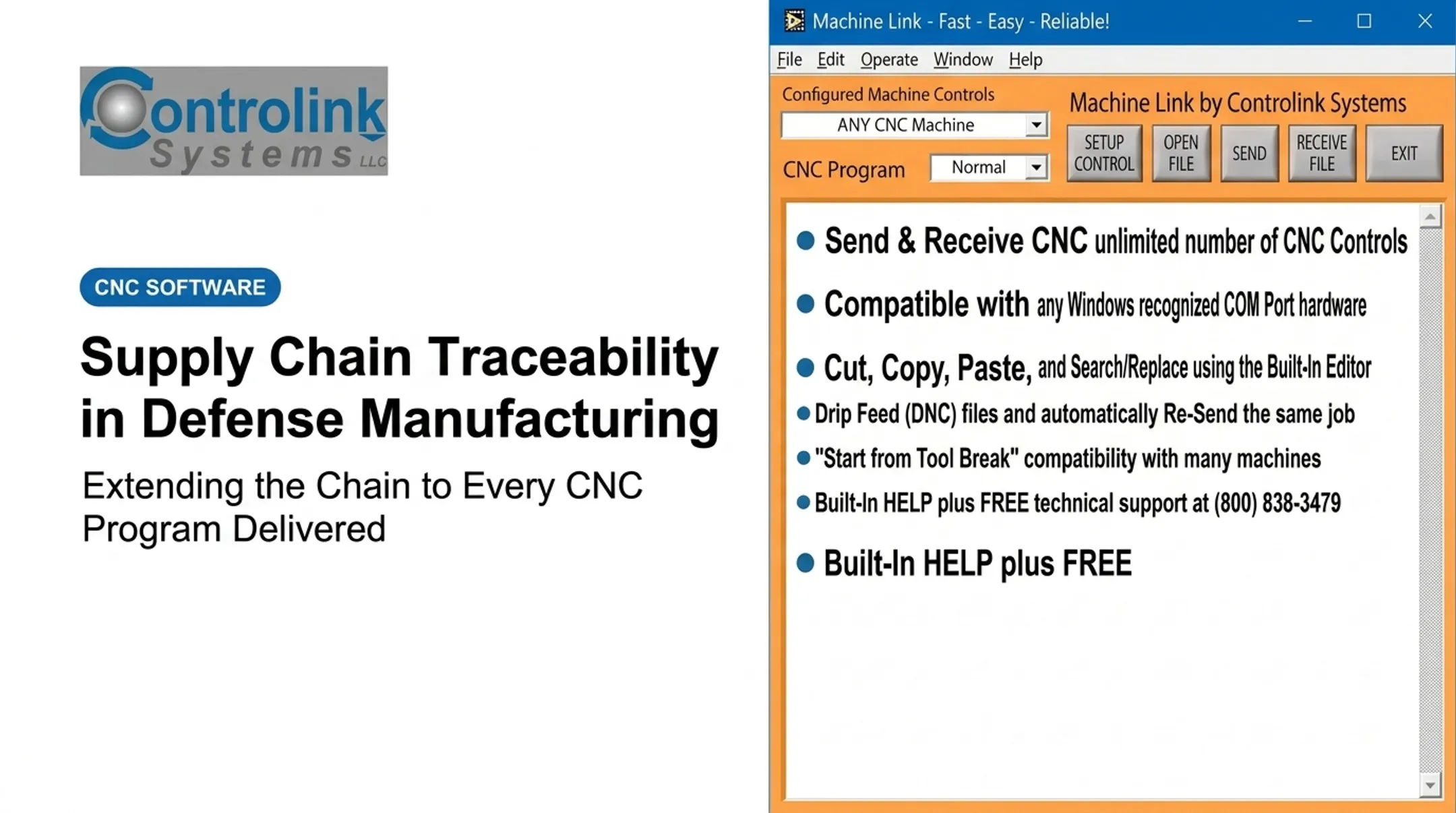
This is the kind of workflow Controlink Systems LLC's Machine Link™ QUICK Serve was built to support. Engineering keeps control over which file reaches which machine, and edits made at the machine get routed back for review rather than silently overwriting the approved version. It's one option worth evaluating if you're mapping out this kind of integration, not a compliance shortcut.
Software support for file control and logging does not replace CMMC governance. Asset inventory, access reviews, incident response, employee training, and your assessment boundary remain your organization's responsibility.
Where Traceability Applies and What Controls Affect It
Traceability touches more systems than most people initially assume:
- Engineering and CAD/CAM workstations
- Post-processors and file servers
- MES, ERP, and QMS platforms
- DNC servers and machine controllers
- Inspection equipment and operator terminals
- Backups, cloud services, and remote-access connections
Evidence Points Across the Lifecycle
Evidence typically needs to exist at each stage of the program lifecycle:
- Creation and engineering approval
- Revision or change
- Release and transfer
- Machine execution
- Inspection and deviation
- Archival and retirement
Miss one of these and you have a gap an assessor can walk right into.
Operational Realities That Complicate This
Real shops are messy environments. You're likely dealing with:
- Legacy controllers that can't log activity the way newer machines do
- Mixed fleets across multiple control brands
- Shared operator accounts (a common but risky shortcut)
- Manual USB transfers for offline equipment
- Intermittent network connectivity on the shop floor
A Simple Evidence-Planning Framework
Map each record to a system of record, owner, and retention rule:
| Record/Event | System of Record | Responsible Owner | Retention Period |
|---|---|---|---|
| Program approval | Engineering release log | Manufacturing engineering | Per contract requirement |
| File transfer | DNC transfer log | IT/quality | Per contract requirement |
| Machine execution | Machine/workstation log | Production supervisor | Per contract requirement |
| Inspection result | QMS record | Quality | Per contract requirement |
Don't insert arbitrary retention numbers without checking current requirements. NARA has noted that CUI status alone doesn't create a special retention timeframe, so your specific retention obligations come from your contract and applicable regulation, not a generic rule of thumb.
Those systems of record often include vendors and cloud services, so treat them as part of the same evidence plan. If an external service stores, processes, or transmits CUI, review its security documentation against applicable DoD cloud requirements. Encryption and audit logging alone don't automatically make a commercial platform suitable — check the actual authorization level.
Common Issues, Misconceptions, and When a CNC Workflow Is Not Enough
The most common mistake: assuming a shared folder with "the latest file" counts as traceability. It doesn't. A shared folder shows you a file. It doesn't show you provenance, approval history, or who accessed it.
Where Program Trails Typically Break
- Generic shared logins that make individual accountability impossible
- Local machine copies that drift from the released version
- Uncontrolled edits made at the controller with no review loop
- Email attachments that bypass release workflows entirely
- Inconsistent revision labels across departments
- Backups that were never actually tested for restore
When a CNC/DNC System Alone Falls Short
A file-transfer tool solves file movement. It doesn't solve everything else CMMC touches:
- CUI identification and marking
- Least-privilege access enforcement
- Endpoint protection and patching
- Incident response planning
- Personnel training
- Physical safeguards and vendor governance
Situations Needing an Additional Control Path
Some scenarios need a documented exception, not a workaround:
- An offline legacy controller that can't participate in network logging
- A supplier receiving only limited technical data
- A machine that moved onto a different network segment
- A process requiring a controlled manual transfer step
Don't claim certification based on deploying software. Build a documented shared-responsibility breakdown showing exactly what your organization owns, what the software provider owns, and what any hosting provider owns. That document tends to matter more in an actual assessment than any single tool's feature list.
Conclusion
An auditable CNC program trail ties approved technical data to controlled machine execution and retained evidence. Get that right, and you protect sensitive information while keeping production consistent.
Build that trail with deliberate controls:
- Map the information flow
- Define your system boundary
- Control revisions and access
- Secure your transfers
- Review evidence on a recurring basis
A tool without governance behind it won't hold up under scrutiny.
If you're evaluating how CNC/DNC communications or shop-floor automation could fit into that workflow, Controlink Systems LLC has been building these integrations since 1998, connecting engineering systems, databases, machines, and operators.
That's a technology conversation, not a compliance certification. Your CMMC assessment boundary and governance decisions remain yours to own.
Frequently Asked Questions
What are the compliance requirements for CMMC?
Requirements depend on your contract, whether you handle FCI or CUI, your required CMMC level, and your defined system scope. Map those factors first, then confirm details against current DoD, FAR, and DFARS sources.
Is DLP required for CMMC?
CMMC does not mandate a product labeled "data loss prevention." It does require practices that protect, control, and monitor FCI or CUI in transit. DLP is one way to meet that risk.
What are the 110 controls required for CMMC 2.0 Level 2?
Level 2 aligns with the 110 security requirements in NIST SP 800-171 Rev. 2, organized across 14 domains including access control, audit and accountability, and configuration management. Those domains are the baseline assessors use for Level 2 evidence reviews.
Which DFARS clause requires CMMC?
DFARS 252.204-7021 is the current contract clause addressing CMMC level compliance. Verify current contract language directly, since clause versions and effective dates have changed over time.
How does CMMC apply to CNC machine shops?
A shop falls into scope when its systems process, store, or transmit FCI or CUI — including drawings, CNC programs, or customer submissions. Scope depends entirely on your specific contract and defined environment.
What evidence should manufacturers keep for CMMC traceability?
Keep asset and data-flow records, access approvals, CNC program revision history, and transfer logs. Add configuration changes, incident records, and backup validation evidence. Retention still follows your scope and contract.