
Introduction
Walk into most CNC shops and you'll find the same problem hiding in plain sight. Engineering files live in three or four places at once. Operators grab whatever program looks right from a USB drive or shared folder. Supervisors find out which revision actually ran on a machine only after a part fails inspection.
Industry 4.0 doesn't fix that chaos by simply connecting machines to the internet. It works when data, software, equipment, and people run inside one controlled production workflow.
The National Institute of Standards and Technology defines Industry 4.0 as automating manufacturing through robotics, IoT, big-data analytics, and connected systems—not just adding sensors to old equipment.
Connected CNC program delivery is the foundation: it gives manufacturers the traceability, version control, and machine-level data that make MES-based smart manufacturing possible.
Key Takeaways
- MES links production planning and engineering data to real-time CNC execution on the floor
- Connected program delivery puts the correct, approved file on the right machine for every job
- Program history, machine feedback, and quality records form a complete digital thread
- Start with one CNC/DNC use case, then expand toward broader Industry 4.0 goals
How MES Fits Into Industry 4.0 Manufacturing
Industry 4.0 in manufacturing means coordinating equipment, software, processes, and people through shared, real-time data. It is an operating philosophy backed by connected systems, not a standalone product.
A Manufacturing Execution System sits between your business planning tools and the actual machines making parts. MES turns work orders, routings, and quality requirements into controlled production activity. Think of it as the translator between "what should happen" and "what is happening right now."
Why Raw Machine Data Isn't Enough
A spindle load reading or cycle-time number means little on its own. That data only becomes useful when tied to context:
- Work order and part number
- Program revision
- Operator and machine ID
- Tool and material lot
- Quality status
Without that context, you're collecting numbers, not intelligence.
The System Stack, From ERP to Machine Control
Each layer of the manufacturing stack has a distinct job:
| System | Primary Responsibility |
|---|---|
| ERP | Business planning, orders, scheduling |
| Engineering/PDM | Authoritative source for approved part programs and revisions |
| MES | Executes orders, tracks production, manages quality data |
| DNC/CNC Communications | Delivers approved programs to machine controls |
| PLCs & Machine Controls | Physical execution and real-time feedback |
Engineering, not the shop floor, should remain the single source of truth for CNC program revisions. Everything downstream references that authority.
MES supports several Industry 4.0 capabilities directly:
- Real-time visibility into job status
- Electronic work instructions
- Quality tracking tied to each order
- Event-driven workflows that act when something goes wrong—no waiting for someone to notice
Deloitte's 2025 survey of 600 manufacturing executives found that 46% were already using industrial IoT in smart manufacturing efforts. Connected shop-floor data collection is becoming standard practice, not an early-adopter experiment.
How Connected CNC Program Delivery Creates a Smart Shop-Floor Foundation
Basic DNC file transfer moves a file from Point A to Point B. That's it. Connected CNC program delivery governs the entire lifecycle, including approval, revision control, machine routing, delivery confirmation, and the production context surrounding that program.
Modern Machine Shop describes DNC as the network that lets operators download part programs and digital files directly to machine controls. But that same connection can capture far more: operator ID, job number, cycle time, scrap counts, and downtime reasons.
The Program Lifecycle, End to End
Here's what a controlled workflow actually looks like:
- Engineering creates or revises a CNC program and routes it for approval
- The system associates the approved revision with the part, operation, work order, and compatible machine
- The operator retrieves the authorized program at the machine, with access controlled by role
- The system records delivery, confirmation, machine use, and any exceptions

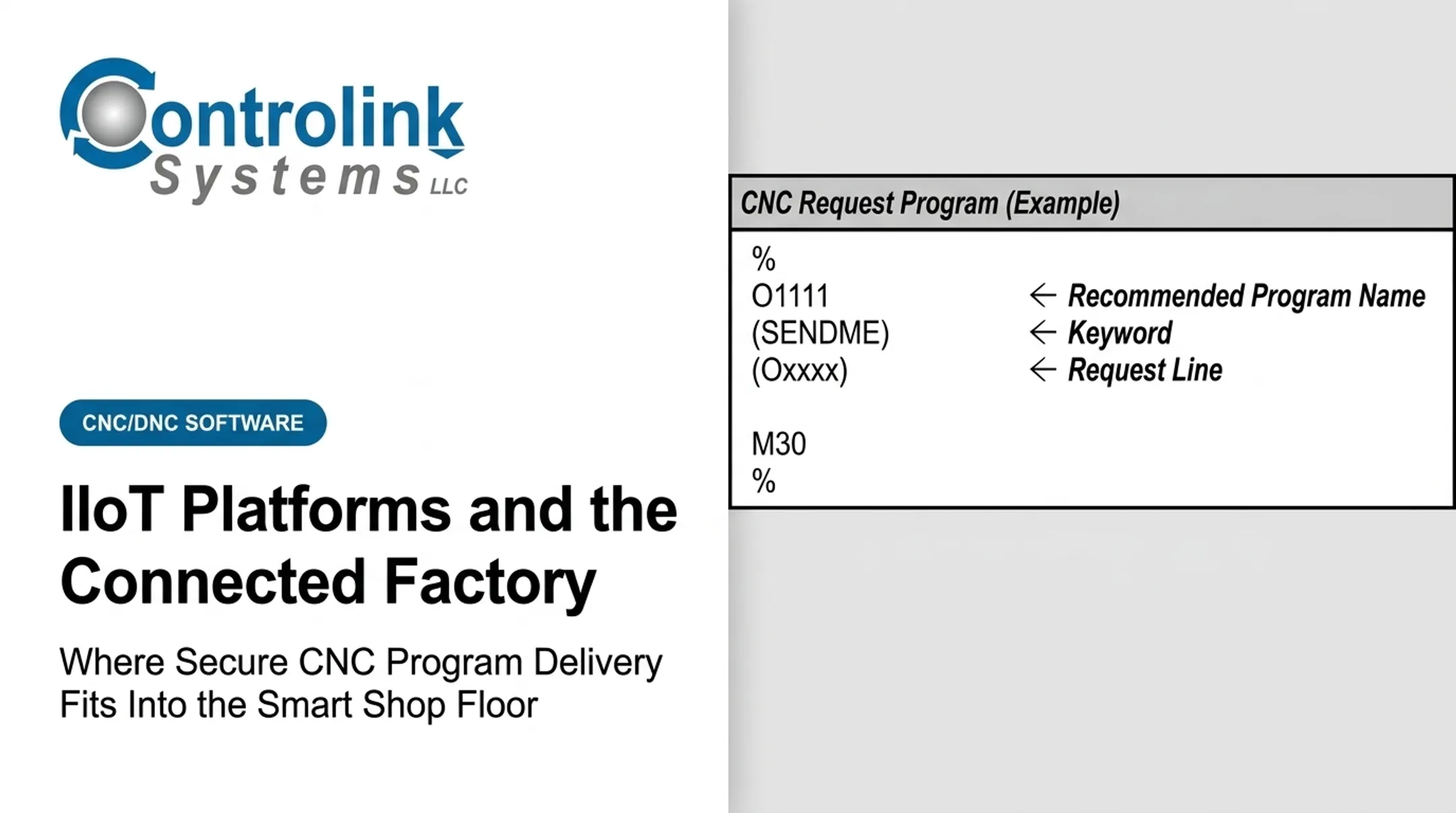
Controlink's Machine Link™ QUICK Serve puts that lifecycle into practice instead of relying on a plain file share. It continuously monitors each CNC machine for file requests and serves the correct engineering-approved program directly to the control. Operators trigger the request using keywords embedded in a CNC Program Request file. No manual PC interaction is required.
Why Version Control Actually Matters
Operators pulling files from local folders, USB drives, or personal libraries create risk you can't see until it's too late. Modern Machine Shop notes that missing or weak program header information can cause confusion, wasted time, and scrap parts. Program headers help operators confirm they have the right version before hitting cycle start.
Compatibility matters too. A correct revision on the wrong post-processor, or missing offset and workholding verification, still produces bad parts. Connected delivery systems should confirm machine compatibility before a program ever reaches the control.
A Practical Comparison
Ametek's original DNC process required operators to make several trips between the machine and computer just to send one program. Corrected programs often weren't sent back and saved, so the same fix got repeated on future jobs.
After deploying QUICK Serve DNC, operators retrieved programs at the machine without leaving it. Corrected copies were routed to an Engineering folder for review before entering the program library.
That's the digital thread in action: part revision → approved program → machine and operation → operator confirmation → production result → quality record. Each link stays traceable instead of disappearing into someone's desktop folder.
Business and Shop-Floor Benefits of Connecting CNC Programs to MES
Controlled program delivery reduces scrap risk by making sure machinists run the latest engineering-approved file every time. Program control doesn't replace simulation, first-piece inspection, or operator judgment. It removes one specific, entirely avoidable failure mode: running the wrong revision.
That same connected delivery layer also gives supervisors real-time visibility paper logs never could:
- Current program status on every connected machine
- Work-order progress without a floor walk
- Exception alerts the moment something goes wrong
- Machine activity across multiple lines from one screen
Traceability Solves Compliance Headaches
When a quality issue surfaces weeks after a part shipped, you need answers fast. Which revision ran? On which machine? Under what conditions? A connected system answers those questions in minutes instead of days spent digging through paper travelers.
NIST's closed-loop CNC pilot with Boeing 737 leading-edge panel production makes the payoff concrete. The pilot automated 90% of one manual step in the scrap-reorder process after the CNC detected scrap and triggered an automatic reorder in the ERP system. That's one documented result for one manual step, not a universal benchmark, but it shows what's possible when CNC execution data flows into enterprise systems automatically.

Metrics Worth Tracking After Implementation
Once you connect CNC delivery to broader systems, track these:
- Incorrect-program incidents per month
- Scrap attributed to program revision errors
- Time spent locating or transferring files
- Program-related downtime hours
- First-pass yield by machine or product family
- Time required to retrieve records during an audit
Standardized digital workflows also support faster changeovers and more consistent operator execution—the guesswork of "which file do I use" is gone.
Building a Practical Connected CNC and MES Foundation
Don't attempt a plant-wide transformation on day one. Start with one high-value process, one machine group, or one recurring program-control problem you already know is costing you time or scrap.
Set Governance Before You Deploy Anything
Before connecting a single machine, define:
- Program ownership and approval states
- Revision naming conventions
- Machine compatibility rules
- User permissions and retention policies
- Rollback and change-notification procedures
Skipping this step is how connected systems end up just as messy as the file shares they replaced.
Map Your Integrations
Identify every system that needs to exchange data with the others:
- Engineering and ERP
- MES and DNC communications
- CNC controls, PLCs, and databases
- Quality tools
Controlink routinely interfaces with SQL databases, PLC hardware, and motion controllers over CAN, Modbus, Serial, Profinet, and EtherCAT. That protocol range covers most mixed-equipment shop floors.
Don't Ignore Legacy Equipment
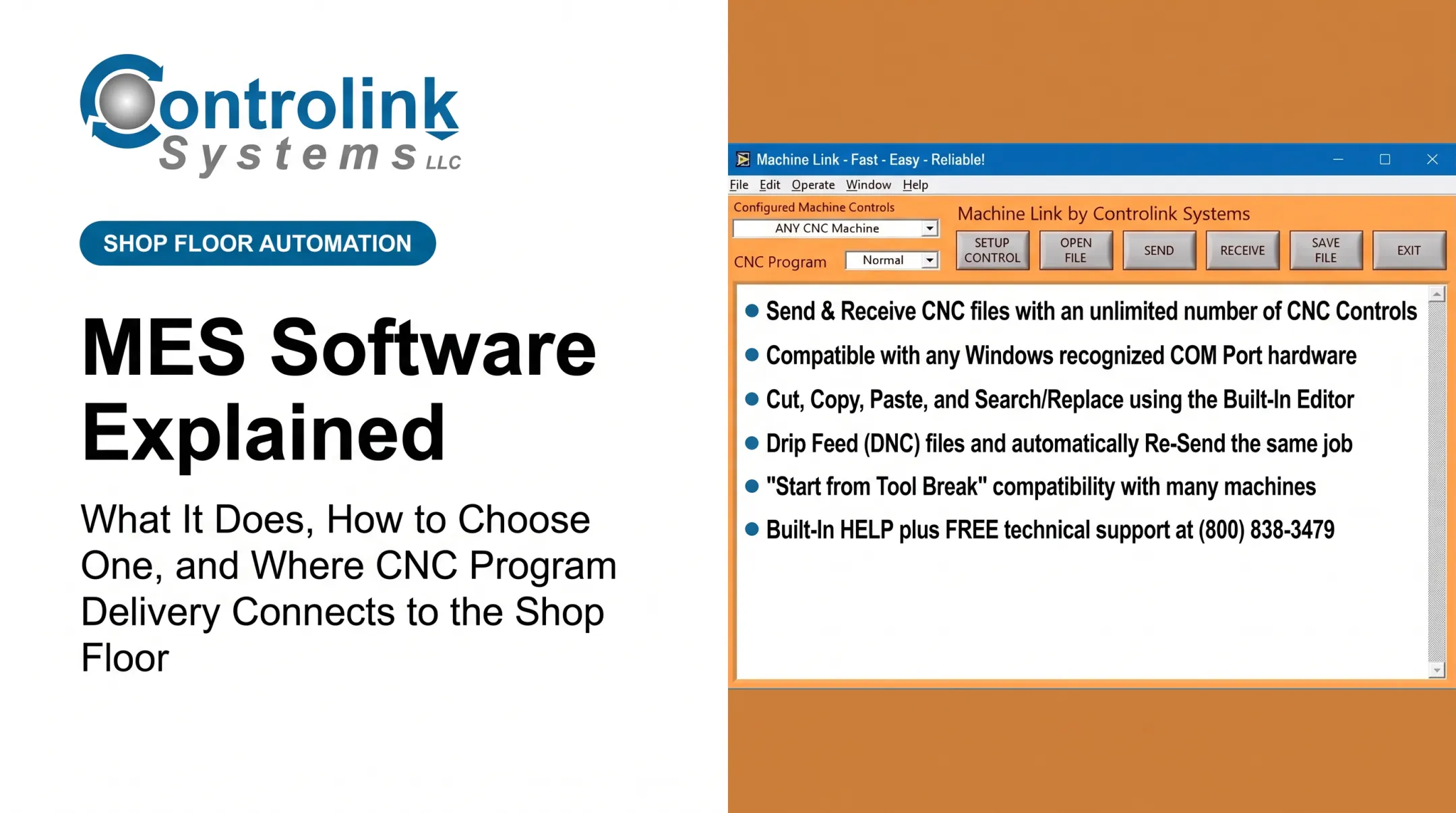
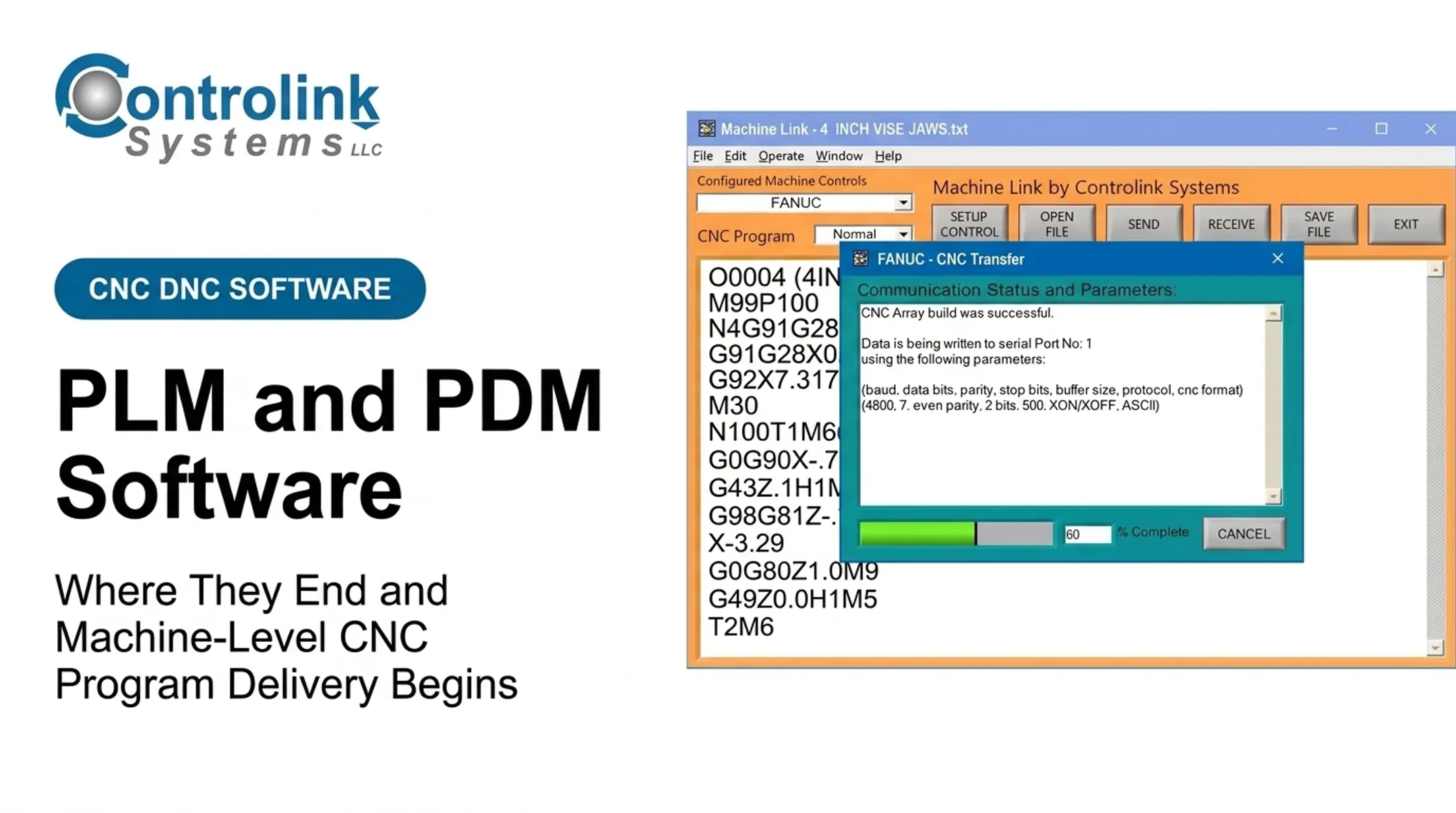
Older CNC controls without native networking can still join a connected workflow. Machine Link™ sends and receives programs over standard RS-232 serial communications, meaning shops don't need to replace working machines just to gain connectivity. Wireless hardware bridges serial and Ethernet systems where running new cable isn't practical.
Build for Operators, Not Just Engineers
Operators need clear machine-level interfaces, visible program identity and revision numbers, and a simple way to flag mismatches. If the interface adds friction, adoption stalls no matter how good the backend is.
Security and Reliability Can't Be an Afterthought
NIST's Guide to Operational Technology Security recommends role-based access, network segmentation between OT and enterprise systems, and audit logs for exactly this kind of connected environment. Build in backup and recovery procedures, and make sure machines fail safely if the network drops mid-job.
A Phased Rollout That Actually Works
- Baseline current program-management problems and metrics
- Pilot controlled delivery on selected equipment
- Validate operator adoption and exception handling
- Expand to additional machines and broader MES functions

Controlink has built CNC/DNC communications, process monitoring, and shop-floor automation links since 1998 for manufacturers including Timken and 3M. If you're evaluating where to start, a focused CNC/DNC pilot on one machine group is a low-risk entry point into a broader Industry 4.0 strategy.
Frequently Asked Questions
What is a Manufacturing Execution System (MES)?
An MES is the software layer that manages and records production execution between planning systems and the shop floor. It connects directly to CNC program delivery by confirming the right revision reaches the right machine for each work order.
How is MES different from SCADA?
SCADA primarily monitors and controls industrial equipment and processes in real time. MES manages broader production execution, including work orders, quality, materials, and genealogy. The two systems commonly integrate rather than compete.
What are the main applications of Industry 4.0 in manufacturing today?
Common applications include connected equipment, IIoT data collection, MES, predictive maintenance, quality analytics, and digital work instructions. Connected CNC program delivery is a practical, immediately usable example of this in machining environments.
What is Industry 4.0 in manufacturing?
Industry 4.0 refers to integrating digital technologies, connected machines, software, and data to create more visible, responsive, and coordinated manufacturing operations. It's an operating approach, not a single piece of equipment.
How does an MES improve CNC program management?
MES adds approval workflows, revision control, and machine-specific delivery to what used to be a manual file-transfer process. It also links the executed program to operator confirmation, production results, and quality records.
Can manufacturers connect legacy CNC machines to an MES?
Yes. Legacy equipment can connect through gateways, edge devices, or DNC communications like RS-232 serial links, depending on controller compatibility. Network and cybersecurity requirements should be assessed project by project.