Introduction
Today's factory floor would be almost unrecognizable to someone who worked in manufacturing just a generation ago. Robots assemble components without human hands, machines communicate in real time, and software predicts failures before they happen—and the pace of change is accelerating.
Manufacturers are navigating pressure from every direction:
- A widening skilled labor shortage with no near-term fix
- Reshoring demands that require faster, leaner domestic production
- Rising quality expectations from customers in automotive, aerospace, and medical sectors
- Global competitors already running automated plants at lower cost
According to a joint study by Deloitte and The Manufacturing Institute, the U.S. manufacturing industry could face a shortfall of 1.9 million workers by 2033. For many shops, automation has shifted from competitive advantage to survival strategy.
This article explores what's driving this shift, the technologies behind it, what it means for operations, and how manufacturers—from large plants to CNC machine shops—can navigate the transition.
Key Takeaways
- Automation evolved from mechanization to AI-driven smart manufacturing across four industrial revolutions
- AI, collaborative robots, and IoT sensors make factories faster, more precise, and far easier to reconfigure
- Predictive maintenance, automated quality control, and flexible production scheduling drive the biggest uptime and throughput gains
- Shop-floor connectivity (CNC/DNC communications, PLC integration) is the critical but often overlooked foundation
- Costs, cybersecurity risks, and workforce upskilling are real hurdles, but each has practical, proven solutions
From Assembly Lines to Smart Factories: The Evolution of Manufacturing Automation
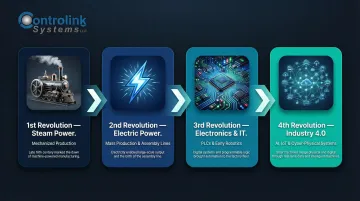
Manufacturing has gone through four distinct industrial revolutions, each fundamentally changing how goods are made:
- First Revolution — Steam power replaced manual labor, mechanizing production for the first time
- Second Revolution — Electric power enabled mass production; Ford's assembly line standardized output and reshaped manufacturing economics
- Third Revolution — Electronics and IT automated individual processes, with PLCs and early robotics cutting human error in repetitive tasks
- Fourth Revolution (Industry 4.0) — AI, IoT, and cyber-physical systems enable self-optimizing production across entire facilities
Today's shift is categorically different from its predecessors. According to the World Economic Forum, Industry 4.0 is evolving at an exponential rather than linear pace, disrupting almost every industry globally.
The critical mindset shift: Early automation replaced single manual tasks. Modern automation connects and optimizes entire production ecosystems—machines, data, people, and supply chains working as one integrated system.
What took decades in earlier revolutions now happens in years. For machine shops and manufacturers, that compression means the gap between early adopters and late movers is wider — and opens faster — than at any point in industrial history.
Key Technologies Powering Today's Factory Floor
Artificial Intelligence and Machine Learning
AI moves manufacturing from reactive to predictive—analyzing real-time operational data to anticipate equipment failures, optimize process parameters, and make quality decisions at machine speed. McKinsey research sizes the long-term AI opportunity at $4.4 trillion in added productivity growth potential from corporate use cases.
Machine learning enables quality control systems to detect defects with accuracy and speed that manual inspection cannot match. AI-powered vision systems consistently achieve over 95% defect detection accuracy, and when integrated with PLCs, reduce false-positive classifications by 28% compared to standalone cameras—directly reducing scrap and rework costs.
Robotics and Collaborative Robots (Cobots)
Traditional industrial robots and modern cobots serve very different roles on the shop floor:
- Traditional robots: Fixed, caged, single-purpose, and costly to reprogram
- Cobots: Work safely alongside operators without safety caging, are easier to reprogram, and adapt to varying tasks
The cobot market is expanding fast. According to Markets and Markets research, the global cobot market is projected to grow from $1.26 billion in 2024 to $3.38 billion by 2030, registering a CAGR of 18.9%.
Real-world example: At the Stellantis Mirafiori factory in Italy, 11 Universal Robots cobots handle complex assembly operations for the FIAT 500 electric car. A UR10e press-sets 10 blind pop rivets on the door line; another UR10 tightens hood hinge screws to the correct torque.
Both applications free operators from awkward postures and prevent kickback from tightening tools. Worker ergonomics improve while quality and repeatability stay consistent.
The Internet of Things (IoT) and Connected Machines
IoT-enabled sensors on equipment, tools, and production lines stream real-time data to centralized systems, creating a live picture of shop-floor performance. According to IoT Analytics, the number of connected IoT devices reached 18.5 billion in 2024 and is expected to grow 14% year-over-year to 21.1 billion by 2025.
This connectivity delivers two core advantages for manufacturing operations:
- Predictive maintenance: Sensor data flags equipment stress before failures occur, reducing unplanned downtime
- Production optimization: Real-time visibility into throughput, cycle times, and quality metrics enables faster process adjustments
Without the ability to share and act on data, automation remains siloed. Connectivity is what separates a room full of machines from a true smart factory.
How Automation Is Reshaping Manufacturing Operations
Predictive Maintenance: From Reactive to Proactive
AI-driven predictive maintenance uses real-time equipment data to identify anomalies and forecast failures before they cause downtime. The financial gap between reactive and predictive maintenance is staggering: predictive maintenance reduces unplanned downtime by 30–50% and overall maintenance costs by 18–25%. Proactive repairs cost 4 to 5 times less than emergency repairs on the same asset.
The stakes are enormous. Unplanned downtime costs industrial manufacturers an estimated $50 billion annually. In the automotive sector, the cost of an idle production line at a large plant has reached $2.3 million per hour—or more than $600 per second.
Traditional scheduled or reactive maintenance can't compete with this precision. When a machine fails unexpectedly, the damage spreads fast:
- Production loss and idle labor while repairs are arranged
- Emergency labor premiums and expedited parts procurement
- Secondary damage to adjacent components
- Contractual penalties for missed delivery commitments
Quality Control at Machine Speed
Automated vision systems and AI inspection tools can check every single part at production speed — something 100% human inspection cannot economically achieve. Manual inspection carries error rates of 20–30% due to fatigue; AI-powered machine vision routinely exceeds 95% accuracy and reaches 98–100% in controlled environments.
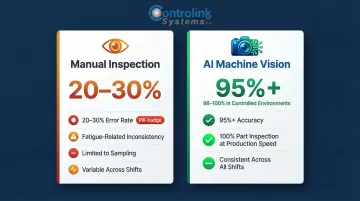
The practical gains are direct:
- Lower defect escape rates and less scrap
- Reduced warranty claims and rework costs
- Consistent inspection quality across all three shifts
For complex components like semiconductors, deep learning models handle large defect libraries and irregular surfaces where traditional rules-based vision algorithms break down.
Production Flexibility and Customization
Modern automation systems allow manufacturers to switch between product variants or change production parameters far more quickly than rigid legacy systems. This enables manufacturers to respond to demand shifts and customer customization requests without sacrificing efficiency.
The key is reprogrammable, adaptive automation rather than fixed, single-purpose systems. Cobots demonstrate this in practice — their intuitive interfaces allow rapid redeployment for high-mix production without specialized programming knowledge.
Workforce Role Transformation
Automation does eliminate some repetitive, physically demanding roles — this reality must be addressed honestly. At the same time, it creates demand for higher-skill positions: robotics technicians, data analysts, automation programmers, and process engineers.
According to U.S. Bureau of Labor Statistics projections to 2032:
- Industrial machinery maintenance technicians could grow by 16%
- Mechanical and industrial engineers are likely to expand by 11%
- Software developers, computer systems managers, and information analysts could increase by nearly 13%
- Data scientist roles are projected to grow by close to 30%
The mix of skills the factory floor demands is shifting — and manufacturers who invest in retraining now will be better positioned to fill these roles from within.
The Shop-Floor Connectivity Layer: The Unsung Foundation of Automation
Most automation discussions focus on the visible technologies—robots, AI, sensors—but overlook the critical software infrastructure underneath: the systems that allow CNC machines, PLCs, databases, and control hardware to communicate with each other. Without this connectivity layer, even the most advanced robots operate in isolation.
DNC (Distributed Numerical Control) and CNC communication software addresses these gaps directly. Key capabilities include:
- Ensures machinists always run the latest engineering-approved programs
- Eliminates the need to physically walk files across the shop floor
- Reduces scrap caused by outdated or incorrect programs
- Gives managers real-time visibility into what every machine is doing
Systems that communicate across multiple standards—Modbus, Profinet, EtherCAT, Serial, CAN—are critical for integrating legacy equipment with modern automation infrastructure. According to a 2026 Manufacturing Leadership Council survey, 37% of manufacturing leaders cite data interoperability and legacy equipment as their primary roadblocks to smart factory execution.
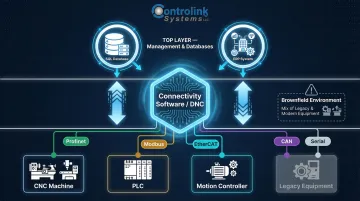
The reality of the U.S. manufacturing floor is a "brownfield" environment—a mix of brand-new smart machines operating alongside decades-old legacy equipment. Manufacturers are understandably reluctant to replace expensive machine tools any sooner than necessary, making retrofitting current facilities the most significant change companies make to accommodate IoT.
That's precisely where connectivity software earns its keep. Controlink Systems LLC has spent over 25 years building the integrations between CNC machines, PLCs, SQL databases, and motion controllers that make shop-floor automation actually function. For manufacturers starting their automation journey, optimizing communication between existing machines is often the highest-ROI first step—before investing in new robots or AI systems.
Real Challenges Manufacturers Face When Automating
Automation pays off — but only if manufacturers go in clear-eyed about what it actually takes. Three challenges trip up most facilities before they see returns.
Cost and ROI Pressure
Implementation cost weighs heavily on small and mid-sized shops. The business case must account for integration complexity, training, and transition time — not just hardware price. A facility-wide overhaul rarely delivers fast returns. Starting with a single high-impact process or communication bottleneck typically gets you to ROI faster.
The Workforce Skills Gap
Most shop floors weren't hired or trained for programming, data analysis, or equipment diagnostics — and that gap shows up fast once automation goes live. Automation requires workers with new competencies:
- CNC program management and troubleshooting
- Real-time data interpretation and process monitoring
- Equipment maintenance for automated systems
Investing in upskilling alongside the technology isn't optional. Without it, automation underperforms.
Cybersecurity Exposure
The more connected a factory becomes, the larger its attack surface. According to the IBM X-Force Threat Intelligence Index 2026, manufacturing was the #1 targeted industry for the fifth consecutive year — representing 27.7% of all cyberattacks in 2025. Attackers routinely exploit public-facing applications and outdated legacy equipment to deploy ransomware.
Protecting connected operations means implementing IEC 62443 zone segmentation and following NIST Cybersecurity Framework 2.0 guidelines to defend production data, intellectual property, and OT network integrity.
The Future of the Factory Floor
Manufacturing is moving toward increasingly autonomous production. AI systems now make real-time decisions on the floor. Humanoid robots handle tasks that once required human dexterity. And "lights-out" factories — running with no human presence during certain shifts — have moved from concept to reality.
In July 2024, Xiaomi launched a new smart factory in Changping, Beijing — a $330 million facility capable of producing 10 million flagship smartphones per year. The plant uses robotics, machine vision, automated logistics, and a proprietary AI management system called HyperIMP to run continuously, averaging one smartphone per second at full capacity.
Similarly, FANUC's robot manufacturing plant in Yamanashi, Japan, has operated in lights-out mode since 2001, employing robots to autonomously produce other robots and CNC machines, running unsupervised for up to 30 days at a time.
That said, fully lights-out operations remain rare. Most manufacturers are settling into a hybrid model — automated systems handle repetitive, precision, and data-intensive tasks, while humans focus on judgment, exception handling, and continuous improvement. Gartner advises manufacturers to pursue "lights-out processes" rather than entirely lights-out facilities.
Sustainability is also becoming a stronger driver of automation investment. Automated systems reduce waste and enable more precise resource use. Specific efficiency gains already documented include:
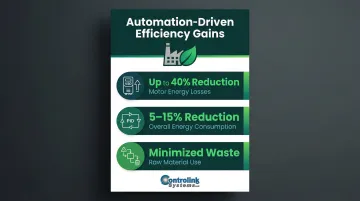
- Upgrading to Variable Speed Drives (VSDs) cuts motor energy losses by up to 40%
- Optimizing PID control loops reduces overall energy consumption by 5–15%
- Tighter process control limits raw material waste at the source
These gains align automation spending with environmental goals and regulatory compliance — making the business case easier to build.
Frequently Asked Questions
What does automated manufacturing mean?
Automated manufacturing uses machines, software, and control systems to perform production tasks with minimal human intervention. It spans everything from simple mechanized processes to AI-driven smart factories that self-optimize in real time based on production data.
How is AI transforming the factory floor?
AI enables predictive maintenance by forecasting equipment failures before they occur, powers quality inspection systems that detect defects at machine speed with over 95% accuracy, and continuously optimizes production parameters based on real-time data to improve efficiency and reduce waste.
Are there any fully automated factories?
Yes, a small number of "lights-out" or "dark" factories exist (such as Xiaomi's smartphone facility in Beijing and FANUC's robot manufacturing plant in Japan), but they remain the exception. Most manufacturers operate hybrid environments where automation handles specific tasks while humans manage oversight, exceptions, and higher-skill work.
What are the biggest challenges of implementing factory automation?
The biggest hurdles are upfront implementation costs (especially for SMEs) and the workforce skills gap, which demands significant investment in training. Cybersecurity is a growing concern too — manufacturing absorbed 27.7% of all global cyberattacks in 2025.
How do cobots differ from traditional industrial robots?
Traditional robots are typically caged, fixed, and programmed for a single task, requiring expensive safety infrastructure. Cobots (collaborative robots) are designed to work safely alongside humans without barriers, are easier to reprogram for different tasks, and are generally lower-cost to deploy—making automation accessible to smaller manufacturers.
How can small manufacturers get started with automation?
Start with high-impact, lower-complexity improvements, such as connecting CNC machines with DNC communication software or automating a single repetitive process. Focus on shop-floor connectivity first to integrate existing equipment, build confidence, and demonstrate ROI before committing to larger investments in robots or AI systems.