Introduction
Factory environments present a dual challenge that costs manufacturers dearly: equipment failures that drain millions in unplanned downtime and environmental hazards that put workers at risk. The world's 500 largest companies lose approximately $1.4 trillion annually to unplanned downtime, representing a 62% increase since 2019. For the average large facility, this translates to $129 million per year, with hourly downtime costs averaging $260,000. Meanwhile, exposure to harmful working conditions resulted in 687 workplace fatalities in 2024 alone.
Both are preventable — and increasingly, the same monitoring infrastructure addresses both. Modern factories use a layered approach: equipment health (vibration, thermal anomalies), environmental safety (air quality, gas detection), and production process visibility (real-time machine status).
This guide identifies the 8 most effective tools available today to help you build a monitoring strategy that protects both your assets and your workforce.
Key Takeaways
- Factory monitoring spans three critical domains: equipment health, environmental safety, and production visibility
- Thermal cameras and acoustic imagers detect electrical and mechanical failures before catastrophic breakdowns occur
- Environmental sensors and gas detection systems protect worker health while supporting OSHA compliance
- SCADA platforms and machine monitoring software centralize scattered data into unified dashboards
- Tool selection comes down to your facility's risk profile, legacy equipment compatibility, and monitoring frequency needs
What "Monitoring Factory Working Conditions" Actually Covers
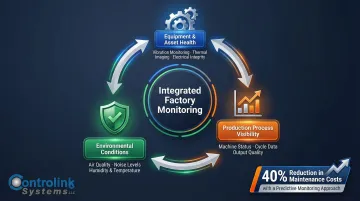
Factory working condition monitoring rests on three interconnected pillars:
1. Equipment/Asset Health — Tracking vibration signatures, temperature anomalies, and electrical integrity to predict failures before they occur
2. Environmental Conditions — Monitoring air quality, noise levels, temperature, and humidity that affect worker safety and productivity
3. Production Process Visibility — Capturing real-time machine status, cycle data, and output quality to identify inefficiencies
A siloed approach—monitoring only machines while ignoring air quality, or tracking production without watching equipment health—leaves dangerous blind spots. Research shows that facilities using predictive maintenance achieve a 40% reduction in maintenance costs and 35–45% reduction in unplanned downtime compared to reactive strategies.
Yet 70% of manufacturers still rely on manual data collection, and 81% of IT leaders admit that data silos hinder digital transformation.
Each tool below was chosen based on how well it covers one or more of these pillars — because a gap in any one area can turn a minor issue into an unplanned shutdown.
8 Best Tools for Monitoring Factory Working Conditions
These tools were selected based on reliability, breadth of monitoring capability, ease of integration with existing shop-floor infrastructure, and real-world applicability across manufacturing environments.
Teledyne FLIR Thermal Imaging Cameras
Teledyne FLIR is the global leader in thermal imaging technology, holding approximately 25% of the market. Their cameras detect heat anomalies in electrical panels, motors, pumps, and mechanical systems—areas where early warning prevents catastrophic failure.
Why it stands out: FLIR cameras detect temperature differentials invisible to the naked eye, allowing technicians to inspect energized equipment without shutdowns. The 2023 update to NFPA 70B transformed thermographic inspection from a recommendation into a mandatory requirement—all electrical equipment must now be inspected at least annually. FLIR's AI-assisted diagnostics help even entry-level technicians interpret results and prioritize corrective action, eliminating the guesswork from thermal analysis.
| Best For | Electrical system inspection, motor and pump heat anomaly detection, preventive maintenance programs | | Key Features | Thermal + visible light fusion imaging, AI-assisted diagnostics, route-based inspection workflow tools | | Deployment Type | Handheld (portable inspection) and fixed-mount continuous monitoring options available |
Monnit Industrial IoT Environmental Sensors
Monnit provides wireless industrial-grade sensors designed to monitor environmental parameters—temperature, humidity, air pressure, CO₂, and more—across factory floors, making them a practical choice for worker safety and equipment storage condition oversight.
Why it stands out: Sensors deploy wirelessly with no infrastructure overhaul required. Data is pushed to a cloud dashboard with configurable alerts, and the platform scales from a single machine room to multi-site facilities. This is a major advantage for manufacturers monitoring distributed environments where running cable would be cost-prohibitive. Research shows that at 1,000 ppm of CO₂, workers experience moderate decrements in decision-making, and at 2,500 ppm, large and statistically significant reductions occur. Monnit's CO₂ sensors measure 0–10,000 ppm and provide 8-hour time-weighted averages, enabling automated HVAC responses before cognitive degradation impacts productivity.
| Best For | Ambient temperature, humidity, CO₂, and environmental condition monitoring for worker safety | | Key Features | Wireless deployment, cloud-based alerts, multi-sensor dashboard, long battery life | | Deployment Type | Fixed wireless sensors; continuous real-time monitoring |
Fluke ii910 Precision Acoustic Imager
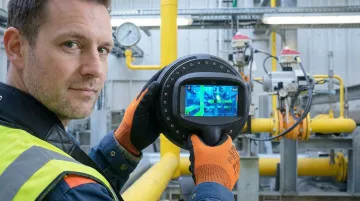
Fluke's acoustic imaging camera uses ultrasonic frequency detection to locate compressed air/gas leaks, vacuum leaks, and partial electrical discharge—issues that directly inflate energy costs and create safety hazards on the shop floor.
Why it stands out: Compressed air leaks can consume 20-30% of a compressor's output, yet 80% are inaudible to the human ear. Acoustic imaging lets technicians scan large areas rapidly without shutting down equipment. The ii910 visualizes high-frequency leaks and creates actionable repair lists. NFPA 70B now requires regular partial discharge inspection for systems 600V and above, making acoustic imaging not just cost-effective but compliance-critical. Repairing detected leaks typically recovers 5-10% of total system flow.
| Best For | Compressed air/gas leak detection, partial discharge identification, mechanical friction detection | | Key Features | Visual sound mapping, wide-frequency detection, works in loud factory environments | | Deployment Type | Handheld; periodic inspection and troubleshooting |
SKF Enlight Collect IMx-16 Vibration Monitoring
SKF's Enlight platform provides continuous vibration and temperature monitoring for rotating assets—bearings, motors, fans, and compressors—making it a cornerstone tool for predictive maintenance in high-precision manufacturing environments.
Why it stands out: Vibration data is analyzed against baseline signatures to detect bearing defects, imbalance, and misalignment early—often weeks before failure. Continuous data collection eliminates the gaps between manual route-based inspections. At the Sappi Gratkorn paper mill, continuous SKF monitoring detected 23 out of 25 machinery problems early enough to repair during scheduled stoppages (a 92% success rate), saving an estimated $4 million in avoided downtime over two years. The system integrates with CMMS platforms to trigger work orders automatically, closing the loop between detection and action.
| Best For | Rotating equipment health: bearings, motors, compressors, fans | | Key Features | Multi-channel vibration + temperature sensing, cloud connectivity, CMMS integration, automatic alert thresholds | | Deployment Type | Fixed continuous monitoring; permanent installation on critical assets |
MSA Safety Gas & Air Quality Detection Systems
MSA Safety offers a comprehensive range of fixed and portable gas detection instruments designed to monitor for toxic gases, oxygen deficiency, and combustible vapors in industrial environments—essential for factories handling chemicals, coolants, or operating in confined spaces.
Why it stands out: Real-time gas level alerts protect workers before OSHA exposure limits are breached. OSHA 29 CFR 1910.146 strictly governs permit-required confined spaces—before entry, the internal atmosphere must be tested with a calibrated direct-reading instrument for oxygen, flammable gases, and toxic contaminants, in that exact order. MSA's systems integrate with facility alarm networks and emergency response protocols, and their data logging capabilities support compliance documentation—a key concern for automotive, aerospace, and medical device manufacturers. OSHA recommends that instruments undergo a "bump test" before each day's use to verify sensor response.
| Best For | Worker safety in environments with hazardous gases, coolant mist, VOCs, or oxygen-depleted zones | | Key Features | Multi-gas detection, configurable alarm thresholds, data logging, integration with facility alarm systems | | Deployment Type | Fixed installed detectors and portable personal monitors; continuous and on-demand monitoring |
Inductive Automation Ignition (SCADA/HMI Platform)
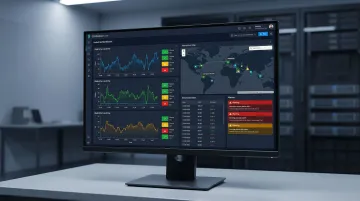
Ignition by Inductive Automation is a widely adopted SCADA/HMI platform that aggregates data from PLCs, sensors, and equipment across the factory floor into a single, centralized real-time monitoring interface—making it the command center that ties individual monitoring tools together.
Why it stands out: Ignition's open architecture supports Modbus, OPC-UA, Siemens S7, Allen-Bradley, and many other industrial protocols, allowing it to pull data from legacy and modern machines alike. Unlimited client licensing reduces long-term costs—one server price covers unlimited tags, clients, and connections. Its ability to serve live dashboards on mobile devices eliminates the need to physically walk the shop floor to check machine status. Ignition is used by 61% to 69% of Fortune 100 companies—a strong indicator of how well it holds up under real industrial demands.
| Best For | Centralizing multi-source factory data, real-time production and equipment dashboards, alert management | | Key Features | Protocol-agnostic connectivity (Modbus, OPC-UA, Siemens S7, Allen-Bradley), mobile HMI, historian data logging, unlimited tags | | Deployment Type | Server-based or cloud-hosted; continuous centralized monitoring across the entire facility |
NI (National Instruments) LabVIEW / DAQmx for Custom Process Monitoring
NI's LabVIEW and DAQmx platform enables engineers to build fully customized high-speed process monitoring and control systems—ideal for manufacturers with unique test requirements, complex multi-channel data acquisition needs, or specialized CNC/shop-floor automation challenges that off-the-shelf tools cannot address.
Why it stands out: The NI platform is sensor-agnostic and supports virtually any data acquisition need—from vibration and acoustic analysis to temperature and force—with real-time processing speeds that commercial CMMS tools cannot match. NI's CompactRIO and PXI systems use Field-Programmable Gate Arrays (FPGAs) to execute hardware-timed control loops, achieving deterministic, sub-millisecond latency for high-speed applications.
As an NI Partner Network member since 2000, Controlink Systems LLC builds and deploys custom NI-based monitoring solutions for machine shops and manufacturing facilities—translating raw sensor data into actionable shop-floor decisions. Controlink's deployments cover:
- PXI, cDAQ, cRIO, and FieldPoint hardware configurations
- SQL database integration for production data logging
- PLC and multi-axis motion controller interfacing
| Best For | High-speed process monitoring, custom test and measurement, vibration analysis, end-of-line testing | | Key Features | Flexible DAQ hardware, LabVIEW graphical programming, SQL database integration, PLC and motion controller interfacing | | Deployment Type | Custom-built fixed systems; continuous or triggered monitoring tailored to specific processes |
MachineMetrics Machine Monitoring Platform
MachineMetrics is a cloud-based machine monitoring and production intelligence platform that connects directly to CNC machines and other shop-floor equipment to capture real-time utilization, cycle time, downtime, and OEE data—giving operations managers live visibility into exactly what is happening on every machine.
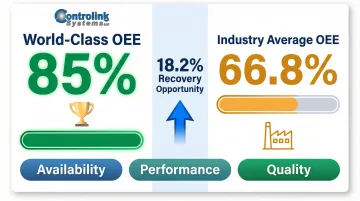
Why it stands out: MachineMetrics connects to both modern and legacy CNC machines through its hardware adapters, eliminating the need for manual production tracking. For modern machines, it uses protocols like MTConnect and OPC-UA; for legacy analog equipment without network interfaces, it uses I/O modules that accept 0-40VDC signals from the machine's circuitry to track "in-cycle" status and "part count." Its AI-driven analytics surface inefficiencies and downtime patterns that would otherwise go undetected. While world-class OEE is considered 85%, actual discrete manufacturing averages only 66.8% OEE—representing a massive opportunity for capacity recovery. In one case study, a manufacturer used MachineMetrics to achieve a 25-30% increase in OEE without purchasing new equipment.
| Best For | CNC machine utilization tracking, production efficiency monitoring, OEE improvement | | Key Features | Real-time machine connection (legacy + modern CNCs), OEE dashboards, downtime categorization, AI-assisted analysis | | Deployment Type | Cloud-based with on-machine edge hardware; continuous real-time monitoring |
How We Chose These 8 Tools
Tools were assessed across four critical dimensions:
- Breadth of monitoring coverage — Does it address equipment health, environmental safety, or process visibility?
- Ease of integration — Can it connect to legacy equipment and existing factory infrastructure without major overhauls?
- Scalability — Does it work for single-facility operations and multi-site deployments?
- Real-world adoption — Is there evidence of successful implementation in manufacturing environments?
Common mistakes manufacturers make when selecting monitoring tools:
- Buying isolated point solutions that create data silos instead of integrated visibility
- Over-investing in enterprise-grade software without trained personnel to interpret the data
- Focusing only on equipment health while ignoring environmental safety conditions that affect worker health and OSHA compliance
- Selecting tools based on features rather than compatibility with existing infrastructure
The most effective monitoring strategy combines continuous fixed monitoring for critical assets with handheld or periodic tools for the broader facility. The tools on this list were selected to support that kind of layered, practical approach.
That means deploying continuous vibration monitoring on Tier 1 rotating equipment while using thermal and acoustic cameras for periodic inspection of electrical systems and compressed air networks.
Conclusion
The right factory monitoring setup gives your team full visibility across equipment health, worker safety, and production performance—without overcomplicating your existing infrastructure or outpacing your team's skill set. The best approach is rarely one tool. It's a combination chosen for your facility's specific processes and constraints.
When off-the-shelf platforms don't map cleanly to your processes, a purpose-built solution becomes worth the investment. Controlink Systems LLC has spent over 25 years designing custom monitoring systems for CNC machine shops and complex shop-floor environments, including:
- NI-based process monitoring and real-time data acquisition
- DNC communications for CNC program management
- Shop-floor automation and custom HMI integration
Their team can build a system that fits your equipment, your workflow, and your uptime targets. Call (800) 838-3479 to discuss what a custom monitoring solution would look like for your facility.
Frequently Asked Questions
What are examples of monitoring tools for factory working conditions?
Factory monitoring tools fall into several categories, each targeting a different risk layer:
- Thermal imaging cameras (such as FLIR) for detecting electrical and mechanical heat anomalies
- IoT environmental sensors for tracking temperature, humidity, and air quality
- Acoustic imagers for compressed air leak detection
- Vibration sensors for rotating equipment health
- Gas detectors for worker safety
- SCADA/HMI platforms (such as Ignition) that centralize all monitoring data into unified dashboards
What are common employee monitoring tools for factory working conditions?
The most common employee-focused tools are fixed gas detectors, air quality monitors, and noise dosimeters — all designed to catch hazardous exposure before OSHA limits are reached. Some facilities also deploy wearable safety devices that track worker location and real-time environmental exposure.
What systems are used to monitor manufacturing processes?
Manufacturing process monitoring typically spans four tool types: SCADA/HMI systems (such as Ignition) for plant-wide visibility, machine monitoring platforms for real-time OEE tracking, custom DAQ-based systems (such as NI LabVIEW/DAQmx) for high-speed data acquisition, and condition monitoring software that tracks asset health through vibration and temperature. Each addresses a different layer of the monitoring stack.
What is the difference between condition monitoring and process monitoring in manufacturing?
Condition monitoring focuses on individual asset health: vibration, temperature, and wear patterns that signal impending failures. Process monitoring tracks operational parameters such as cycle times, output rates, tolerances, and quality metrics. The two work as complementary layers — one protecting your equipment, the other optimizing your production.
How do factory environmental monitoring systems improve worker safety?
Environmental monitoring systems detect hazardous gas concentrations, excessive heat, poor air quality, or high noise levels before they reach dangerous thresholds. Real-time alerts allow workers and supervisors to respond before OSHA exposure limits are breached or health incidents occur. For example, CO₂ sensors can trigger HVAC adjustments before cognitive performance degrades, and gas detectors can evacuate confined spaces before toxic exposure causes injury.
What should manufacturers consider when choosing a factory monitoring tool?
Start by matching the tool to the specific hazard or failure mode you need to address. From there, evaluate:
- Protocol compatibility with legacy equipment (Modbus, OPC-UA, and similar standards)
- Monitoring frequency — continuous vs. periodic, based on asset criticality
- Personnel readiness to interpret alerts and act on data
- Total cost of ownership, including installation, licensing, and integration with existing CMMS or ERP systems