Introduction
Walk any manufacturing floor and you'll find sensor data logging systems embedded at every stage of production. Temperature probes track heat-treat cycles, torque sensors verify fastener tension, pressure transducers monitor hydraulic systems, and vibration sensors watch rotating equipment. Together, these sensors generate continuous process data that operators rely on to keep production within specification.
Yet many manufacturers operate under a costly misconception: having sensor data visible on a screen is not the same as having audit-ready records. A live dashboard shows current conditions — it doesn't prove what happened three weeks ago during a suspect production run.
When quality auditors, regulatory inspectors, or customer representatives arrive, they don't want to see a monitoring screen. They want evidence: timestamped, retrievable proof that your process stayed in control for every unit shipped. That distinction determines whether you pass an audit cleanly or face findings, rework, and reputational damage.
Key Takeaways
- Sensor data logging systems capture, timestamp, and store process measurements — creating the traceable records auditors demand
- Audit readiness means structured, retrievable, tamper-evident data — live monitoring dashboards alone won't cut it
- ISO 9001, IATF 16949, AS9100, and FDA 21 CFR Part 11 define specific logging and traceability requirements
- Common gaps include inconsistent timestamps, data dropouts, and siloed storage on individual machines
- Platforms that integrate with SQL databases and PLC hardware close those gaps — putting audit evidence a few clicks away
What Is a Sensor Data Logging System?
A sensor data logging system is an automated platform that collects, timestamps, and stores continuous or event-triggered measurements from physical sensors—temperature, pressure, torque, vibration, flow, position—into a structured, persistent record.
The operational gap these systems solve is fundamental: the difference between knowing a process ran within spec and being able to prove it. The first supports daily operations; the second satisfies auditors, regulators, and customers who require objective evidence that critical process parameters were controlled throughout production.
What Sensor Data Logging Is Not
Sensor data logging is distinct from:
- Live monitoring dashboards show current values in real time but don't create permanent, queryable records
- Alarm systems flag out-of-spec conditions but miss the full measurement history leading up to the event
- Basic event counters tally occurrences without capturing the values or timestamps auditors actually need
- Manual data entry sheets introduce human error, gaps, and data integrity questions that automated logging eliminates
What separates a logging system from all of these is persistence and structure. Logged records survive beyond the current shift, are organized for query and retrieval, and carry the metadata—timestamps, machine IDs, product identifiers, lot numbers—required to tie measurements directly to specific production events.
How Sensor Data Logging Systems Create an Audit Trail
Audit readiness is achieved through a defined sequence—from sensor signal capture through structured storage to on-demand retrieval. A failure at any stage breaks the evidentiary chain auditors depend on.
Data Capture and Timestamping
Logging begins at the sensor level. Analog or digital signals are sampled at defined intervals—every second, every machine cycle, or at defined process events—and each reading is paired with a precise, synchronized timestamp.
Inconsistent or missing timestamps are among the most cited audit deficiencies. When machines or data loggers run on unsynchronized clocks, the resulting logs cannot reliably establish event sequences, directly undermining an auditor's ability to validate process conformance in a given time window.
Capture strategies vary by compliance requirement:
- Continuous logging: Samples at fixed intervals (e.g., 1 Hz, 10 Hz) for processes requiring uninterrupted traceability
- Condition-triggered logging: Captures data only when specific thresholds or events occur, reducing storage overhead while maintaining critical evidence
- Cycle-based logging: Records measurements tied to discrete production cycles (e.g., every part, every tool change)
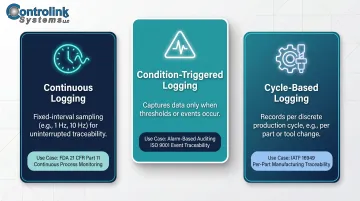
The choice must align with what the relevant compliance standard requires to demonstrate process conformance.
Centralized Storage and Data Integrity
Captured data is written to a centralized repository—such as a SQL database—rather than stored locally on individual devices. Centralized storage delivers three critical audit benefits:
- Prevents data loss when equipment is reset, replaced, or taken offline
- Enables cross-process correlation by linking data from multiple machines, sensors, and production stages in a single queryable system
- Makes logs accessible without requiring physical access to the machine or manual file extraction
Data integrity protections are non-negotiable in audit-ready systems. FDA 21 CFR Part 11.10(e) explicitly requires secure, computer-generated, time-stamped audit trails that independently record the date and time of entries and actions, with changes that do not obscure previous data. Systems must demonstrate that records have not been altered since they were written.
Academic security research describes tamper-evident logging using cryptographic linking and append-only structures that enable detection of modification attempts. In practice, this means write-once or write-protected database architectures with access controls that prevent unauthorized editing.
Controlink's process monitoring solutions interface directly with SQL databases and PLC hardware, providing the database-backed logging architecture that these integrity requirements demand.
Retrieval and Reporting
Audit-ready systems allow authorized users to query historical data by time range, sensor, product, machine, or operator—and export that data in structured formats auditors can review. This capability transforms stored data into usable audit evidence.
Generating reports on demand, filtered by production lot or date, eliminates manual reconstruction from screenshots or paper logs. That matters because auditors specifically look for evidence that records existed in real time—not that they were assembled after the fact.
What Auditors Actually Look For in Manufacturing Sensor Logs
Auditors across common manufacturing standards—ISO 9001, IATF 16949, FDA 21 CFR Part 11, AS9100—share consistent expectations. They want to verify that:
- The process ran within defined control limits
- The evidence is objective and unaltered
- Records are traceable to a specific product, batch, or production event
- Data is available for the full retention period required by the standard
Specific Attributes Auditors Evaluate
| Attribute | What Auditors Require | Regulatory Reference |
|---|---|---|
| Completeness | No unexplained gaps; original electronic records required — not transcribed summaries | FDA Warning Letter, Simtra BioPharma |
| Traceability | Logged data must link to a specific work order, machine, operator, or product identifier | ISO 9001, IATF 16949 |
| Timestamp Consistency | Clocks synchronized across systems; gaps in time correlation undermine conformance validation | FDA 21 CFR Part 11 |
| Retention Period | Automotive: life of product plus one year (IATF 16949 §7.5.3.2.1); FDA-regulated: audit trails retained at least as long as the subject electronic records (21 CFR Part 11.10(e)) | IATF 16949, FDA 21 CFR Part 11 |
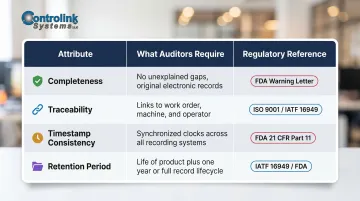
When any of these attributes fall short, auditors don't just note the gap — they look for patterns that suggest systemic data integrity problems.
Red Flags Auditors Watch For
- Data that exists only in dashboard views with no export capability
- Gaps in logs that coincide with non-conforming product periods
- Logs manually compiled after the fact rather than system-generated in real time
- Audit trail modifications without documented justification — a pattern FDA's Shiva Analyticals Warning Letter cited specifically, flagging high volumes of add/modify/delete actions in MassLynx software
A 2025 peer-reviewed study analyzing 856 FDA Form 483s found that receiving a Form 483 was associated with a greater than 50% chance of escalation to a Warning Letter if responses were inadequate—underscoring the stakes of logging deficiencies.
Common Logging Gaps That Put Manufacturers at Audit Risk
Dashboard-Only Monitoring
The most prevalent gap: manufacturers relying on real-time monitoring dashboards as their primary record. Auditors cannot verify past process performance from a live screen, and many platforms do not retain historical data beyond a short rolling window by default. If the data isn't written to persistent storage, it doesn't exist for audit purposes.
Fragmented Data Across Machines
Sensor data scattered across individual machine HMIs—disconnected from a central repository—forces manual reconstruction of production timelines during an audit. Manual compilation introduces integrity questions. When each machine logs locally with no centralized database, you can't prove cross-machine correlation or timeline consistency.
Timestamp and Synchronization Failures
When machines or data loggers run on unsynchronized clocks, the resulting logs cannot reliably establish event sequences. This directly undermines the auditor's ability to validate process conformance in a given time window.
McKinsey notes that many SMEs still collect data manually using pen and paper or spreadsheets, which introduces timestamp inconsistencies and data gaps that automated logging eliminates.
Configuration Drift
Systems correctly configured at installation can drift out of compliance as machines are updated, sensors are replaced, or logging intervals change without documentation. Regular validation of logging coverage is a firm requirement under most quality standards—not an afterthought.
Where Sensor Data Logging Systems Are Used in Manufacturing
Sensor data logging is critical across multiple manufacturing workflow stages:
- Incoming material inspection — verifying raw materials meet specifications before entering production
- In-process production monitoring — demonstrating that control limits held throughout machining, assembly, or forming
- End-of-line (EOL) testing — confirming finished products meet functional and quality specifications
- Post-process quality verification — validating that heat treatment, coating, or secondary operations were performed correctly
Industries Where Audit Requirements Make Logging Non-Negotiable
- Automotive suppliers under IATF 16949: Control plans require documented measurement systems, sample size and frequency, and reaction plans across prototype, pre-launch, and production phases
- Aerospace and defense manufacturers under AS9100: Incorporates ISO 9001:2015 documented information requirements with aerospace-specific traceability emphasis
- Medical device manufacturers under FDA 21 CFR Part 11: Requires secure, tamper-evident electronic records and audit trails
- Regulated research environments: Where experimental data integrity is subject to federal oversight
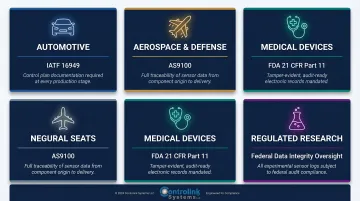
Across all of these sectors, logging requirements tighten as product risk increases — and adoption is accelerating to keep pace. A 2025 Deloitte survey found that 46% of manufacturers are currently using industrial IoT solutions at the facility or network level, with 34% ranking active sensors as a first or second investment priority over the next 24 months — driven in large part by audit and compliance pressure.
Beyond Compliance
The same logging infrastructure that serves quality audits also supports:
- Pinpointing bottlenecks and variability sources for ongoing process improvement
- Tracing root causes of unplanned downtime without relying on operator memory
- Providing objective evidence for warranty claims and customer dispute resolution
For manufacturers already under audit pressure, this means the same system that keeps an auditor satisfied also drives day-to-day operational decisions.
Conclusion
Sensor data logging systems ensure audit readiness by converting continuous process measurements into structured, timestamped, retrievable, and tamper-evident records. The distinction between having data and having auditable evidence is what determines whether a manufacturer passes or struggles through an audit.
Manufacturers who build logging architecture with audit requirements in mind from the start avoid the scramble of manual record reconstruction. That means designing for:
- Centralized databases with consistent query access
- Synchronized timestamps across all acquisition points
- Tamper-evident storage with access audit trails
- Metadata that links sensor readings to specific production events
Getting these elements in place before an auditor arrives eliminates the compliance exposure that comes with fragmented or dashboard-only data.
Understanding how these systems work enables better operational decisions: investing in the right data acquisition hardware, implementing database-backed storage, and validating logging coverage before the auditor arrives. A nonconformance finding — or worse, a product recall tied to unrecoverable process records — costs far more than the engineering time to build logging coverage correctly from the start.
Frequently Asked Questions
What types of sensors generate data that needs to be logged for manufacturing audits?
Common manufacturing sensor types include temperature, pressure, torque, vibration, flow, and position sensors. Which sensors require logging depends on the process parameters specified in your applicable quality standard or control plan—typically anything defined as a critical or significant characteristic.
How long should sensor data logs be retained for compliance purposes?
Retention requirements vary by standard and industry. IATF 16949 typically requires life of product in production and service plus one year. FDA 21 CFR Part 11 requires retention at least as long as the subject electronic records. Always verify your specific standard and customer requirements rather than relying on your logging software's default settings.
What is the difference between real-time monitoring and audit-ready data logging?
Audit-ready logging creates a permanent, timestamped, retrievable record of process conditions over time. Real-time monitoring only shows what's happening now—auditors need historical evidence to verify conformance. Dashboards alone are not evidence.
Can existing sensor systems be retrofitted to produce audit-ready logs?
Yes, most existing sensor systems can be integrated with data logging software, provided they can export timestamped readings into a centralized, access-controlled repository. Retrofitting typically involves communication gateways, PLC interfaces, or SQL database integration.
What compliance standards require sensor data logging in manufacturing?
Key standards include ISO 9001 (general quality management), IATF 16949 (automotive), AS9100 (aerospace and defense), and FDA 21 CFR Part 11 (medical devices and pharmaceuticals). Each sets specific requirements around records, traceability, and data integrity—consult the standard directly to confirm what your logging system must capture.
What happens if sensor data logs have gaps or inconsistencies during an audit?
Unexplained gaps or inconsistencies typically trigger extended audit procedures, requests for additional evidence, or findings of non-conformance. Gaps coinciding with suspect production periods most often result in a formal finding, customer notification, or regulatory enforcement action.