
Introduction
A CNC program looks like just another file until someone with legitimate access changes a feed rate, copies a proprietary tool path to a personal drive, or sends the wrong revision to the wrong machine. What follows is rarely a data-breach headline. It is scrap on the floor, an unplanned shutdown, or a five-axis mill running a program it was never approved to run. That's the sharp edge of insider risk in machining environments. An insider threat is any intentional or unintentional harm by someone with authorized access: an employee, contractor, vendor, or a compromised account under someone else's credentials. This guide focuses on one high-consequence problem: controlling how CNC programs are accessed and moved across engineering, IT, DNC, and shop-floor systems. We'll classify the threats, map the CNC program lifecycle from creation to retirement, apply layered access and movement controls, and outline a response process that protects both cybersecurity and production continuity.
Key Takeaways
- CNC security means controlling who can access a program and where, when, and how it can move.
- Anchor CNC controls in least privilege, engineering approval, version control, audit trails, controlled transfer paths, and rapid access revocation.
- CNC files aren't ordinary office documents—protection requires shared ownership across cybersecurity, engineering, quality, operations, and the shop floor.
- Flag unusual access, revision, transfer, and machine-loading activity, and preserve evidence for investigation.
Why CNC Programs Are an Insider-Threat Target
A CNC program isn't just G-code. It often encodes proprietary geometry, tooling logic, feeds and speeds refined over years, and process knowledge that took a shop's best programmer months to perfect.
Lose that file to a competitor, or run the wrong version on a $2 million machining center, and the cost is immediate.
The Manufacturing Attack Surface
CNC programs pass through more touchpoints than most people realize:
- CAD/CAM workstations and engineering file shares
- DNC servers and controlled transfer software
- Removable media, including USB drives and memory cards
- Email and personal cloud storage
- Operator terminals and machine controllers
- Remote-support tools used by vendors and integrators
- Backup repositories and archive systems
Each touchpoint is a place where a program can be copied, altered, or misdirected, sometimes by someone just doing their job.
Two Different Kinds of Incident
A cybersecurity incident involving stolen program data is not the same as an operational incident involving an altered, obsolete, or misdirected file. The first is theft. The second can produce defective parts, damaged tooling or spindles, unplanned downtime, and traceability failures that put certifications at risk.
Insider incidents aren't rare. The Ponemon Institute's 2022 benchmark found insider-related incidents cost organizations an average of $15.4 million annually, up 34% from 2020, with containment taking an average of 85 days.
In manufacturing, Verizon's 2024 Data Breach Investigations Report found internal actors involved in 27% of breaches—far more than external-threat headlines suggest.
Those figures show up on the floor as control failures, not just breach reports. One shop running 30-plus CNC machines across 10 control types with 40 operators told us their biggest daily headache wasn't malware. It was getting the right program to the right machine, every time.

Common weaknesses:
- Shared operator credentials
- Unrestricted engineering file shares
- Local copies sitting on desktops or laptops
- Unclear program ownership
- Weak revision naming, like "v2_final_FINAL.nc"
- Unapproved USB transfers
- Excessive vendor access left open after a project ends
- Incomplete offboarding when someone leaves
Insider-Threat Categories and Warning Signs in CNC Environments
Not every insider incident looks the same, and treating them all identically wastes investigation time.
Six Categories, Six Different Risks
- Malicious insiders: someone deliberately changes a tool path or feed rate to cause damage or sabotage a job.
- Negligent or accidental insiders: an operator sends an outdated program revision without realizing it.
- Compromised insiders: an external attacker controls a legitimate account and reaches an engineering share.
- Third-party insiders: a vendor or integrator's access outlives the project it was granted for.
- Departing employees: someone leaving the company copies files "just in case" before their last day.
- Collusive insiders: an employee works with an outside party against their own employer.
That last category isn't hypothetical. In 2020, federal prosecutors charged a foreign national with conspiring to recruit an employee at a U.S. battery plant to introduce malware in exchange for a payment reportedly worth $1 million.
The employee reported the approach instead, and the plot was stopped before it caused damage. That case shows how real the collusion risk is, even at well-resourced facilities.
Intent Isn't Obvious From One Event
A single unusual login or file transfer doesn't reveal someone's intent. Context matters: review job role, program revision, machine destination, approval status, and change history before drawing conclusions.
Warning signs worth investigating:
Access and identity signals:
- Access attempts outside normal shift hours
- Repeated failed login or file-access attempts
- First-time access to programs outside someone's normal scope
- Disabled or missing logging
Program and transfer signals:
- Bulk downloads of programs unrelated to a person's job
- Unexpected revisions with no corresponding approval
- Transfers to unapproved or unrecognized devices
- Attempts to bypass approval workflows
None of these signals should trigger an automatic accusation. They should trigger a fair, documented investigation involving HR, legal, and operations, not just IT.
Control the CNC Program Lifecycle From Creation to Machine Execution
Every CNC program moves through a predictable sequence: creation or post-processing, engineering review, approval, controlled storage, distribution, machine loading, execution, revision, archival, and eventual retirement. Insider risk creeps in at every handoff where ownership isn't clear.

Ownership at Each Stage
The person who writes or edits a program shouldn't automatically be the same person who approves it for production, distributes it, or authorizes an emergency change on the floor. Separating these responsibilities is basic role-based access control:
- Programmers and engineers create and edit
- Quality staff validate against specifications
- Supervisors approve production release
- Machinists load and execute approved files only
- IT administrators manage systems, not program content
- Vendors and temporary staff get scoped, time-limited access only
Run access reviews on a set cadence—quarterly is common—to catch privilege creep before it becomes a liability.
Version Control That Actually Holds Up
Every production program should carry:
- A unique identifier and clear approved-or-superseded status
- Full revision history with check-in/check-out controls
- Separate storage for test, superseded, and production-ready versions
Check-in/check-out keeps two people from editing the same file at once. Different file names in the same folder are not enough.
High-risk actions, like approving a new production program, changing a safety-critical parameter, or overriding a release workflow, deserve dual approval. One person shouldn't be able to push a program to a live machine without a second set of eyes.
At Ametek, Inc., for example, operators retrieve programs directly at the machine, but any corrected program coming back from the floor gets saved into an Engineering folder for CNC engineer review before it's allowed back into the program library. That single checkpoint prevents an unreviewed field fix from silently becoming the new standard.
Tamper-evident audit records should capture who accessed, changed, approved, transferred, loaded, or deleted a program, along with timestamp, source, destination, revision, and reason.
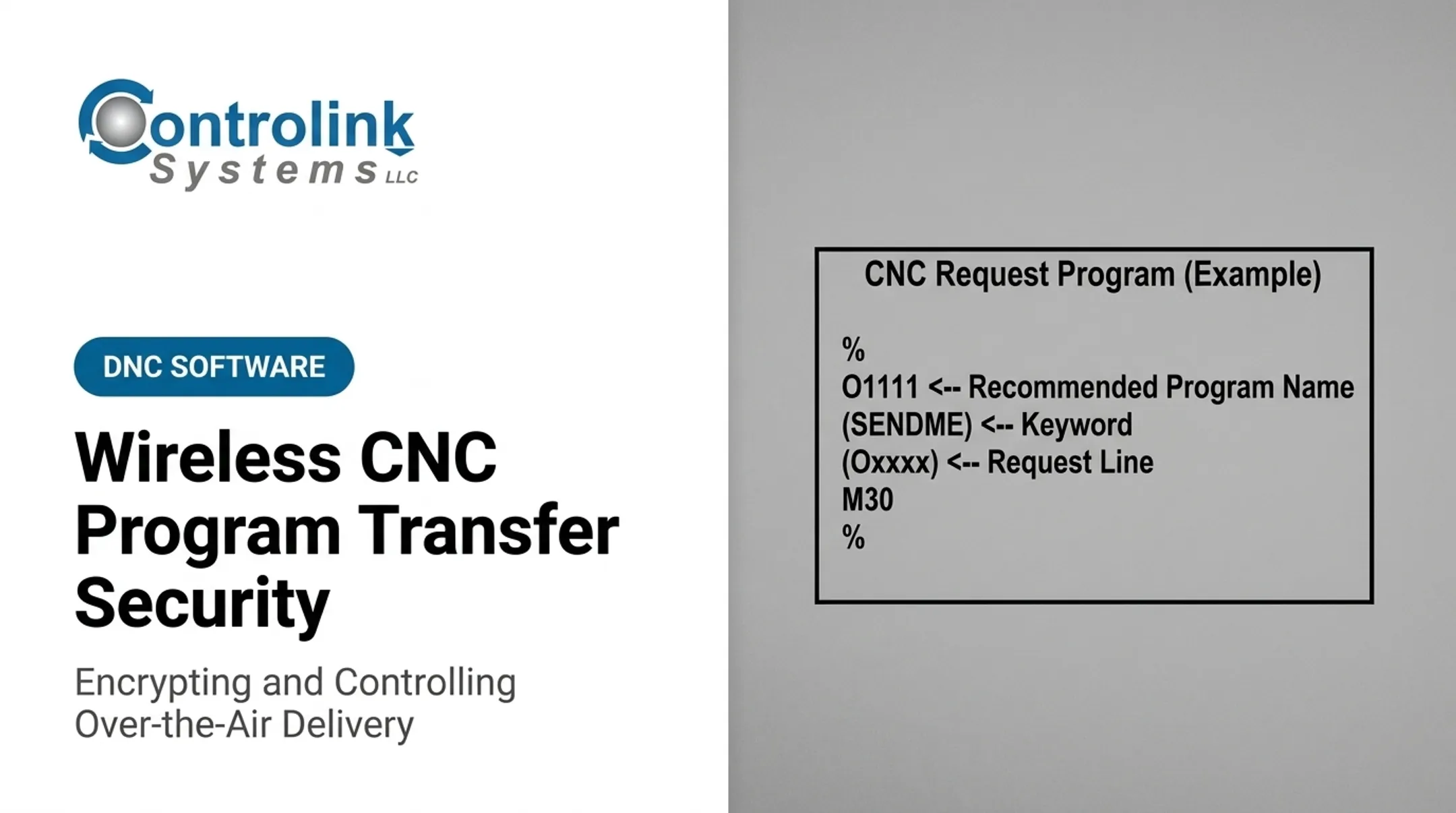
Governed CNC/DNC communication software makes these controls practical on the floor. Controlink Systems' Machine Link™ QUICK Serve serves the latest engineering-approved file directly to a requesting machine control, so operators are not left hunting files and outdated or unapproved revisions are far less likely to run.
It also logs directory activity—including file name, size, and last modification date—giving engineering a record to check against.
Build Layered Access and Movement Controls
Access control and movement control are two different problems, and both need attention.
Lock Down Identity First
- Individual accounts for every user; no shared logins for engineering or admin functions
- Multi-factor authentication wherever it's supported
- Privileged-access restrictions separating admin rights from everyday use
- Strong authentication specifically for remote sessions
Then Control Where Files Can Go
Policy should dictate the approved routes for a CNC program, not habit:
- Restrict USB and removable media
- Block personal cloud storage and unauthorized email transfers
- Limit local downloads
- Route production transfers only through approved DNC paths
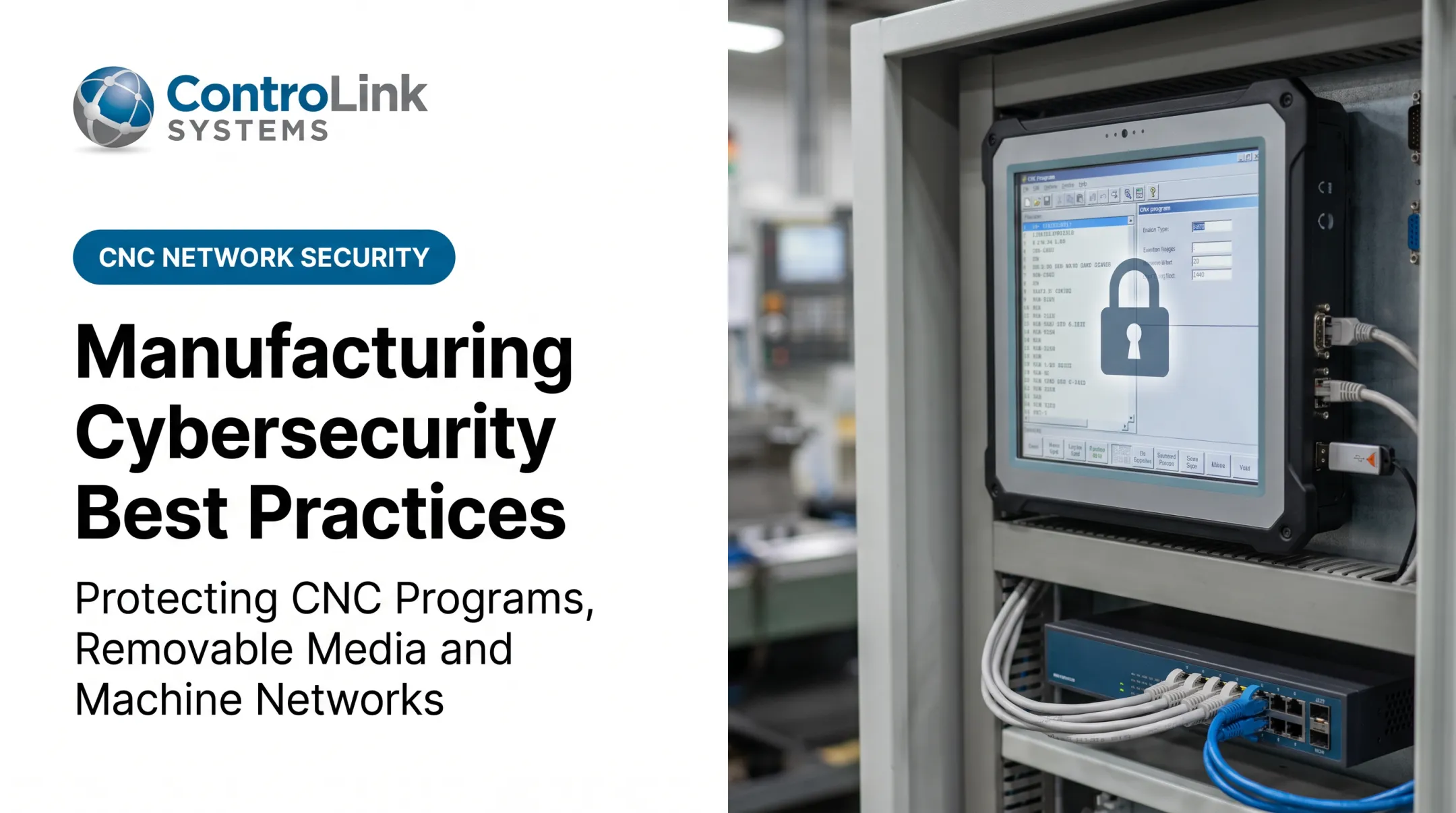
Segmentation matters here too. Access to an engineering repository shouldn't automatically hand someone a path to every machine controller on the floor.
NIST's guidance for operational technology security recommends segmenting and isolating IT and OT networks using isolation devices that permit only explicitly authorized traffic. That principle applies directly to engineering shares versus DNC and machine networks. If one account gets compromised, segmentation limits how far the damage spreads.
Watch, Then Verify
Endpoint, file, and network monitoring should flag unusual copying, renaming, compression, deletion, or transfer of CNC programs. On its own, a single alert means little. Correlated with authentication logs, machine records, and change-management history, it tells a story.
Vendor and remote-support access needs the same discipline:
- Time-limited sessions
- Prior approval
- Full session logging
- Immediate revocation once the work is done
A remote-support tool left open after a project wraps is an open door nobody's watching.
Keep resilient backups of approved programs, with their own access controls and integrity checks. A tampered or accidentally deleted file can then be replaced with a known-good version in minutes, not days.
Implement a Practical CNC Insider-Threat Program
None of this works as a one-time project. It needs a process.
Start with an inventory. Identify every CNC program, repository, DNC server, machine interface, removable-media route, and remote-access path. Note who or what can alter or transmit each one.
Write the policies down, covering:
- Program naming and approval workflows
- Emergency change procedures
- Machine loading rules
- Removable media restrictions
- Vendor access terms
- Logging and retention requirements
- Incident reporting
- Offboarding for employees and contractors
Build a joiner-mover-leaver process that removes accounts and machine permissions the moment someone changes roles or leaves, including service accounts, shared accounts, and temporary workers.
Set detection and response thresholds, then write a playbook covering:
- Suspending the account
- Blocking further transfers
- Isolating the affected machine, where safe to do so
- Verifying the last known-good approved revision
- Preserving evidence
- Communicating with production
- Restoring only after validation

Test it. Run a tabletop exercise around an unauthorized copy, a suspicious revision, or an urgent vendor remote session. Confirm your team can detect, investigate, contain, and recover—not just that the plan looks good on paper.
Governance splits naturally by function:
- Cybersecurity monitors and investigates
- Engineering validates program integrity
- Quality assesses product impact
- Operations manages continuity
- HR/legal guide personnel and privacy matters
For shops integrating CNC/DNC communications, databases, PLCs, and shop-floor automation into a workflow like this, Controlink Systems builds CNC/DNC software and integration solutions for machining environments. Any integration should still be validated against your own access, approval, logging, and security requirements before it's treated as a control.
Conclusion: Treat CNC Program Movement as a Controlled Manufacturing Process
Insider-threat protection is governance over every access and movement event a CNC program goes through, from the moment it's written to the moment it's retired. A training slide or a firewall rule alone does not cover that path.
Work the priorities in order:
- Identify your critical programs and the paths they travel
- Assign least-privilege roles
- Enforce approval and revision control
- Restrict transfer methods
- Monitor activity
- Prepare a response you've actually tested
A practical next step: pick one production cell or one program repository. Document its end-to-end flow, every hand, every folder, every transfer. Use what you find to prioritize controls before expanding the approach across the rest of the facility.
Frequently Asked Questions
What are the categories of insider threats in manufacturing?
The main categories are malicious, negligent or accidental, compromised, third-party, departing, and collusive insiders. A negligent example: an operator loading an outdated CNC revision without realizing engineering had superseded it.
What are the major cybersecurity threats facing the manufacturing industry?
Manufacturers face ransomware, phishing and credential theft, vulnerable legacy OT systems, unauthorized remote access, intellectual-property theft, supply-chain exposure, and insider misuse. Any of these can lead to an altered or misdirected CNC program.
What are the 5 C's of cybersecurity?
There's no single official standard. One common framework uses Change, Compliance, Cost, Continuity, and Coverage as a leadership heuristic. For CNC access, that means controls that adapt, meet obligations, target real risk, keep production running, and cover every machine and account.
How can manufacturers protect CNC programs from insider threats?
Use individual accounts, least privilege, engineering approval, and revision control. Restrict transfers to controlled DNC paths, limit removable media, monitor activity, maintain backups, and offboard departing personnel immediately.
How should a manufacturer respond to suspected CNC program tampering?
Contain safely first, then preserve logs and the suspected file without altering it. Verify the last approved revision, loop in cybersecurity, engineering, quality, and operations, and restore production only after validation.