Introduction
Modern CNC machine shops face relentless pressure: tighter delivery windows, zero-defect quality standards, and the need to produce more with less downtime and scrap. Tool offset errors alone drain $20,000 to $60,000 annually per shop, while unplanned downtime costs industrial manufacturers $50 billion each year. Software has become the linchpin of survival—but not just any software.
That distinction matters. General ERP systems handle financials and procurement; project management tools track tasks and timelines. Manufacturing process management software operates where it counts — on the shop floor, at every machine, across every shift.
Purpose-built shop-floor software goes beyond scheduling and reporting. It:
- Monitors CNC/DNC communications in real time
- Enforces version control on G-code programs
- Captures process data that catches defects before they become scrap
Key Takeaways
- Manufacturing process management software monitors, controls, and optimizes production in real time: from CNC file transfers to quality tracking
- Built specifically for the machine floor—not adapted from ERP or project tools—it handles scheduling, monitoring, and documenting every production step
- Key criteria: real-time monitoring depth, CNC/DNC file management, quality integration, and how well it talks to your existing systems
- Top 2026 platforms: Plex Smart Manufacturing, Tulip Operations, Ignition, ProShop ERP/MES, and Controlink Systems LLC
- Match software to your shop's size, machines, and protocols—not just integration count
What Is Manufacturing Process Management Software?
Manufacturing process management software is a category of digital tools designed to plan, monitor, execute, and optimize production processes at the shop-floor level. It covers job scheduling, machine communication, quality assurance, and real-time process data—everything that happens between order entry and finished part.
Those category boundaries blur intentionally. ERP handles enterprise-wide planning and financials. MES (Manufacturing Execution System) focuses on production execution and tracking. Process management software often sits at the intersection — especially for shops needing real-time monitoring, DNC file transfer, and machine-to-machine data flow. Some platforms span all three functions; others specialize deeply in one layer.
Operational fit is what actually determines whether a platform works for your shop. At minimum, the right solution should:
- Connect to your machines and speak their protocols
- Surface process data where operators can act on it
- Eliminate unnecessary floor walks by centralizing information
Top Manufacturing Process Management Software for 2026
Each platform on this list was evaluated against five criteria:
- Real-time monitoring capability
- Shop-floor integration depth
- Ease of deployment
- Manufacturing-specific workflows
- Proven track records in CNC machine shops and high-mix production environments
Plex Smart Manufacturing Platform
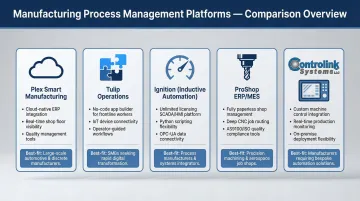
Plex (now part of Rockwell Automation) is a cloud-native smart manufacturing platform widely deployed in automotive, aerospace, and industrial manufacturing. It combines MES, ERP, and quality management in a single system, eliminating the data silos that plague multi-vendor stacks.
What makes it stand out: Real-time production tracking across the entire facility, closed-loop quality control with automatic corrective actions, and tight integration with Rockwell Automation hardware. Mid-to-large manufacturers get a single interface for production visibility, quality, and control — no switching between systems.
| Key Features | Real-time production tracking, quality management, supply chain visibility, shop-floor data collection, workflow automation |
|---|---|
| Pricing | Custom quote; contact vendor |
| Best For | Mid-to-large manufacturers in automotive, aerospace, and industrial sectors needing full MES + ERP integration |
Tulip Operations Platform
Tulip is a no-code/low-code manufacturing operations platform that allows production teams to build and deploy custom apps for process guidance, quality data collection, and real-time operator performance tracking—without waiting on IT.
What makes it stand out: Visual app builder for shop-floor use, built-in IoT connectivity for machine monitoring, and rapid digitization of paper-based processes. A Forrester TEI study found 448% ROI over three years and 70% reduction in product defects. It's a strong fit for high-mix, low-volume shops replacing clipboards and paper travelers with guided digital workflows.
| Key Features | No-code app builder, IoT machine integration, real-time analytics, digital work instructions, quality tracking |
|---|---|
| Pricing | Contact vendor for pricing; free trial available |
| Best For | Manufacturers digitizing manual processes or building custom shop-floor workflows without heavy IT resources |
Ignition by Inductive Automation
Ignition is an industrial application platform (SCADA/MES) that enables manufacturers to build process monitoring and control applications, connect to PLCs and databases, and visualize real-time production data across the plant.
Broad protocol support (Modbus, OPC-UA, Allen-Bradley, Siemens S7) and an unlimited licensing model per server set it apart from tag-based alternatives. It can serve as both the SCADA layer and MES module — which makes it particularly cost-effective in plants with diverse machine types where per-tag licensing costs would otherwise spiral.
| Key Features | SCADA/HMI, MES modules, PLC connectivity, SQL database integration, real-time data historian, unlimited tags/clients |
|---|---|
| Pricing | Per-server licensing; contact vendor for quote |
| Best For | Manufacturers needing deep machine-level process monitoring, multi-protocol connectivity, and custom HMI/SCADA applications |
ProShop ERP/MES
ProShop is an ERP/MES solution purpose-built for job shops and CNC machining environments, offering end-to-end shop management from quoting and scheduling to work instructions, quality documentation, and machine utilization tracking.
What makes it stand out: CNC shop-specific design — digital traveler packets, tool and fixture management, AS9100/ISO integration, and a fully paperless workflow. One aerospace startup achieved AS9100 certification in two months using ProShop, versus the industry norm of 12–18 months.
| Key Features | Scheduling, digital work instructions, CNC tool management, quality/AS9100 documentation, machine utilization tracking |
|---|---|
| Pricing | Contact vendor for pricing; demo available |
| Best For | CNC job shops, aerospace/defense manufacturers, and precision machining facilities needing a fully integrated, shop-floor-native solution |
Controlink Systems LLC
Controlink Systems LLC develops shop-floor software for CNC/DNC communications, high-speed process monitoring, and shop-floor automation — built specifically for machining environments, not adapted from generic enterprise platforms. The company has been a member of the NI Partner Network since 2000, with customers including Timken, 3M, and Oak Ridge National Laboratory.
What makes it stand out: Deep specialization in CNC/DNC file management—ensuring machinists always use the latest engineering-approved programs—combined with real-time process monitoring and the ability to interface with SQL databases, PLCs, and motion controllers across protocols like Modbus, CAN, EtherCAT, and Profinet. Built specifically for the everyday machining shop, not adapted from a generic enterprise platform.
| Key Features | DNC/CNC file transfer and management, high-speed process monitoring and control, shop-floor automation, PLC and database integration, end-of-line (EOL) testing |
|---|---|
| Pricing | Contact Controlink directly at (800) 838-3479 or support@controlinksystems.com |
| Best For | CNC machine shops, stamping plants, automotive and aerospace manufacturers, and research facilities needing specialized DNC communications and shop-floor process control |
Key Features to Look for in Manufacturing Process Management Software
Real-time process monitoring and alerts
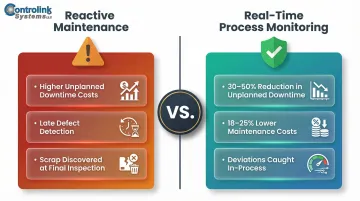
Effective software must capture live data from machines and processes, flagging deviations, defects, or downtime events as they occur—not after the fact. Predictive maintenance and real-time monitoring reduce unplanned downtime by 30–50% and cut maintenance costs by 18–25% compared to reactive strategies. The difference between catching a deviation in-process versus discovering it at final inspection is the difference between adjusting a parameter and scrapping a batch.
CNC/DNC communications and file management
For machining environments, the ability to transfer, version-control, and validate CNC programs directly to and from machines is critical. Tool offset errors and wrong-program crashes drain $20,000–$60,000 per shop annually, often miscategorized as "bad material" or "normal scrap." Networked DNC eliminates manual file transfers via USB drives and enforces strict version control, ensuring operators always run engineering-approved programs.
System integration (PLC, ERP, SQL, protocols)
Process management software should communicate with existing shop infrastructure—PLCs, databases, ERP systems—across common industrial protocols. OPC UA is now the global interoperability standard, with over 1,000 member companies supporting the ecosystem. Without these connections, production data stays trapped in silos—leaving quality and scheduling decisions to guesswork rather than live shop-floor reality.
Quality control and traceability
Built-in quality tracking and production traceability are essential for regulated industries and continuous improvement programs. Digital travelers and an integrated QMS reduce Cost of Poor Quality (COPQ) by addressing the root causes most often overlooked:
- Operators running outdated or unapproved drawing revisions
- First Article Inspections (FAI) delayed by missing documentation
- Corrective actions that never get formally closed out
How We Chose the Best Manufacturing Process Management Software
Each tool on this list was evaluated against criteria specific to production manufacturing — not generic project management or office workflows. Here's what drove every selection decision:
- Shop-floor functionality: Does it work on the machine floor, not just in the front office?
- Protocol and hardware compatibility: Can it integrate with real CNC equipment and industrial communication standards?
- Fit for CNC/machining environments: Is it built for process-oriented work, not just discrete project tracking?
- Proven customer deployments: Has it been validated in actual production manufacturing settings?
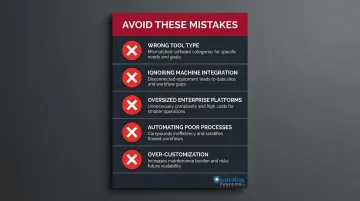
Common mistakes manufacturers make when selecting process management software:
- Choosing tools built for discrete project management rather than continuous process monitoring
- Underestimating the importance of machine-level integration and protocol support
- Selecting enterprise platforms that are too complex or costly for smaller job shops
- Automating poor processes rather than optimizing workflows first
- Over-customizing systems instead of building on flexible, modular setups
A staggering 75% of manufacturing software initiatives fail to deliver meaningful results, largely due to rigid architectures and poor change management. The tools that survive long-term in CNC and machining environments tend to be the ones that fit how the shop actually runs — not the ones with the longest feature list.
Conclusion
The right manufacturing process management software depends on your specific production environment. Large facilities with complex ERP needs are typically better served by platforms like Plex or Ignition. CNC machine shops benefit most from purpose-built tools that handle DNC communications, real-time monitoring, and shop-floor automation without the overhead of enterprise systems.
Evaluate software based on real operational fit: machine compatibility, protocol support, ease of use for floor-level operators, and total cost of ownership. Brand name and integration count matter less than whether the software solves the problems your operators face every shift.
If your shop needs to tighten CNC/DNC file management, cut scrap, or get real-time visibility into machine performance, Controlink Systems LLC builds software for exactly that — DNC communication tools, process monitoring systems, and shop-floor automation developed specifically for machining environments. Call (800) 838-3479 or visit controlinksystems.com to talk through your needs.
Frequently Asked Questions
Is MES the same as ERP?
No. According to the ISA-95 standard, ERP (Level 4) handles business planning and logistics—financials, procurement, high-level scheduling. MES (Level 3) manages manufacturing operations, including detailed production execution, quality control, and shop-floor tracking. Many modern platforms offer both, but they serve distinct operational layers.
What is a factory management system?
A factory management system is software that oversees and coordinates manufacturing operations—production scheduling, machine monitoring, quality control, inventory, and workforce management. The goal is a single source of truth across machines, inventory, and labor.
What are the 4 types of management systems?
The four common types in manufacturing are ERP (Enterprise Resource Planning), MES (Manufacturing Execution System), CMMS (Computerized Maintenance Management System), and QMS (Quality Management System). Each targets a different operational layer and is frequently integrated with the others.
What is the difference between MES and manufacturing process management software?
MES is a formalized category that tracks and controls production execution across the factory floor. "Process management software" is broader, including MES capabilities but also extending to specialized tools like DNC/CNC communications software, SCADA systems, and process monitoring platforms that operate at the machine level.
What features should CNC shops prioritize in process management software?
CNC shops should prioritize DNC/CNC program file management and version control, real-time machine monitoring, PLC and database integration, and a user-friendly HMI. These directly affect machine utilization, part quality, and the ability to eliminate manual file-transfer errors on the floor.
Can manufacturing process management software help reduce scrap and rework?
Yes. When machinists always run the latest engineering-approved CNC programs, process deviations get flagged before bad parts multiply. Integrating quality checks into the production workflow cuts scrap and rework at the source rather than catching problems after the fact.