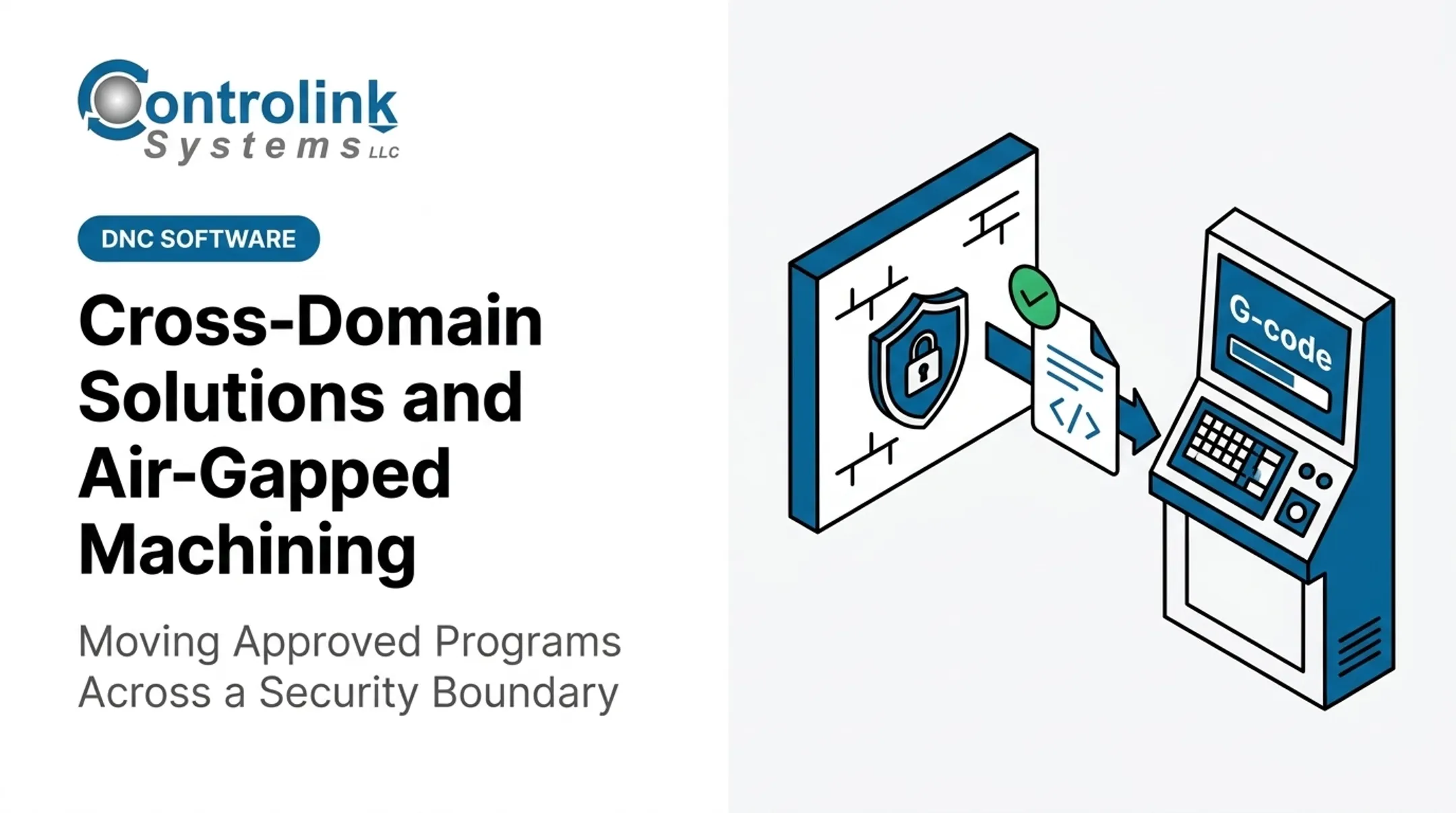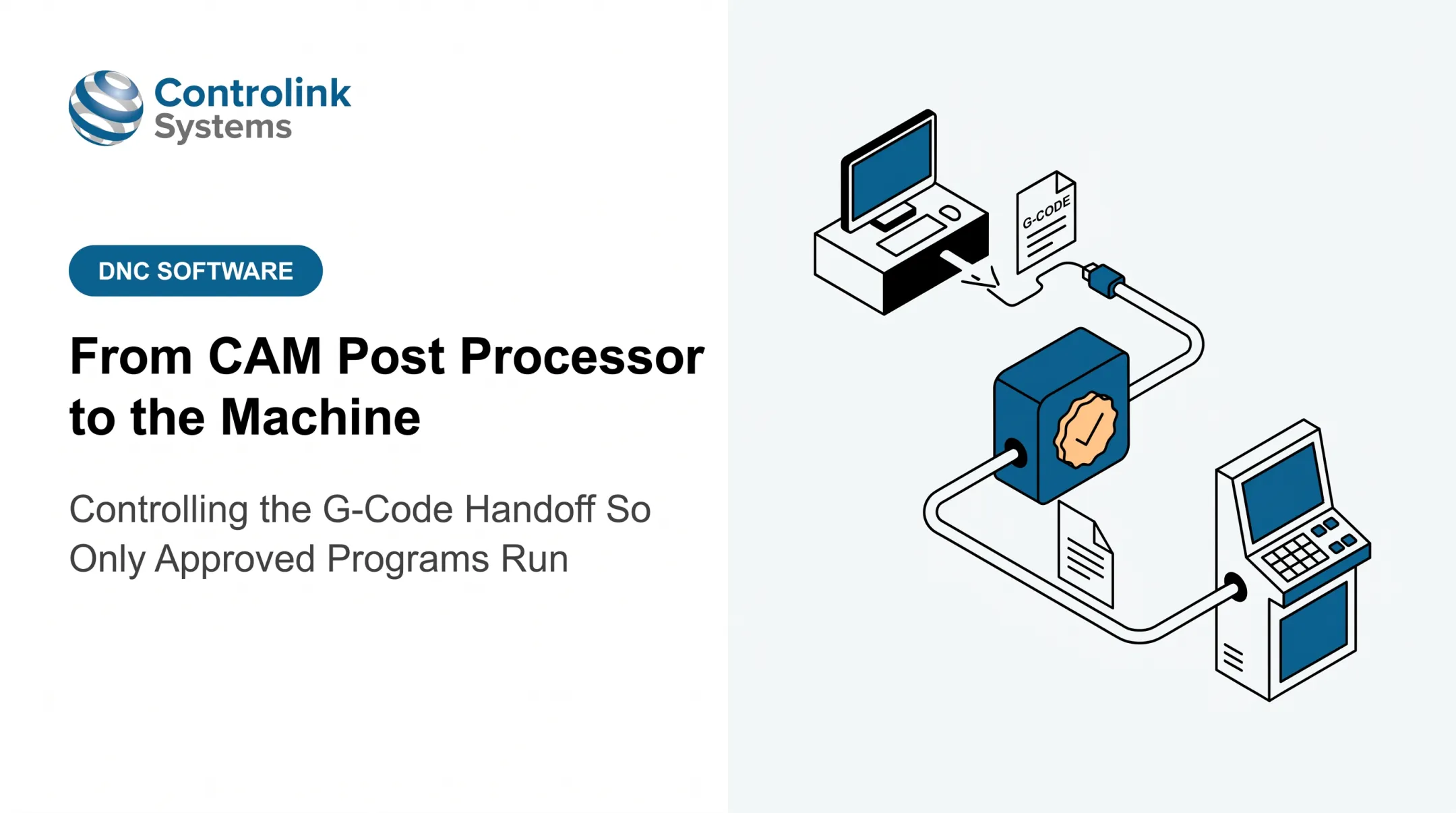

CIMCO's DNC documentation specifically names walking programs to the shop floor as a downtime driver, and it's not hard to see why. A mobile CNC program request fixes this, but only when it's built correctly. Pulling a file onto a phone screen means nothing if that file is the wrong revision or incompatible with the machine.
This article covers when mobile program requests make sense, what has to be in place first, how the request-and-retrieve process should work, and where shops commonly get it wrong.
Key Takeaways
- Capture machine ID, job number, part number, and program revision before every mobile retrieval.
- Operators only receive engineering-approved, machine-compatible files.
- Role-based access and audit trails keep outdated or unauthorized code off the control.
- Mobile access cuts unnecessary walking without replacing approval and inspection steps.
- Requests still route through your existing program repository and CNC/DNC path.
How to Request and Retrieve an Approved CNC Program From a Phone
Getting a program from a phone to a machine control involves four steps. Skip any of them and you're back to the old problem, just with a shinier interface.
Step 1: Prepare the Request With Real Identifiers
A vague request produces a vague result. Before submitting anything, the machinist should have:
- Operator identity
- Work order or job number
- Part number and operation
- Machine ID
- Tooling or setup reference
- Program name or revision, if known
The phone interface should let the operator select or scan these fields, not type them from memory. Standing next to an active machine is the wrong time to guess at a filename that might match three other similar parts.
Step 2: Submit and Route the Request
Once submitted, the request routes to the correct program repository, engineering queue, or DNC workflow. Before anything transfers, the system should display:
- Approval status
- Revision number and date
- Source location
- Intended machine or control
If any of that information is missing, the request should stop there rather than proceed on a guess.
Step 3: Verify Before Accepting
This is the step most shops shortcut, and it's the one that causes the most trouble. The returned file needs to match the machine and job context, not just carry a similar name. Check:
- Machine-control compatibility and file format
- Required offsets
- Tooling and material match
- Setup instructions tied to that specific job
A file named similarly to the correct one, but three revisions old, looks identical at a glance. The verification screen is what catches it.
Step 4: Retrieve, Transfer, and Record
The final step moves the approved file through the shop's authorized CNC/DNC path, whether that's wired serial, Ethernet, or a managed wireless connection. The operator's permissions should stay limited to what their role allows: request and retrieve, not edit or release.
Every request, approval, and transfer event should get logged, so a supervisor can trace exactly which revision ran and who pulled it.
This is where a system like Controlink Systems' Machine Link™ QUICK Serve comes in. It scans machines continuously for file requests over wireless or wired serial connections and serves the correct approved file directly to the control. Keywords embedded in a CNC Program Request file drive the match, so operators avoid manual typing at the machine.
Optional Email/Text MSG support lets a request originate from a phone and route to a specific CNC machine tool control. Whether a full mobile-app-style interface fits your shop depends on your existing repository and controls. Confirm that before assuming any off-the-shelf feature covers it.

When Mobile CNC Program Requests Make Sense (and What Affects Retrieval Accuracy)
Mobile requests earn their keep when operators change programs often, machines sit spread across a large floor, or the current process leans on walking, phone tag, or informal file drops. A shop with two CNC machines ten feet from the programmer's desk probably doesn't need this. A shop running twenty machines across three bays almost certainly does.
What Has to Be in Place First
Before mobile retrieval works reliably, a shop needs:
| Component | Purpose |
|---|---|
| Managed mobile interface | Lets operators submit structured requests, not free text |
| Secure user authentication | Confirms who is requesting and what they're allowed to do |
| Approved program repository | Single source of truth for revisions and approval status |
| DNC or machine communication | Transfers the file to the control once verified |
| Shop-floor connectivity | Wired backbone or managed local wireless, tested for reliability |
| Machine and work-order identification | Standardized IDs so requests match the right context |
Integration often touches legacy CNC controls, shop PCs, servers, and sometimes MES or ERP platforms. Validate this against your actual environment. Don't assume a vendor's generic architecture maps to your controls without testing.
Program Identity and Machine Compatibility
Part numbers, operation numbers, and filenames get duplicated or nearly duplicated across jobs more often than anyone likes to admit. Modern Machine Shop recommends embedding part name, revision, operation number, and storage location directly in the program header.
Insufficient documentation leads to confused operators, wasted time, scrap, and in worse cases, machine damage.
The mobile workflow should carry this metadata forward. A program tied to a specific controller, axis configuration, postprocessor, or tooling arrangement needs to get flagged or filtered before transfer, not discovered as a mismatch at the control.
Permissions and Connectivity
Different roles need different rights. A machinist requesting and retrieving a file is a different action than an engineer approving one or editing code. Role-based access keeps engineering in control while still letting operators move quickly.
Access control only helps if the request reaches the system reliably. On the connectivity side, NIST's OT security guidance recommends a primarily wired backbone with localized, segmented wireless for mobile devices, including encryption and device allowlisting.
Wireless works fine for mobile requests when it is planned, not bolted on. Weak connectivity without visible sync timestamps or retry behavior leads to missing results or, worse, an operator running a stale local copy without realizing it.

Common Mistakes and Troubleshooting Mobile CNC Program Requests
Most failures trace back to a handful of repeatable causes.
Skipping job and revision checks. Operators search by a short filename, grab the first match, and assume the newest upload is approved. Prevent this by:
- Requiring multiple identifiers in every search
- Displaying revision, approval status, and effective date before retrieval completes
Requesting the wrong machine or setup. Machine IDs are unclear, two machines share similar names, or the request skips tooling and fixture details. Tighten the process by:
- Standardizing machine identifiers
- Linking every request to a work order and setup record
- Showing a confirmation screen before transfer
The program doesn't appear at all. The file is usually still awaiting approval, sitting in the wrong repository, or waiting on a mobile sync. Address gaps by:
- Showing request status with timestamps
- Giving operators an escalation path to engineering
- Blocking substitutions through personal messaging or a USB drive
The file won't transfer or run. Network interruptions, an unavailable DNC service, an incompatible format, or insufficient permissions all cause this. Recover faster with:
- A clear error message plus a retry or queue option
- A support record logging the machine, user, revision, and failed action

Ametek's original DNC setup forced operators into several trips between the machine and computer just to send a corrected program. Fixes often weren't saved back correctly, so the same problem got fixed twice.
After moving to Machine Link™ QUICK Serve, corrected programs route into an Engineering folder for review before entering the program library. Operators retrieve files without leaving the machine.
Alternatives to Mobile CNC Program Requests
Mobile retrieval is one option inside a broader program-management strategy, not the automatic answer for every shop.
| Method | Best Fit | Trade-Off |
|---|---|---|
| Central terminal/DNC access | Machines clustered near a controlled terminal, infrequent requests | Centralized control, but adds walking and queuing during revision changes |
| Paper forms, phone calls, informal messaging | Temporary fallback during outages, very small shops | Hard to verify revision status or authorization; shouldn't be the normal path |
| Integrated shop-floor CNC/DNC workflow | Shops needing program requests tied to approvals, work orders, and audit records | Requires planning, training, and cybersecurity controls across legacy systems |
Products like Machine Link™ PLUS, which handles six simultaneous communication sessions from one computer, illustrate a middle ground for shops servicing many machines without a full mobile buildout yet. The right fit depends on machine count, floor layout, and how much connectivity infrastructure already exists.
Conclusion
Pulling an approved program from a phone keeps machinists where they're most useful: at the machine. That convenience holds only when the controls behind the request are solid. Gaps in the process—not the phone—are what turn a shortcut into scrap:
- Weak operator or device identification
- Outdated program revisions
- Unclear download permissions
- Unverified machine compatibility
Before adopting or expanding a mobile solution, look hard at your existing CNC/DNC communications, program repository, and approval process. The mobile interface is only as reliable as what it connects to.
Frequently Asked Questions
What is a mobile CNC program request?
A mobile CNC program request lets a machinist identify a job and pull an approved program from the shop’s program-management or DNC workflow on a phone or mobile device—not from local phone storage.
Can machinists retrieve CNC programs without leaving the machine?
Yes, when the shop has a secure mobile interface, a connected program repository, a machine communication path, and permissions that support retrieval at the point of work. Without those pieces, mobile access just moves the risk around.
How do shops prevent operators from using outdated CNC programs?
Through revision control, visible engineering approval status, role-based access, machine-compatibility checks, timestamps, and audit trails. Each layer catches what the others might miss.
What information should a machinist include in a program request?
Machine ID, work order, part number, operation, program name or revision, and any material, tooling, or fixture details tied to the setup. More specificity means fewer wrong-file mistakes.
Is internet or Wi-Fi required for mobile CNC program access?
It depends on architecture. Many shops use managed floor Wi-Fi or a secured local network, with wired serial still common on the machine side. The system should show sync status and never silently serve a stale file during a drop.
How can mobile CNC program requests integrate with existing DNC or shop-floor systems?
They tie into CNC/DNC repositories, engineering approval workflows, and often MES or ERP records, plus authentication and audit logging. Validate fit against your controls before rollout. Contact Controlink Systems at (800) 838-3479 or support@controlinksystems.com to review your setup.