Introduction
In a busy machine shop, every minute of unplanned downtime, every scrapped part from the wrong NC file, and every approval email that goes unanswered costs real money. A single wrong-version error can turn a batch of aerospace parts into expensive scrap metal. A machine sitting idle for 30 minutes waiting on a supervisor's approval can wipe out the day's margin. All of it traces back to the same root cause: manual processes that weren't built for modern production volume or speed.
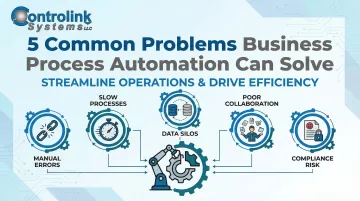
Business process automation (BPA) in manufacturing means using software and integrated systems to handle repetitive shop-floor tasks automatically — program delivery to CNC machines, data collection, approval routing, and more. This article covers five specific problems BPA solves, with each one rooted in situations machine shops deal with daily.
Key Takeaways
- Automation pushes approved CNC programs directly to machines, cutting scrap from manual file errors
- BPA connects ERP, MES, and shop-floor equipment into one unified production view
- Automated workflows route approvals and escalate delays without waiting on a supervisor
- Real-time alerts catch idle machines before undetected downtime costs thousands
- Existing staff produce more output once automation removes low-value manual tasks
Problem 1: Manual Data Entry and Wrong File Errors
The $120,000 Cost of a Single Setup Mistake
A machinist manually selects what appears to be the correct NC program version, machines a batch of parts to outdated specs, and the shop discovers the error only during inspection. The downstream cost compounds rapidly: scrapped material, rework labor, delivery delay, and potentially lost customer trust.
In aerospace and medical machining, a single scrapped part can cost $150 to $900. A wrong-tool-in-pocket crash from a simple data entry error can result in $12,000 to $40,000 in spindle damage.
This isn't an isolated incident. Manual file selection, handwritten job travelers, and verbal program change communications are standard practice in many shops—and create systemic risk every shift. Human error drives up to 80% of manufacturing defects, and in automotive CNC machining, rework rates can reach 15% in high-volume shops.
Operators may input the wrong tool length, zero point, or fixture offset. Even a transposed number in the offset table is one of the most expensive mistakes a CNC shop can make.
How Automation Eliminates the Wrong-Version Problem
Business process automation addresses this through automated DNC (Direct Numerical Control) systems that push the correct, engineering-approved program directly to the machine the moment a job is scheduled. The machinist never selects a file manually, never walks to a server, and never asks engineering which version to run.
Controlink's shop-floor software is built around this workflow, ensuring machinists always receive the latest approved files without leaving their workstation. Automating program delivery removes the manual selection step entirely—the point where wrong-version errors begin.
Measurable ROI in Reduced Scrap and Faster Cycles
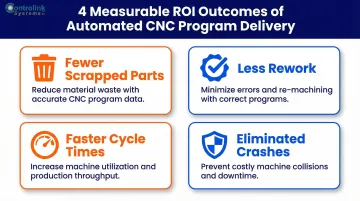
The ROI here is direct and measurable:
- Fewer scrapped parts — Eliminating manual file selection removes the primary source of wrong-version errors
- Less rework — Correct programs from the start mean first-article acceptance rates improve dramatically
- Faster cycle times — Operators spend time machining parts instead of hunting for files or verifying versions
- Eliminated crashes — Digital validation prevents tool pocket mismatches and offset errors before the first cut
Tool presetters and automated setup validation systems compound these gains by moving tool measurements outside the machine, automating data collection, and sending validated tool data directly to the CNC control. For most shops, the scrap reduction alone covers the cost of automation within the first year.
Problem 2: Disconnected Systems and Data Silos
When Engineering Changes Don't Reach the Shop Floor
Engineering updates a CNC program in the CAM system, but the shop floor is still running the old version because there's no live link between systems. Changes don't propagate until someone physically delivers a USB drive or sends an email—and by then, another batch may already be in process. This scenario plays out daily in shops where systems operate as isolated islands.
The broader version of this problem affects entire operations: 73% of manufacturers report their production, quality control, and supply chain systems do not fully integrate. An order change in the ERP doesn't automatically update the shop floor schedule. Quality data captured on the floor never flows back to management dashboards. Companies lose 20% to 30% of their revenue annually due to inefficiencies caused by data silos, and 70% of manufacturers still rely on manual data collection processes.
Connecting the Shop Floor Ecosystem
BPA solves this through system integration: connecting disconnected systems so they share data in real time. When ERP, MES, quality management, and CNC machines communicate automatically, every operator and manager works from the same current data — not multiple conflicting versions.
That's where Controlink's system linking approach comes in. By interfacing CNC/DNC systems with SQL databases, PLCs, and multi-axis motion controllers via protocols like Modbus, EtherCAT, and Profinet, engineering changes, quality alerts, and production status flow automatically across the shop — no USB drives, no manual re-entry.
Quantified Benefits of Integration
Real integration delivers measurable improvements:
| Integration Benefit | Improvement | Context |
|---|---|---|
| Scrap Reduction | 60% decline | Post-cloud ERP implementation |
| Training Costs | 50% reduction | Consistent interface across functions |
| Logistics Costs | 20% reduction | Improved inventory accuracy |
| Administrative Savings | $100 per purchase order | Automated receipt matching |
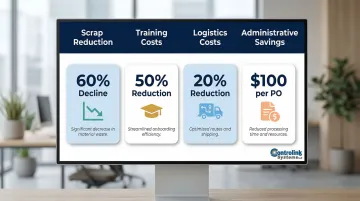
Connected systems eliminate the manual handoffs that slow shops down. Operators stop re-entering data. Managers see accurate floor status without chasing it down. And when a quality alert fires at one station, the right people know immediately — before the next batch runs.
Problem 3: Approval Bottlenecks and Workflow Delays
The 45-Minute Wait for a 30-Second Decision
A machine needs a tooling change that requires supervisor sign-off, but the supervisor is on the production floor, unreachable by email, and the operator simply waits. The machine sits idle for 45 minutes waiting on a decision that takes 30 seconds to make. The lost capacity is never recovered, and the operator's frustration builds.
This pattern repeats constantly: purchase order approvals, engineering change order sign-offs, maintenance work order releases, and quality disposition decisions all get stuck in manual, person-dependent queues. Even in 2024, 25% of manufacturers still use paper-based systems to track quality, creating slow, error-prone workflows that don't scale with production demands.
When engineering changes arrive on the shop floor late, workers execute production tasks based on outdated work orders — leading to errors, rework, and longer lead times.
Automated Workflow Routing and Escalation
BPA addresses this by removing the human bottleneck from routine routing decisions. A well-configured workflow system will:
- Route approval requests to the right person automatically based on request type and value
- Send mobile notifications so supervisors respond from anywhere on the floor
- Escalate unanswered items after a defined window — no manual follow-up required
- Deliver the latest work orders and assembly instructions directly to the shop floor
Nothing sits in limbo. Machines keep running.
By automating administrative bottlenecks — billing, approvals, data entry — small teams redirect those hours toward actual production work. Productivity increases without adding headcount.
Problem 4: No Real-Time Visibility Into Machine Performance and Downtime
The $47,000-Per-Hour Blind Spot
A CNC machine has been sitting idle for 30 minutes but no alert was triggered, no ticket was created, and no supervisor knows. By the time it's discovered, the shift has lost an hour of productive capacity. Discrete manufacturing downtime costs an average of $47,000 per hour, and the average manufacturer faces roughly 800 hours of downtime annually, with equipment failures accounting for about 42% of that downtime.
Without automated monitoring, shops rely on operators to self-report problems — which leads to underreporting, delayed responses, and a management team flying blind on actual machine utilization.
The true cost includes what machinists call the Restart Tax: when a CNC machine goes down unexpectedly and comes back up, it needs 15-45 minutes to reach thermal stability, and the first batch after restart is often scrap. That penalty adds 30-120 minutes of lost production beyond the actual repair time.
Real-Time Monitoring and Predictive Maintenance
BPA-enabled process monitoring changes this. Automated data collection from machine controllers, sensors, and PLCs feeds real-time dashboards and triggers alerts when machines go idle or fault conditions arise. It also creates a timestamped record for post-shift analysis. Instead of discovering problems after the fact, supervisors receive instant notifications the moment a machine enters an abnormal state.
The performance gap between shops with and without real-time visibility is stark. Modern Machine Shop's Top Shops benchmarking data shows that industry-leading shops achieve a median Overall Equipment Effectiveness (OEE) of 73%, versus 65% for standard shops — an 8-point advantage that translates directly to capacity and profitability.
Manual OEE tracking (clipboards and spreadsheets) fails to capture critical downtime and quality events, misreporting production by as much as 50%.
Real-time monitoring delivers measurable results across the shop floor:
- Reduces unplanned downtime by 30-50% through IIoT monitoring with predictive maintenance
- Cuts operator overtime — one major machine tool manufacturer reduced it by 100 hours per month after MES deployment
- Improves OEE by up to 42%, based on documented post-implementation results
- Shifts maintenance from reactive firefighting to scheduled, data-driven interventions
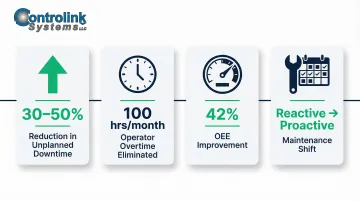
For job shops running on tight margins, that shift from reactive to proactive isn't just an operational improvement — it's the difference between a profitable quarter and one spent explaining missed deadlines.
Problem 5: Scaling Production Without Proportionally Increasing Labor
The 1.9 Million Unfilled Jobs Crisis
The manufacturing labor shortage is real and ongoing. The U.S. manufacturing sector faces a projected need for 3.8 million new workers by 2033, with 1.9 million of those roles at risk of going unfilled. The cost of those missing jobs could potentially total $1 trillion in 2030 alone. Finding skilled machinists and operators is harder and more expensive than it was a decade ago, and expecting headcount growth to solve output problems isn't viable for most shops.
As of August 2025, roughly 409,000 manufacturing positions sat unfilled. Attracting and retaining talent ranks as the top business challenge for over 65% of respondents in the National Association of Manufacturers' outlook survey. The workforce pipeline simply isn't keeping pace — and shops can't hire their way out of the gap.
Extracting More Output From Existing Staff
Business process automation allows shops to extract more output from existing staff by eliminating low-value, time-consuming manual tasks. Operators spend time machining parts instead of walking across the shop, hunting for files, or re-entering data. Automation decouples growth from headcount, making it the only mathematically viable way to scale output.
Real-world examples demonstrate the impact:
- 3 machines with 44 pallets and 400 tools operated by just 2 people — enabled by palletized automation
- $10,000 in cost savings achieved through cobot machine tending, with operators shifted to higher-skill work
- Setup time cut by 42% through automated fixturing, pushing spindle utilization from 38% to 60%+
- 64 hours of unattended machining time added per week via lights-out secondary operations
When automation handles the repetitive, low-skill tasks, experienced operators can focus on the work that actually requires their judgment. The result: shops gain the output equivalent of an additional machine without adding equipment or headcount — a meaningful advantage when skilled labor isn't available at any wage.
Frequently Asked Questions
What is business process automation in manufacturing?
BPA in manufacturing refers to using software and integrated systems to automate repetitive, manual tasks on the shop floor—such as program delivery to CNC machines, data collection, and approval routing—to improve speed, accuracy, and productivity.
What are the benefits of business process automation?
Key benefits include reduced human error, faster throughput, real-time data visibility, lower scrap rates, and the ability to scale output without equivalent headcount growth. Shops that automate even a handful of manual processes typically see measurable gains in quality and output within the first few months.
What challenges does business process automation present and how can they be resolved?
Common challenges include integrating with legacy equipment, upfront implementation effort, and operator change resistance. These are addressed by choosing software built specifically for legacy CNC environments—solutions with straightforward interfaces that shorten the learning curve and reduce resistance on the shop floor.
How does automation reduce scrap and rework in a machine shop?
Automation eliminates the manual file selection and data entry steps where wrong-version errors originate, ensuring every machine runs the correct, engineering-approved program every time. This removes the primary source of costly scrap and rework.
Can small machine shops benefit from business process automation?
Yes. BPA scales to small shops—even automating one or two high-error or high-delay processes can deliver measurable ROI in reduced scrap, faster cycle times, and less supervisory time spent chasing problems. A single targeted fix builds confidence and makes the case for going further.
Where should a machine shop start with business process automation?
Identify your single highest-cost manual process—often file management or approval workflows—and start there. Small, targeted automation projects build confidence and deliver fast, visible results before expanding scope.