Introduction
Modern manufacturing faces persistent challenges that trace back to one root cause: uncontrolled or poorly managed process variables. Inconsistent quality, unplanned downtime, and excessive scrap all stem directly from inadequate control of temperature, pressure, flow rate, and other critical parameters.
Industrial process control systems eliminate these problems by continuously monitoring and automatically adjusting process variables to keep production on target with minimal manual intervention.
This guide provides engineers and shop managers with a complete reference for understanding or upgrading control infrastructure. We'll cover the definition of industrial process control, its core components, system types, key controllers, measurable benefits, and common challenges—so you can evaluate where your current setup falls short and what to do about it.
Key Takeaways
- Industrial process control systems automatically monitor and adjust variables like temperature, pressure, flow rate, and speed to maintain target conditions with minimal manual intervention
- Core components include sensors, controllers (PLCs, DCSs), HMIs, communication networks, and final control elements like valves and actuators
- Continuous, discrete, and batch control are the three primary system types, each suited to different production environments and material flows
- Implementing the right system reduces scrap, cuts downtime, improves product consistency, and enables predictive maintenance
- Key controller types include PLCs for discrete/CNC manufacturing, DCSs for large continuous plants, and SCADA for remote supervisory monitoring
What Is an Industrial Process Control System?
Industrial process control is the automated monitoring and adjustment of process variables—temperature, pressure, flow rate, chemical composition, and machine speed—using feedback loops to maintain target operating conditions without constant human intervention. According to the National Institute of Standards and Technology (NIST), an Industrial Control System (ICS) includes SCADA systems, Distributed Control Systems (DCS), and Programmable Logic Controllers (PLC) used to control industrial processes such as manufacturing, product handling, production, and distribution.
Process control vs. basic automation Basic automation follows fixed, preset sequences—turn on motor A, wait 10 seconds, open valve B. Process control continuously adapts in real-time to deviations, comparing actual output against desired setpoints and correcting course as conditions shift. This closed-loop approach enables systems to respond to disturbances automatically, maintaining stability even as conditions change.
The term covers a wide spectrum of complexity—from a single-loop PID controller governing one machine to a distributed control system orchestrating hundreds of loops across an entire facility.
The scale of adoption reflects this trajectory. The International Federation of Robotics reports that global automated robot density reached a record 162 units per 10,000 manufacturing employees in 2023, more than doubling from 74 units seven years prior. Manufacturing's shift toward automated control is no longer emerging—it's well underway.
Core Components of a Process Control System
Sensors and Transmitters
Sensors serve as the "eyes" of the control system, converting real-world process conditions—temperature, pressure, flow, vibration, level—into usable electrical or digital signals. Without accurate sensor data, no automated adjustment is possible. The global Industrial Sensors Market was valued at $27.97 billion in 2024 and is projected to reach $42.1 billion by 2029, driven heavily by the Industrial Internet of Things (IIoT).
Modern smart sensors perform onboard self-diagnostics, report device status, and share fault information, enabling more intelligent alarms and reducing reactive maintenance. For example, the HART (Highway Addressable Remote Transducer) protocol superimposes a digital signal on a traditional 4–20 mA analog signal, allowing diagnostic data to be transmitted alongside the primary process variable.
Sensor calibration drift remains a persistent challenge. Drift is a gradual deviation from calibrated values that occurs without any corresponding change in the actual measured condition, driven by temperature fluctuations, mechanical stress, and contamination. Left unchecked, drift introduces process variability that undermines product consistency.
Controllers and the Control Loop
Controllers (PLCs, DCSs, PACs) receive sensor data, compare actual readings against programmed setpoints, and calculate corrective outputs using control algorithms—most commonly PID (proportional-integral-derivative) control.
The PID algorithm calculates an error value as the difference between a measured process variable and a desired setpoint, then computes a control action across three terms: the present error (Proportional), the accumulation of past errors (Integral), and a prediction of future errors (Derivative).
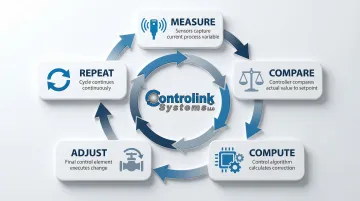
The continuous control loop cycle operates as follows:
- Measure — Sensors capture current process variable
- Compare — Controller compares actual value to setpoint
- Compute — Control algorithm calculates required correction
- Adjust — Final control element executes the change
- Repeat — Cycle continues continuously
A primary survey of over 11,000 controllers in the refining, chemicals, and pulp and paper industries found that 97% of regulatory controllers use a PID feedback control algorithm. Yet proper loop tuning is critical—poor tuning causes overcorrection, oscillation, or sluggish response that undermines process stability. Historical industry audits reveal that over 30% of process controllers operate in manual mode, 25% rely on default factory tuning, and 30% fail due to equipment issues like valve stiction.
HMIs, Actuators, and Communication Networks
Human-Machine Interfaces (HMIs) display real-time process data, active alarms, and control options for operators. Intuitive HMI design directly reduces training time and lowers the risk of errors on the shop floor. The ANSI/ISA-101.01-2015 standard provides guidelines for HMI design to enhance operator performance and situational awareness. Poor HMI design forces operators to rely on memory or guesswork, increasing cognitive load and contributing to accidents and production losses.
For machining environments specifically, HMI software built around machine tool workflows—like the solutions Controlink Systems LLC has developed since 1998—reduces training costs by presenting only the data operators actually need, without the clutter of general-purpose interfaces.
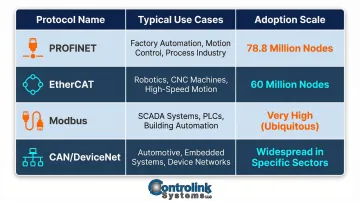
Final control elements—valves, motors, drives, and actuators—physically execute controller commands. These components communicate via industrial protocols such as Modbus, EtherCAT, Profinet, and CAN, which are essential for integrating diverse equipment into a unified system.
Key Industrial Communication Protocols:
| Protocol | Typical Use Cases | Adoption Scale |
|---|---|---|
| PROFINET | PLC-to-PLC communication, manufacturing line control, process control | 78.8 million installed nodes globally (2024) |
| EtherCAT | Multi-axis servo synchronization, robotics, CNC machines | De facto standard for motion control; achieves ±1µs sync precision |
| Modbus | Measurement instruments, power meters, temperature control | Hundreds of thousands to millions of devices |
| CAN/DeviceNet | Factory automation, electrical drives, limit switches | Millions of nodes installed |
Main Types of Industrial Process Control Systems
Different production environments require different control strategies. Many manufacturing facilities layer multiple approaches within a single operation for maximum effectiveness.
Continuous Process Control
Continuous process control maintains steady-state operations where materials flow uninterrupted through the system. Typical applications include chemical processing, oil refining, power generation, and water treatment—environments where stopping production is either costly or impossible. Interruptions in continuous processes carry massive financial penalties: 83% of decision-makers agree unplanned downtime costs a minimum of $10,000 per hour, with 76% estimating costs up to $500,000 per hour.
Discrete Process Control
Discrete control manages individual manufacturing steps with distinct start and stop points. This approach is directly relevant to CNC machining, assembly lines, robotic cells, packaging operations, and end-of-line testing—environments where each part or unit is processed separately and traceability of individual actions matters. According to the 2021 US Census Bureau Annual Survey of Manufactures, the value of shipments for discrete sectors is massive: Transportation Equipment reached $826.6 billion, Machinery reached $354.9 billion, and Computer and Electronic Products reached $308.5 billion.
Batch Process Control
Batch control follows recipe-driven production with precise sequences, defined ingredient quantities, timing, and processing phases. The ISA-88.00.01-2010 standard (Batch Control – Part 1: Models and Terminology) establishes a consistent set of models and terminology for batch control systems, using a modular approach that scales with production needs.
Batch processes are prevalent in pharmaceuticals, food and beverage, biotech, and specialty chemicals where product consistency and regulatory traceability are critical. In regulated industries, batch processes must comply with strict traceability requirements such as FDA 21 CFR Part 11 (US) and EudraLex Volume 4, Annex 11 (Europe).
Advanced Control Strategies
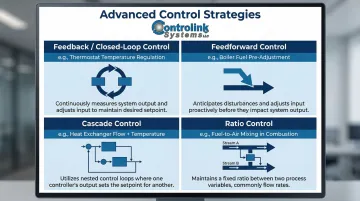
Most systems rely on one or more of four core strategies:
- Feedback (closed-loop) control — the most common approach; measures output and adjusts inputs to correct deviations in real time
- Feedforward control — anticipates disturbances before they affect output by measuring key disturbance variables and acting preemptively
- Cascade control — uses a secondary feedback loop to detect upsets sooner than the primary variable can; commonly applied to furnace temperature where an inner loop manages fuel gas pressure
- Ratio control — maintains proportional relationships between variables, keeping product quality consistent in chemical blending and stoichiometric reactant applications
Key Controllers Used in Industrial Process Control
Programmable Logic Controllers (PLCs)
PLCs are the primary industrial workhorse for discrete manufacturing and high-speed operations. Their rugged design withstands harsh environments — vibration, extreme temperatures, electrical noise — making them ideal for controlling CNC equipment, robotics, conveyor systems, and packaging lines.
PLCs use ladder logic programming and conform to strict industrial standards:
- IEC 61131-3 — defines PLC programming languages
- IEC 60529 — governs Ingress Protection ratings
- UL 508A — covers Industrial Control Panel requirements
The global PLC market is projected to grow from $13.33 billion in 2026 to $16.4 billion by 2031, driven by Industry 4.0 adoption. Modern PLCs can also handle continuous process loops when scaled appropriately.
Distributed Control Systems (DCS)
DCS are plant-wide, modular control systems designed to monitor and manage large numbers of interconnected control loops in continuous manufacturing environments. A centralized supervisory loop mediates a group of localized controllers that share production tasks — modularizing the system to limit the impact of any single fault.
The result is a unified HMI and alarm environment across an entire facility, reducing operator confusion and enabling centralized oversight. Major DCS vendors include ABB, Emerson, Honeywell, Siemens, and Yokogawa. The global DCS market is expected to reach $29.32 billion by 2030, growing at a CAGR of 6.3% from 2025.
SCADA Systems
SCADA (Supervisory Control and Data Acquisition) systems are built for remote monitoring and control of geographically distributed assets—pipelines, power grids, water treatment networks. SCADA integrates with field-level PLCs and RTUs to aggregate data, display it centrally, and trigger supervisory-level commands. A SCADA control center performs centralized monitoring over long-distance communications networks, making it ideal for infrastructure and utility applications.
PACs and HMIs
Programmable Automation Controllers (PACs) are advanced successors to PLCs, combining multi-domain control — logic, motion, process, and vision — within a single platform. Unlike standard PLCs, PACs offer direct connectivity to MES and ERP systems, making them well-suited for plant-wide deployments that span analog and high-speed discrete control.
HMIs are the critical operator interface across all controller types. Purpose-built HMI software reduces training costs and supports continuous uptime by providing intuitive, context-aware interfaces tailored to specific workflows. Controlink Systems, an NI Partner Network member since 2000, develops HMI solutions on NI hardware and software platforms specifically for machining and discrete manufacturing environments.
Key Benefits of Industrial Process Control
Key Benefits of Industrial Process Control
Improved Product Quality and Consistency
Tight, automated control of process variables reduces output variation, lowers defect rates, and ensures every part or batch meets spec consistently. Scrap and rework costs consume a median of 1.0% of annual manufacturing sales — a financial drain that process control directly targets.
The data backs this up. In automotive CNC machining, re-engineering fixturing and implementing in-process probing reduced scrap from 6% to 0.8% and pushed first-pass yield above 98.5%. A separate study using root-cause identification in CNC cutting reduced dimensional rejection rates from 11.87% to 1.92%.
Increased Throughput and Efficiency
Fewer process upsets mean less unplanned downtime and equipment running closer to rated capacity. Production can be accelerated with confidence because the system continuously monitors and corrects performance before defects accumulate.
The financial exposure is real: a 2024 Siemens report found that one hour of downtime costs $2.3 million in the automotive sector. ITIC's 2024 survey puts the average hourly downtime cost above $300,000 for over 90% of mid-size and large enterprises.
Safety and Predictive Maintenance
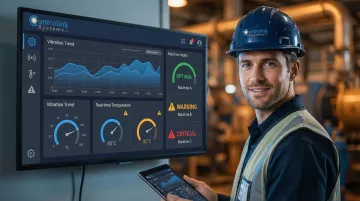
Those downtime costs point to an equally important dimension: operational risk. Automated alarm management and safety interlock logic protect personnel by responding faster than any human reaction time. Shifts in vibration signatures, temperature trends, or performance deviations signal impending failure — enabling scheduled maintenance instead of emergency shutdowns.
AI-driven machine-health monitoring delivers measurable results: 50% less unplanned downtime and 40% lower maintenance costs, according to Siemens. In one SKF case study at a paper mill, wireless vibration monitoring caught worn rotor bars weeks before failure — saving $60,000 in downtime and lost production.
Common Challenges and Implementation Best Practices
Common Challenges
Manufacturing operations face several persistent challenges with process control:
- Sensor calibration drift leading to inaccurate process readings and increased variability
- Poor PID loop tuning — over 30% of industrial controllers run in manual mode due to tuning difficulties, 25% rely on default factory parameters, and another 30% fail due to equipment issues like valve stiction
- Integration difficulties when connecting modern control software with legacy CNC or shop-floor equipment using incompatible protocols
- Cybersecurity exposure as more connected systems create more entry points for attackers — the manufacturing sector experiences extortion (29%) and data theft (24%) as leading attack impacts, according to the IBM X-Force 2025 Threat Intelligence Index
Implementation Best Practices
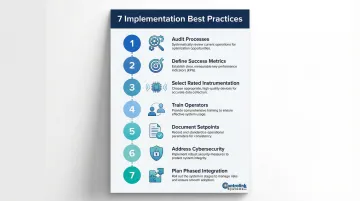
Manufacturing shops evaluating or upgrading process control should follow these practical steps:
- Audit your processes first — identify high-variability, high-scrap, or frequently interrupted operations as the priority targets
- Define success metrics before implementation — for example, target scrap rate reduction, cycle time improvement, or OEE gains
- Select instrumentation rated for your environment — temperature swings, coolant exposure, and vibration all degrade sensors that aren't specified for shop-floor conditions
- Train operators on control principles, not just interface navigation, so they can recognize and respond to anomalies before small deviations become scrapped parts
- Document all setpoints, alarm thresholds, and configuration changes — this record supports faster troubleshooting and simplifies compliance audits
- Address cybersecurity using authoritative frameworks such as NIST Special Publication 800-82 Rev. 3 and the ISA/IEC 62443 series of standards, which define requirements for securing operational technology (OT) environments
- Plan phased integration for legacy equipment. The average CNC machine in production was 8.7 years old as of 2024, and many OT systems run on infrastructure developed decades earlier — incompatible with modern security and communication standards by design.
For CNC and discrete manufacturing environments, purpose-built DNC communication and shop-floor automation software is worth prioritizing. Controlink Systems LLC builds solutions specifically for this — connecting machine tools, transferring engineering-approved programs reliably, and reducing manual intervention on the production floor.
Frequently Asked Questions
What is an industrial process control system?
An industrial process control system automatically monitors and adjusts process variables using sensors, controllers, and actuators to maintain optimal production conditions and minimize the need for manual intervention. It uses feedback loops to continuously compare actual performance against target setpoints and make real-time corrections.
What are the main types of industrial process control systems?
Continuous, discrete, and batch control are the three primary categories. Continuous handles steady-state operations (oil refining, chemical processing); discrete manages individual steps in CNC machining and assembly; batch follows recipe-driven sequences in pharmaceuticals and food production. Most facilities use a combination.
What are the main types of controllers used in industrial process control systems?
Four controller types dominate industrial environments: PLCs (best for discrete, high-speed CNC operations), DCS (plant-wide continuous processes), SCADA (geographically distributed asset monitoring), and PACs (multi-domain control in a single platform). The right choice depends on your process type, scale, and integration requirements.
What is the difference between a PLC and a DCS?
PLCs control individual machines or defined process areas and excel in discrete, high-speed tasks like CNC machining and robotic assembly. DCS manages plant-wide continuous processes with tighter loop integration and a unified operator interface across many control points, making it ideal for chemical plants, refineries, and large-scale continuous manufacturing.
How do process control systems help reduce scrap and downtime in manufacturing?
Real-time deviation detection catches problems before defects accumulate, and automated alarms prevent unplanned stoppages. Studies show process control can cut dimensional rejection rates from 11.87% to 1.92% and scrap from 6% to 0.8%. Predictive maintenance enabled by these systems reduces unplanned downtime by up to 50%.
Can process control systems integrate with existing CNC machines and shop equipment?
Yes. Modern systems use standard industrial protocols (Modbus, EtherCAT, Profinet, CAN) and software middleware to connect legacy CNC equipment. Phased integration approaches allow shops to extend asset life while progressively adding modern control capabilities. Many facilities successfully integrate equipment with an average age of 8+ years into modern control architectures using protocol converters and purpose-built communication software.