Introduction
Production lines in modern manufacturing facilities generate thousands of process data points every second — spindle load, cutting force, temperature, vibration, dimensional output — yet most shops still rely on end-of-shift reports or manual spot checks to catch problems. By the time a defect is discovered, dozens or hundreds of parts may already be scrap.
Real-time process analysis tools close this gap by connecting live machine data directly to quality, throughput, and cost outcomes. The financial stakes are significant: Cost of Poor Quality (COPQ) consumes 5% to 30% of total sales revenue in manufacturing, and the real number often runs 10 times higher than visible scrap costs once hidden rework and downtime are factored in.
This guide covers the top manufacturing process analysis tools built for real-time data — what sets each apart and how to match the right platform to your operation.
Key Takeaways
- Real-time analysis tools pull live data from machines and sensors to drive faster, more accurate decisions
- Top platforms combine hardware integration, configurable dashboards, alerting, and database connectivity in one place
- Key selection criteria: protocol support (Modbus, OPC-UA, EtherCAT), CNC/PLC compatibility, and shop-floor scalability
- Tools covered: Controlink Systems LLC, NI LabVIEW/InsightCM, Ignition by Inductive Automation, AVEVA PI System, Siemens Opcenter Analytics
- Match the platform to your process complexity and IT/OT requirements — no single tool fits every facility
What Real-Time Process Analysis Actually Means on the Shop Floor
Real-time process analysis is the continuous measurement and interpretation of process variables — speed, force, temperature, vibration, dimensional output — against defined process limits as production occurs, not after a batch is complete.
The distinction from traditional Statistical Process Control (SPC) matters: real-time systems stream live data with immediate alerting, while traditional SPC reviews data after the fact.
Why the Distinction Matters for Scrap Reduction
A 2023 study on predictive scrap reduction in automotive stamping using deep learning-enabled digital SPC detected impending out-of-control conditions just 0.5 seconds before conventional SPC triggers — providing a lead time of roughly 3 strokes (about 3 seconds) to initiate an automatic press stop before producing a bad part. This early detection achieved up to 96% accuracy in scrap prediction and enabled scrap reduction of up to 50% in real production environments.
The Architecture That Makes It Possible
Those results depend on a specific infrastructure. The typical real-time process analysis stack flows as follows:
- Sensors and data acquisition hardware capture process variables at the machine level (force transducers, thermocouples, accelerometers, dimensional probes)
- Communication layer transmits data via industrial protocols — OPC-UA, Modbus, EtherCAT, Profinet, or serial connections
- Software platform receives, processes, and interprets live data streams against configured limits and rules
- Dashboards and alerts surface actionable information to operators and engineers in real time
- Historian or SQL database archives time-series data for trend analysis, root-cause investigation, and continuous improvement
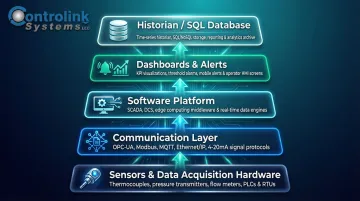
Each layer in this stack is a potential point of failure — and the tools you choose at the software layer determine how quickly a signal at the sensor becomes a corrective action on the floor.
Best Manufacturing Process Analysis Tools for Real-Time Data
The tools below represent the strongest options available for real-time process data in manufacturing environments. Each was evaluated on real-time data acquisition capability, hardware and protocol compatibility, ease of deployment in a shop environment, integration with existing CNC/PLC infrastructure, and demonstrated use in precision manufacturing settings.
Controlink Systems LLC
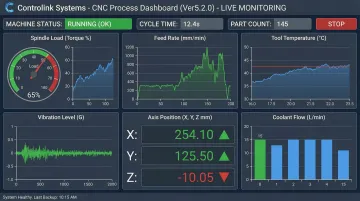
Controlink Systems LLC (Lawrenceburg, IN) has provided NI-based software and hardware solutions for high-speed process monitoring, CNC/DNC communications, shop-floor automation, and end-of-line testing since 1998. Customers include Timken, 3M, Oak Ridge National Laboratory, and Busche Enterprises.
Controlink stands out for its depth of manufacturing-floor integration: the platform routinely interfaces with SQL databases, PLC hardware, and single/multi-axis motion controllers, and supports a wide range of protocols (CAN, UDS, Modbus, Serial, Profinet, EtherCAT). Its user-friendly HMI interfaces are designed for the everyday shop environment — reducing training overhead while keeping critical process data visible and actionable.
| Attribute | Details |
|---|---|
| Key Features | High-speed process monitoring, CNC/DNC communications, vibration analysis, EOL testing, shop-floor automation, configurable HMI dashboards |
| Protocol & Integration Support | CAN, UDS, Modbus, Serial, Profinet, EtherCAT; SQL database and PLC connectivity; NI hardware and software ecosystem |
| Best Fit For | CNC machine shops, precision machining, automotive and aerospace manufacturers, research and test environments needing NI-based solutions |
NI LabVIEW / InsightCM
National Instruments (now part of Emerson following an $8.2 billion acquisition completed in October 2023) offers LabVIEW for custom data acquisition and process control applications, alongside InsightCM for condition monitoring — both widely deployed in precision manufacturing, test cells, and industrial research environments.
LabVIEW's graphical programming environment allows engineers to build tailored real-time monitoring applications that interface directly with NI DAQ hardware, PLCs, and third-party instruments. InsightCM adds purpose-built machinery health monitoring with automated fault detection and trending. At the time of acquisition, NI reported serving approximately 35,000 customers across semiconductor, electronics, transportation, and aerospace markets.
For example, Jetek Technology used NI PXI hardware and LabVIEW FPGA Module to develop a 32-site MEMS microphone test system, increasing testing speed by roughly 20X through concurrent FPGA processing.
| Attribute | Details |
|---|---|
| Key Features | Graphical system design, real-time DAQ, signal processing, automated fault detection, customizable dashboards |
| Protocol & Integration Support | OPC-UA, Modbus, EtherCAT, serial, NI hardware ecosystem; database and cloud connectivity |
| Best Fit For | Engineers building custom test and monitoring applications; facilities already invested in NI hardware infrastructure |
Ignition by Inductive Automation
Ignition is a web-based SCADA/MES platform used across discrete and process manufacturing for real-time data visualization, alarming, and historian functions. It is widely adopted in plants where a single platform needs to bridge OT devices and enterprise systems.
Ignition's unlimited tag licensing and OPC-UA connectivity allow it to pull live data from virtually any PLC or controller brand without per-tag cost penalties. Its integrated SQL database support and scripting environment make it well-suited for shops that want real-time dashboards connected directly to production databases. The platform is used by 69% of Fortune 100 companies and 44% of Fortune 500 companies, with thousands of installations across more than 140 countries.
| Attribute | Details |
|---|---|
| Key Features | Real-time SCADA dashboards, OPC-UA data acquisition, historian, alarming, MES modules, unlimited tag licensing |
| Protocol & Integration Support | OPC-UA, Modbus TCP/RTU, MQTT, SQL databases (MySQL, MSSQL, Oracle), REST API |
| Best Fit For | Multi-machine or multi-line facilities needing scalable, cross-vendor real-time visibility without per-tag licensing cost |
AVEVA PI System
The AVEVA PI System (formerly OSIsoft PI, acquired by AVEVA for $5.0 billion in March 2021) is the industrial standard for operational data infrastructure — collecting, storing, and contextualizing time-series process data from sensors, controllers, and machines across large manufacturing operations.
PI System's strength lies in its historian and data contextualization layer, which gives process engineers a searchable, high-resolution record of every process variable for root-cause analysis and continuous improvement. The system is used by 25 of the top 25 pharma companies and 9 of the top 10 mining companies, and 75% of the world's crude oil, natural gas, and liquids are produced using the AVEVA PI System.
| Attribute | Details |
|---|---|
| Key Features | High-speed time-series historian, asset framework for data contextualization, real-time dashboards, analytics and reporting |
| Protocol & Integration Support | OPC-UA/DA, Modbus, PI connectors for 450+ data sources, integration with ERP/MES systems |
| Best Fit For | Large or multi-site manufacturing operations requiring enterprise-grade process data infrastructure and long-term trend analysis |
Siemens Opcenter Analytics
Siemens Opcenter Analytics (part of the Opcenter MES suite) provides real-time and historical production analytics with pre-built KPI models for OEE, quality, throughput, and yield — targeted at discrete manufacturing environments.
Opcenter Analytics connects directly to machine data, MES records, and ERP systems to surface actionable insights without requiring manual data aggregation. Its pre-built manufacturing analytics library reduces deployment time compared to building custom dashboards from scratch. In a notable deployment, Egicon (electronics/automotive) integrated Opcenter Execution Electronics IoT and Valor software, reducing their repair rate by 80% (from 30 ppm to 6 ppm) and achieving a scrap rate of zero percent in 2019.
| Attribute | Details |
|---|---|
| Key Features | Pre-built OEE/quality KPI models, real-time production dashboards, anomaly detection, drill-down root-cause analysis |
| Protocol & Integration Support | OPC-UA, SAP/ERP integration, Siemens MES ecosystem, REST APIs |
| Best Fit For | Mid-to-large discrete manufacturers, particularly those already using Siemens automation or MES infrastructure |
How We Selected These Tools
Each tool on this list was evaluated against four criteria: real-time data acquisition architecture (not just post-process reporting), native hardware and protocol compatibility with shop-floor equipment, scalability from single-machine to multi-line deployments, and a demonstrated track record in precision or high-volume manufacturing environments.
Common selection mistakes manufacturers make:
- A visually impressive demo doesn't confirm the platform can connect to your Fanuc controllers or legacy Modbus PLCs — expect months of integration delays and middleware costs if you choose on aesthetics alone.
- Assuming "OPC-UA support" means seamless integration often leads to forced hardware upgrades when machines actually expose data via proprietary serial protocols or require specific driver versions.
- Real-world deployments require network segmentation, firewall rules, security reviews, and IT/OT coordination — not a simple software install. Companies routinely underestimate IoT project costs by 40-60%, and 75% of manufacturing software initiatives fail to deliver meaningful results.
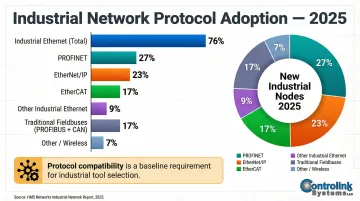
That third point on protocol compatibility isn't theoretical. According to HMS Networks' 2025 industrial network analysis, Industrial Ethernet now accounts for 76% of new nodes globally, with PROFINET (27%), EtherNet/IP (23%), and EtherCAT (17%) leading adoption. Traditional fieldbuses like PROFIBUS and CAN have dropped to 17% combined. Protocol compatibility is a baseline requirement — your process analysis tool must speak the languages your machines already use.
Conclusion
The right real-time process analysis tool is one that fits your specific machine communication infrastructure, data volume requirements, and the skill level of the people who will use it daily — not just the one with the most features on a spec sheet.
Evaluate tools against live pilot conditions before committing to a facility-wide rollout. A practical starting sequence:
- Connect to one machine or cell first — validate data accuracy and alert responsiveness
- Expand to a second cell — confirm the integration holds under real production load
- Scale facility-wide — with known configurations and trained operators already in place
This phased approach surfaces integration challenges early, while they're still low-cost to fix.
For shops that need a process monitoring solution bridging CNC/DNC communications, shop-floor automation, and real-time data analysis — without a steep learning curve — Controlink Systems LLC has been developing and deploying these systems since 1998. Their team works with machine shops, automotive facilities, and precision manufacturers to configure solutions around your specific environment. Call (800) 838-3479 to talk through your setup and what integration would actually look like.
Frequently Asked Questions
What type of system provides real-time process data for manufacturing decision-making?
SCADA systems, dedicated process monitoring platforms, and MES solutions with live data acquisition modules are the primary system types. Each pulls data from sensors, PLCs, and CNC controllers via industrial protocols like OPC-UA or Modbus to deliver process data directly to operators and plant managers.
Which tools link real-time process data to manufacturing rules?
Platforms like Ignition, Siemens Opcenter, and specialized tools like those from Controlink Systems can be configured with rule-based logic: threshold alerts, SPC limits, and automated responses. This logic acts on live process data, triggering alarms, stopping machines, or logging events when defined conditions are met.
How do you implement real-time process data integration with manufacturing rules?
Connect the data source — sensor, PLC, or CNC — to the monitoring platform using a supported protocol. Then configure tags for each process variable and define rule logic (alarm thresholds, SPC limits, interlocks) that the software evaluates against incoming data in real time.
What is the difference between process monitoring and process analysis in manufacturing?
Process monitoring is the continuous, real-time observation of process variables against set limits, alerting when something goes out of range. Process analysis involves interpreting historical and live data to understand root causes, trends, and improvement opportunities. The best tools support both functions in a unified platform.
Can real-time manufacturing data tools integrate with existing CNC machines and PLCs without replacing them?
Yes. Most modern process analysis platforms connect to existing CNC machines and PLCs via standard industrial protocols (Modbus, Profinet, EtherCAT, serial, OPC-UA) — no machine replacement required. The integration approach depends on the controller brand and available communication ports, so verify protocol compatibility before selecting a tool.
How does real-time process analysis help reduce scrap and downtime in a machine shop?
Real-time analysis catches process deviations (tool wear, temperature drift, dimensional variation) as they occur rather than at end-of-batch inspection, allowing operators to intervene before defective parts accumulate. Automated alerts and process interlocks further reduce unplanned downtime by flagging equipment degradation before it becomes a failure.