
Introduction
Walk onto many "connected" shop floors today and you'll find dashboards glowing with machine data, utilization charts, and alarm histories. Yet ask how the CNC program actually gets to the machine, and the answer is often a USB drive, a shared folder nobody fully controls, or an operator's memory of which revision is current.
That's the practical tension: IIoT connects machines, people, software, and data. Secure CNC program delivery connects the approved manufacturing instructions to the machine that runs them. One without the other leaves a gap where scrap, downtime, and confusion live.
This article looks at where IIoT platforms stop and CNC/DNC execution starts, how security and interoperability standards like MTConnect fit together, and a practical, phased way to connect program delivery to a smarter shop floor.
Key Takeaways
- An IIoT platform delivers connectivity, data, and analytics without replacing CNC/DNC execution systems
- CNC program delivery turns engineering data into controlled machine action
- Current-file control, permissions, and revision traceability cut scrap and preventable downtime
- MTConnect improves machine visibility and works with CNC/DNC communications, not in place of them
What an IIoT Platform Does in a Connected Factory
An IIoT platform is a stack, not a single tool. It typically combines connectivity, edge or gateway functions, data management, analytics, device administration, applications, and user interfaces. That stack links operational technology (the machines) with information technology (the systems that report on them).
How Industrial IoT Differs From Consumer IoT
Consumer IoT collects and shares data to improve convenience. Industrial IoT carries heavier requirements:
- Machine-to-machine communication that must work reliably, not occasionally
- Operational continuity where downtime has real cost
- Low-latency decisions for time-sensitive processes
- Support for legacy equipment that predates modern networking
- Safety and security expectations that go beyond typical office IT
The Data Path on a Connected Shop Floor
Data typically flows from sensors, PLCs, and CNC controls, through an edge or communications layer, into local applications, databases, cloud services, dashboards, and business systems. That's the visibility side. Visibility shows machine status, alarms, and utilization. Control is different: delivering or authorizing the specific program a CNC machine will run. That step carries real production and quality consequences if it fails. Common IIoT outcomes (better utilization, predictive maintenance, quality visibility, less waste, faster decisions) all depend on trustworthy, contextualized data. Building the platform is only part of the challenge. McKinsey's research found that many manufacturers piloting industrial IoT had not scaled those use cases to meaningful operational or financial benefit, citing combined technical and organizational barriers. Dashboards are the easy part. Getting the right data and the right instructions to execute reliably is where scaling gets hard.

Where Secure CNC Program Delivery Fits
CNC program delivery sits at the execution layer, the point where engineering-approved manufacturing data becomes an actual instruction set running on a controller. It belongs in the connected-factory architecture because it's the last mile before metal gets cut.
The End-to-End Workflow
A controlled program delivery process generally moves through these steps:
- Program creation or revision by engineering or programming staff
- Approval confirming the program is production-ready
- Controlled storage in a managed location, not scattered folders
- Request from an operator or a connected system
- Communication with the CNC control over the appropriate protocol
- Verification that the correct file reached the correct machine
- Machining, followed by feedback or production records Skip or weaken any step, and you introduce risk.
Why "Latest Approved" Matters
Sending the wrong file isn't a minor inconvenience. It creates real production risk:
- Duplicate files with slightly different names causing confusion at the control
- Uncontrolled edits made directly at the machine, never reflected back to engineering
- Outdated revisions run because nobody flagged the change
- Programs sent to the wrong machine destination
- Manual transfer errors from copying files by hand Those risks also explain why CNC program delivery is not the same thing as machine monitoring or MES. MES manages production context: jobs, schedules, and work orders. An IIoT platform aggregates and analyzes data across machines. DNC communications govern the reliable movement of the program itself. These systems complement each other rather than compete.

Mixed Equipment Is the Norm, Not the Exception
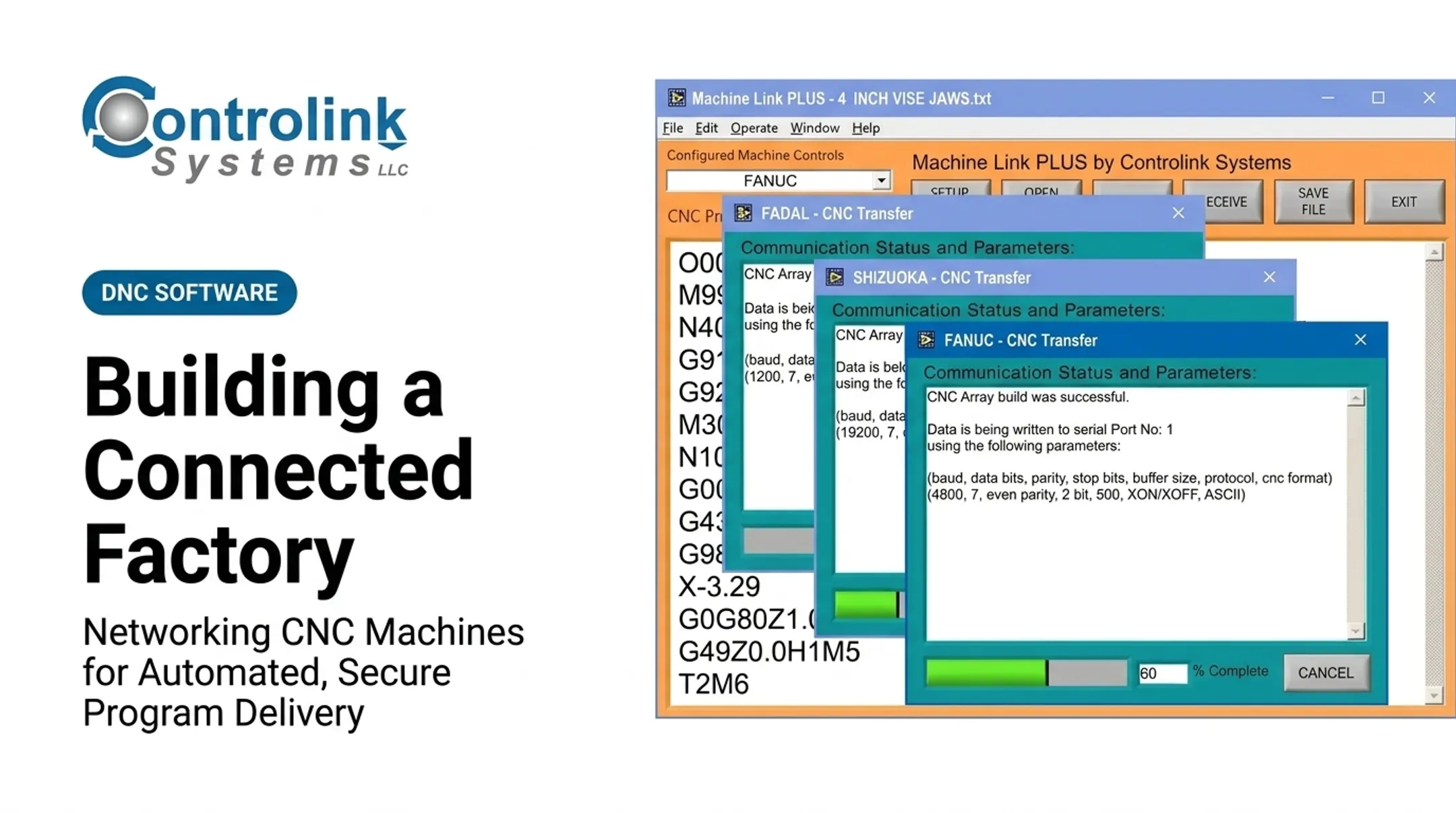
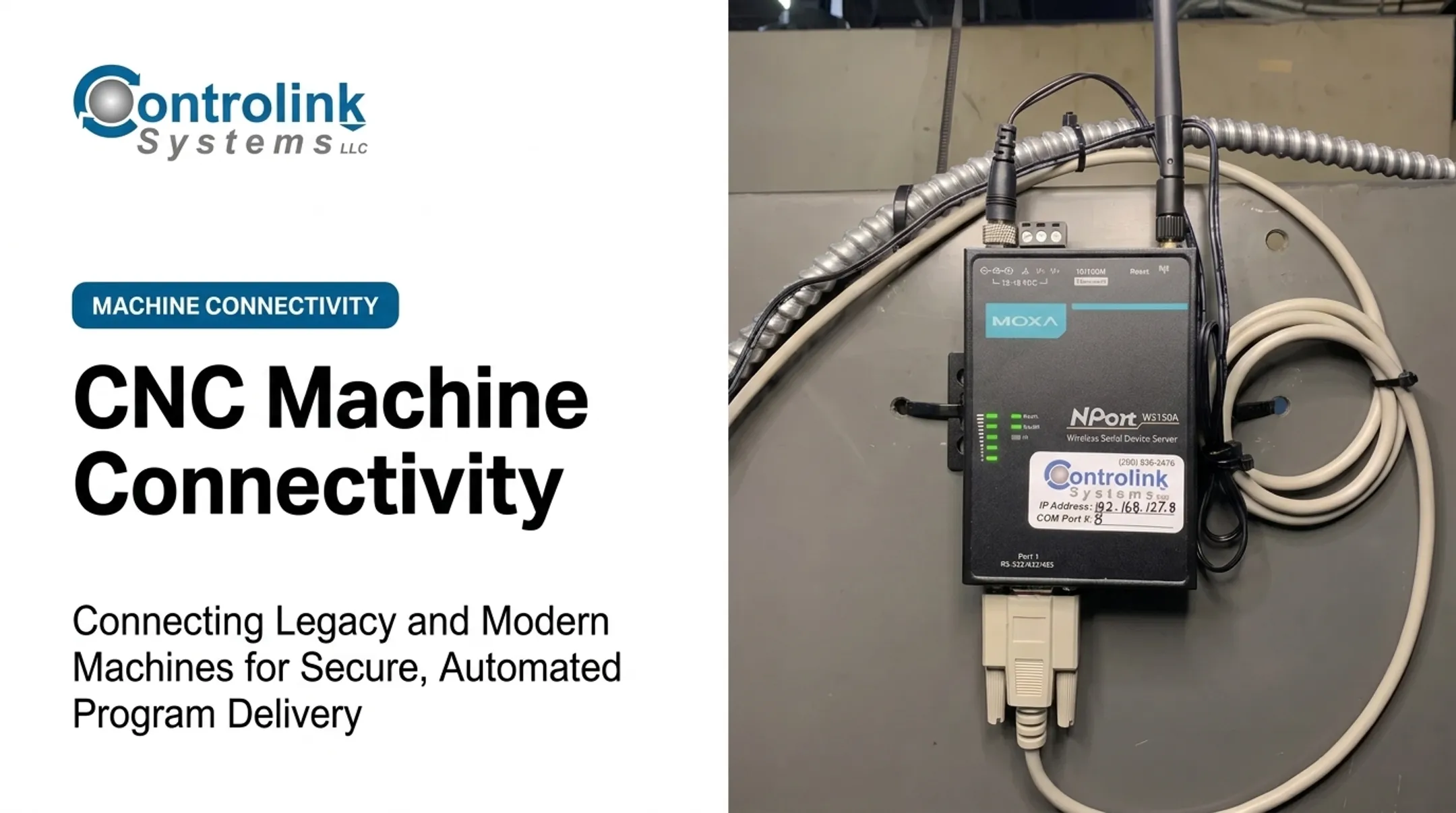
Most shops aren't running one control brand on one protocol. They're managing older CNC controls alongside newer ones, different manufacturers, a mix of serial and Ethernet connections, PLCs, databases, and multiple industrial protocols. The communications layer has to account for those machine-specific constraints—not assume uniformity that doesn't exist on the floor. This is where Controlink Systems LLC has spent over 25 years working: linking CNC/DNC communications with shop-floor automation. Its Machine Link™ QUICK Serve tool, for example, continuously monitors CNC machines for file requests over wireless or wired serial connections and returns the latest engineering-approved file directly to the control. It supports both older and newer CNC controls in the same shop. Ametek, Inc. shows what changes when program delivery is controlled instead of manual. Its original DNC process required operators to make repeated trips between the machine and a computer. After implementing Machine Link™ QUICK Serve, operators retrieve programs directly at the machine. Corrections made on the floor land in an Engineering folder for review before joining the approved library, so engineering stays in the loop instead of getting bypassed. Shop-floor outcomes follow a clear pattern:
- Less walking between stations
- More time spent machining
- Reduced scrap risk from outdated files
- Better machine-tool utilization
- Clearer accountability when a program changes
Security, Interoperability, and Data Governance
CNC files aren't documents to be casually emailed or copied. They're executable manufacturing instructions. A corrupted, outdated, or unauthorized file can affect part quality, damage tooling, or stop production outright.
A Defense-in-Depth Approach
NIST's guidance on operational technology security lays out priorities that differ from typical IT security. NIST notes that OT prioritizes safety first, followed by availability, integrity, and confidentiality—the reverse of the conventional IT order. That means building layers:
- User authentication and role-based authorization matched to actual job responsibilities
- Network segmentation, including a DMZ between OT and enterprise networks
- Secure transfer methods for programs in transit
- Endpoint protection vetted for OT compatibility and performance before deployment
- Backups and tested recovery procedures
- Monitoring for unusual activity
Governance Beyond the Network
Technical controls only work if program governance backs them up:
- Approved repositories as the single source of truth
- Revision history for every change
- Documented approval before a program reaches the floor
- Machine-specific validation before execution
- Read/write permissions tied to roles
- Audit logs and a defined process for emergency changes
Where MTConnect Fits (and Where It Doesn't)
MTConnect is often mentioned in the same breath as CNC program delivery, but they solve different problems. The MTConnect standard defines a read-only protocol for retrieving structured information from manufacturing equipment—equipment metadata, streaming data, and assets—through adapters and agents. It's built for visibility, not for pushing an executable program to a controller.
That means program delivery still requires separate, controller-specific communication and file-transfer capability. Interoperability planning should identify:
- Which systems actually need to exchange data
- The direction and timing of each exchange
- Which protocols each system supports
Don't assume a cloud dashboard can talk directly to every CNC control on the floor—most can't.

Cloud Analytics vs. Edge Execution
Once you map those controller-specific transfer paths, the next decision is where each workload should run. Historical trends and cross-factory analysis can live in the cloud. Time-sensitive production instructions generally can't wait on a network round trip.
Keep urgent program delivery at the edge unless you have:
- A validated local fallback for connectivity loss
- Confirmed that a machine never depends on the internet for an urgent update
Without that fallback, a connectivity hiccup becomes a production stoppage.
How to Connect CNC Program Delivery to a Smart Shop Floor
Start narrow. Pick one measurable workflow problem: outdated program use, manual transfers, excessive operator travel, or weak revision traceability. Document the current people, systems, machines, and approval steps involved before touching anything.
A Phased Rollout
- Inventory every CNC control and note which interfaces each supports
- Classify programs and assign release permissions by role
- Connect a representative machine group first, not the whole floor at once
- Validate security and recovery procedures under real shop conditions
- Expand only after results check out, not on assumptions alone
Measure Outcomes, Not Just Connectivity
Measure outcomes, not just network status:
- Current-file compliance rate across machines
- Transfer reliability over time
- Auditability of every program change
- Operator usability without extensive retraining
- Integration with production records
- Recovery after a network or system interruption
Manufacturers running mixed CNC fleets, older controls next to newer ones, often find this phased approach avoids the disruption of an all-at-once rollout.
Controlink Systems LLC has helped manufacturers connect CNC/DNC communications to broader shop-floor automation since 1998. Reach the team at (800) 838-3479 or support@controlinksystems.com to talk through your mix of machines and controls.
Frequently Asked Questions
Is there a difference between IoT and IIoT?
Yes. IIoT is the industrial application of IoT principles, with greater emphasis on machine connectivity, operational reliability, industrial security, automation, and mission-critical processes.
What is a smart factory and how does it work?
A smart factory connects machines, people, software, and data so they work together rather than in isolation. Sensors and edge systems collect information, analytics interpret it, and both automated systems and people act on the results.
Is Industry 4.0 the same as smart manufacturing?
The terms overlap but aren't identical. Industry 4.0 describes the broader industrial transformation involving robotics, IoT, and AI, while smart manufacturing describes the connected, data-driven production practices that transformation enables.
What is MTConnect used for?
MTConnect provides standardized machine and equipment data for monitoring, analysis, and interoperability across manufacturing applications. It doesn't automatically solve every program-transfer requirement on its own.
What is an MTConnect adapter?
An adapter translates data from a machine or control into a form an MTConnect agent can use. Implementation details vary depending on the specific equipment and integration architecture involved.
What's the difference between an MTConnect adapter and an agent?
The adapter interfaces with the machine's native data source. The agent collects, organizes, and exposes that data according to the MTConnect standard's structure.