
Introduction
A CNC program can be flawless in its logic, feeds, and speeds, and still produce a nonconforming part. How? The machine ran the wrong revision.
Maybe it was an obsolete file left on a local drive. Maybe an operator grabbed a similarly named version from a shared folder. Either way, the part is scrapped, and the quality team is left reconstructing what actually happened.
Aerospace, defense, medical device, automotive, and precision manufacturers face growing pressure to prove more than "we have a process." Auditors want evidence that the correct, approved information reached the machine at the moment of production.
This article connects the dots between QMS software, CNC program revision control, and conformance to ISO 9001 and AS9100. We'll look at how engineering changes, approvals, shop-floor distribution, and audit evidence work together, and what happens when that chain breaks.
Key Takeaways
- Revision control keeps CNC programs identified, approved, released, distributed, and superseded for ISO 9001 and AS9100 conformance.
- QMS software links program changes to approvals, training records, and corrective actions.
- Disciplined processes and trained people drive conformance; QMS software makes that work traceable and repeatable.
- Getting the right file to the right machine cuts scrap, rework, and audit-day guesswork.
What Is QMS Software and CNC Program Revision Control?
QMS software is a digital system for managing the documents, approvals, records, and workflows that keep a quality management system running. Think document control, corrective action tracking, audit scheduling, training records, and risk registers, all in one connected environment instead of scattered spreadsheets and email chains.
CNC program revision control is narrower but just as critical. It's the method that ensures every machine program has:
- A unique identity (part number, operation, and program number)
- An approved, current revision status
- A documented approval and release history
- Traceability from creation through supersession
The Program Lifecycle
A controlled CNC program typically moves through several stages:
- Creation or modification
- Technical review
- Formal approval
- Controlled release
- Distribution to the correct machine
- Use in production
- Supersession when a newer revision takes over
Each stage generates a record.
Storing a file is not the same as controlling it. A shared network folder or USB stick can preserve data indefinitely without ever proving which revision was approved, who released it, or which file actually reached the machine tool control. That gap is exactly where audit findings and scrap incidents originate.

ISO 9001:2015, Clause 7.5, requires documented information to be maintained and retained as evidence that processes were carried out as planned, whether that information lives on paper or in electronic form per ISO guidance.
AS9100D builds on this with Clause 8.1.2, Configuration Management. That aerospace-specific requirement expects product configuration to be identified and documented with enough detail to support conformity, interchangeability, and safe operation throughout the product lifecycle.
For CNC-driven manufacturers, that means the program itself is documented information subject to control, not just a convenience file sitting next to the machine.
Key Advantages of QMS Software and CNC Program Revision Control
The benefits here aren't abstract. They show up as consistent production runs, defensible audit trails, and faster answers when someone asks, "which revision made this part?"
Stronger Traceability for ISO 9001 and AS9100 Conformance
A controlled revision history links a CNC program to its part number, operation, machine, approver, release date, and associated work order. When a superseded version exists, the record shows exactly when it was retired and why.
This matters most during an audit. Instead of relying on operator memory or digging through old email threads, quality teams can retrieve objective evidence showing what was approved and which revision was intended for production.
AS9100D's Clause 8.5.6 requires that change reviews document who authorized the change and what actions followed—hard to demonstrate without a controlled system behind it.
KPIs worth tracking:
- Time to retrieve audit-ready revision records
- Number of undocumented-change findings per audit cycle
- Missing approval records
- Percentage of controlled programs with complete revision metadata
Fewer Wrong-Program Incidents, Defects, and Production Disruptions
An obsolete or mismatched program doesn't just create a bad part. It can drive incorrect tool paths, wrong feeds and speeds, scrap, rework, unplanned downtime, and in worse cases, damage to tooling or the machine itself.
Modern Machine Shop's review of common CNC programming errors found that missing information, such as part number, revision, and operation number, wastes production time and that misinterpretation of an unclear program can result in scrap workpieces and damaged machines. That's a direct line from poor revision practices to the shop floor.
Revision control closes this gap through:
- Role-based permissions that limit who can edit or release a program
- Status labels distinguishing approved, draft, and obsolete files
- Machine-specific distribution instead of shared, generic folders
- Removal or quarantine of obsolete files from active directories
- Confirmation that the intended file actually transmitted to the control
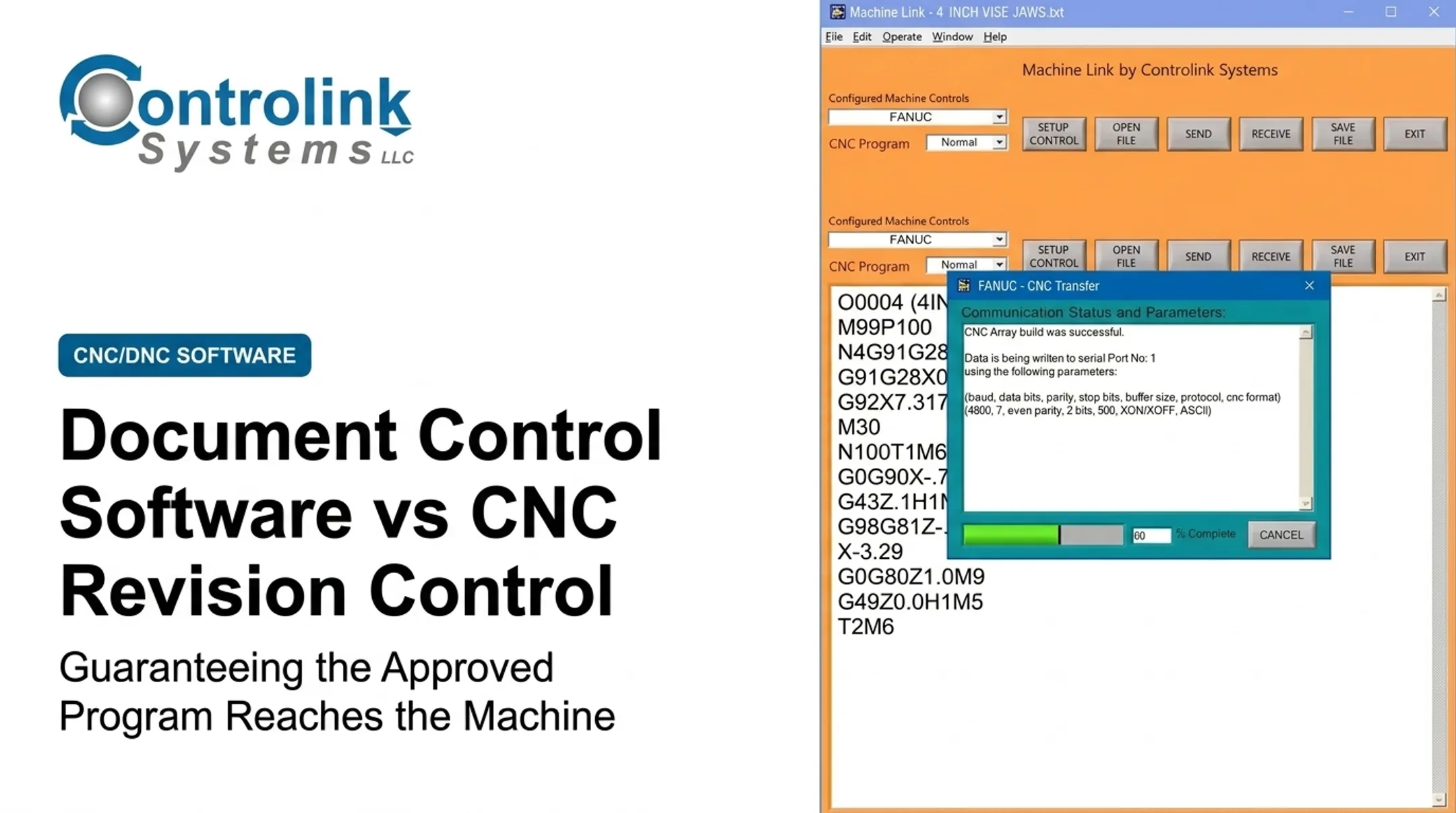
Controlink Systems LLC's Machine Link™ QUICK Serve applies this logic directly on the shop floor. It continuously monitors connected machines for file requests and serves the current, engineering-approved program straight to the control, whether the equipment runs older or newer CNC hardware.
KPIs worth tracking:
- Scrap and rework tied to program changes
- Wrong-revision events
- First-pass yield
- Downtime attributed to program issues
- Engineering-change implementation time
More Disciplined Engineering Change and Configuration Management
Without a structured process, an engineering change becomes an isolated file edit, someone updates a program, saves it, and hopes everyone downstream notices. Revision control turns that into a managed workflow: impact review, authorization, controlled release, and communication to everyone affected.
QMS software extends this by connecting the program revision to related records—drawings, setup sheets, tooling instructions, inspection plans, work instructions, and relevant training records.
A program revision is not the same as a full product configuration change. A program update might only affect a single operation, while a configuration change can touch multiple documents, tools, and approvals at once. Knowing the difference tells your team what else needs a second look.

This discipline matters most in:
- Regulated aerospace and defense work
- Complex, multi-operation parts
- Shops running multiple machines or sites
- Environments with frequent engineering changes
- Production floors still relying on shared drives or manually copied files
KPIs worth tracking:
- Change approval cycle time
- Overdue change actions
- Number of documents requiring updates per change
- Repeat issues from incomplete implementation
What Happens When CNC Program Revision Control Is Missing or Ignored
Here's a familiar pattern: the quality system tightly controls procedures, forms, and audit documents, while CNC program files quietly sit outside that governance. The result is a gap between what engineering approved and what actually ran on the machine.
Common symptoms include:
- Operators selecting similarly named files by guesswork
- Uncontrolled edits made directly at the machine
- Obsolete programs lingering on local drives
- Undocumented offsets or manual adjustments
- Inconsistent output between machines running "the same" job
- Difficulty reconstructing events after a defect surfaces
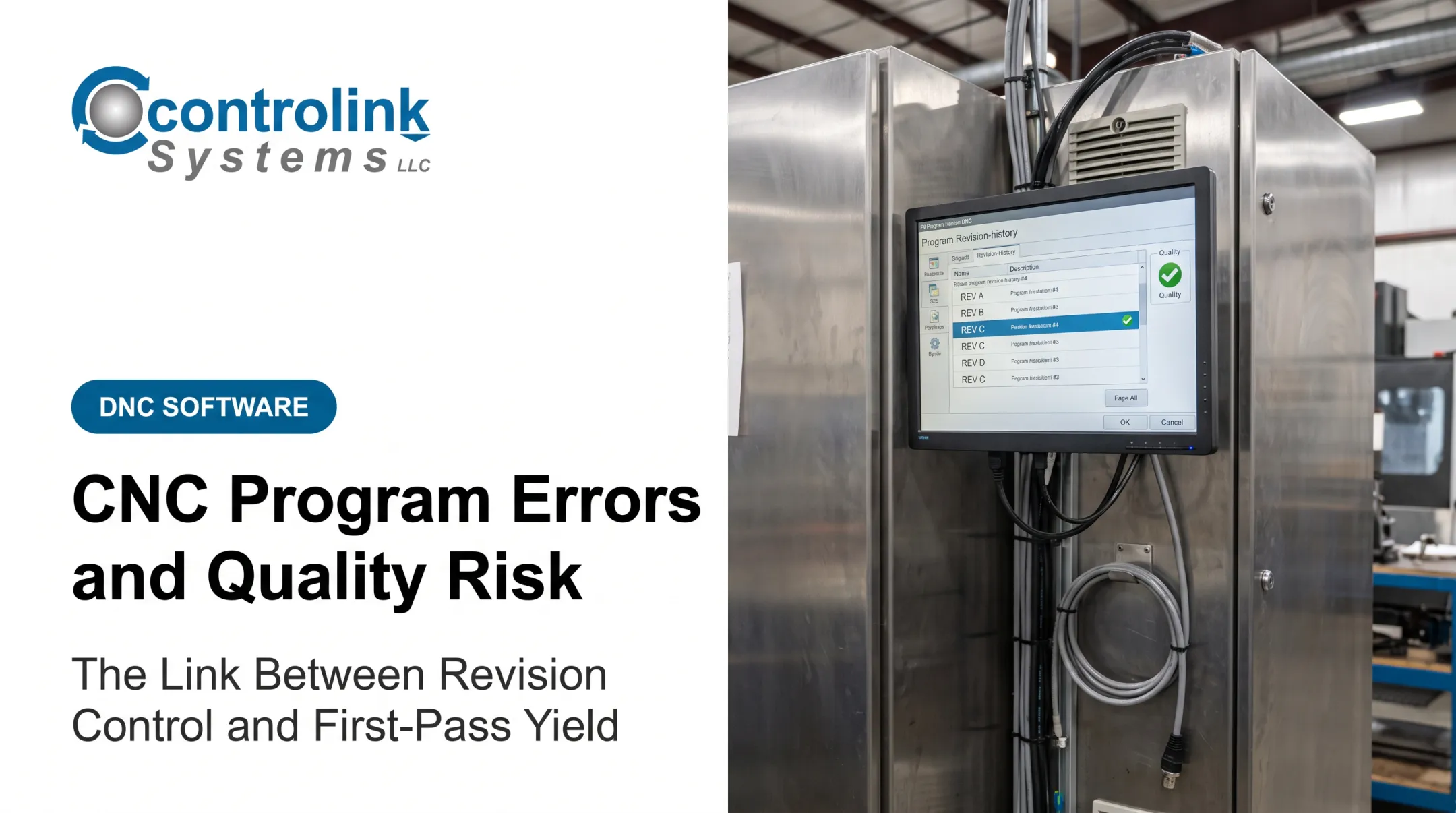
At Ametek, Inc., a Controlink Systems customer, their original DNC setup often failed to save corrected programs sent back from the machines. The result: engineers had to fix the same program twice, once at the machine and again when it came back for review. Machine Link™ QUICK Serve resolved this by routing returned programs into an Engineering folder for review before they re-entered the program library.
That kind of gap creates real audit exposure. IAQG auditor guidance for AS9100 expects clear evidence of document review, version history, obsolete-file withdrawal, and controlled backup and access. Those are exactly the elements missing when program files sit outside formal control. When those records don't exist, demonstrating control of documented information or product conformity becomes a guessing game during an audit.
The business impact compounds quickly:
- Scrap and rework from wrong or outdated programs
- Delayed deliveries when defects surface late
- Engineers stuck firefighting instead of improving processes
- Excess inspection to catch problems better controls would prevent
Scrap and rework aren't minor line items. APQC's benchmarking across more than 870 manufacturing organizations places typical scrap-related material costs at roughly 1% of sales, a figure that adds up fast across multiple shifts and facilities.
How to Get the Most Value from QMS Software and Revision Control
Rolling out revision control well takes more than buying software. Here's a practical sequence.
1. Assess your current state. Map the full program lifecycle:
- Created, named, and approved
- Stored, transferred, and edited
- Backed up and retired
Look specifically for unofficial repositories, USB transfers, and manual handoffs—these are where control typically breaks down.
2. Build a controlled data model. Define unique program identifiers, revision status, part and operation associations, approval authority, effective dates, and rules for handling superseded files and retention.
3. Set role-based permissions. Prevent unauthorized edits while still allowing documented feedback from machinists. Machine Link™ QUICK Serve, for example, routes machine-side edits back to engineering for review rather than letting them silently become the new production standard.
4. Evaluate integration needs early. Before selecting software, map how it needs to connect with CNC/DNC communications, ERP, MES, PLM, CAD/CAM, inspection, and document-control systems. Disconnected systems create duplicate data entry and manual reconciliation—and fresh error risk.
Controlink Systems LLC has built CNC/DNC and shop-floor automation tools since 1998, routinely interfacing with SQL databases, PLC hardware, and motion controllers over Modbus, Profinet, and EtherCAT. When approved files must reach production machines reliably, confirm that depth of connectivity plus the revision safeguards and audit capabilities your quality system requires.
5. Roll out in phases. Start with high-risk or high-volume programs, validate the approval and distribution workflow, train both engineering and shop-floor staff, then expand once you've reviewed incidents and feedback.
6. Measure what matters. Track the metrics that expose control gaps:
- Obsolete-file access attempts
- Program-related nonconformances, scrap, and rework
- Unauthorized changes and approval lead time
- Time to produce audit evidence on request
Software alone does not carry the system. Documented procedures, trained personnel, periodic internal audits, backup and cybersecurity practices, and management review still do the heavy lifting.

Conclusion
CNC program revision control is where engineering intent either becomes controlled shop-floor execution, or gets lost somewhere between the office and the machine. That control is essential for producing consistent, conforming parts.
QMS software delivers the most value when it ties revision history, approvals, machine distribution, and related manufacturing records together into one repeatable, evidence-generating process. That's what turns "we think this is the right file" into "here's proof this was the approved revision."
Evaluate your current CNC workflow against your actual ISO 9001 or AS9100 obligations, then treat improvement as ongoing work rather than a one-time compliance checkbox.
Frequently Asked Questions
What is QMS software?
QMS software is a digital system for managing quality documents, approvals, audit records, corrective actions, training, and nonconformances in one connected environment. For CNC manufacturers, it can also link those records directly to program revisions and approvals.
What is the best QMS software?
There isn’t a single best QMS. Match the tool to your CNC/DNC integration needs, revision controls, permissions, audit trail depth, and existing shop systems.
How much does QMS software cost?
Pricing varies widely based on user count, modules, deployment method, integrations, and implementation or training support. Rather than chasing a generic number, weigh total cost against what you're currently losing to scrap, rework, and audit preparation time.
How much does ISO 9001 cost?
Costs vary by size and scope. Small businesses under 10 employees often see initial certification around $4,000–$6,000 for audits, documentation, and certification fees, plus ongoing surveillance and three-year recertification costs.
How much does AS9100 cost?
AS9100 pricing scales with company size, locations, process complexity, and consulting needs—often tens of thousands of dollars for mid-sized shops. QMS software is only one line item in that broader investment.
What does AS9100 stand for?
AS9100D is the current aerospace quality management standard for aviation, space, and defense. It builds on ISO 9001:2015 with added configuration management and change-control requirements.