Introduction
Picture this: A critical bearing on your highest-volume production line begins to fail at 2 AM on a Friday. By the time your team discovers the problem at shift change, you've lost four hours of production, scrapped $18,000 worth of work-in-progress, and now face a weekend scramble for emergency repairs.
That scenario has a price tag. For mid-sized discrete manufacturers, unplanned downtime averages $260,000 per hour — and Fortune 500 manufacturers absorb $1.4 trillion in losses annually, roughly 11% of total revenue.
Condition monitoring is now a core operational strategy, not an optional reliability add-on. Affordable IIoT sensors, edge computing, and AI-powered diagnostics have made the shift from reactive "fix it when it breaks" maintenance to condition-based monitoring accessible to shops of every size — without requiring deep signal processing expertise.
This guide evaluates the top condition monitoring solutions for manufacturing environments. Each tool is assessed on diagnostics depth, PLC and protocol integration, deployment complexity, and proven performance across CNC shops, automotive plants, and process facilities.
Key Takeaways
- Condition monitoring tracks equipment health indicators like vibration, temperature, and pressure to catch faults early, before costly downtime
- The global machine condition monitoring market will reach $6.58 billion by 2033, growing at 7.0% annually
- Leading platforms span enterprise IIoT (Siemens, Emerson), rotating-equipment specialists (SKF), modular systems (NI), and AI-driven diagnostics (Tractian)
- Match your choice to asset types, team capabilities, protocol compatibility, and deployment environment
What Is Condition Monitoring and Why It Matters in 2026
Condition monitoring is the continuous or periodic measurement of parameters like vibration, temperature, pressure, and current to assess machine health and predict failures before they occur.
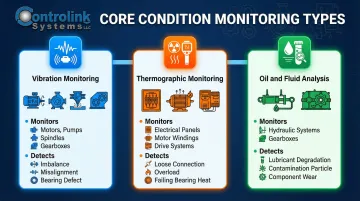
Three Core Monitoring Types Manufacturers Deploy Today
- Vibration monitoring — Accelerometers capture frequency signatures from motors, pumps, spindles, and gearboxes, revealing imbalance, misalignment, and bearing defects long before failure.
- Thermographic monitoring — Infrared sensors and thermal cameras flag heat anomalies in electrical panels, motor windings, and drive systems, pointing to loose connections, overloaded circuits, or failing bearings.
- Oil and fluid analysis — Tracks lubricant degradation and contamination in hydraulic systems and gearboxes; shifts in viscosity, particle count, or chemical composition signal component wear before seizure occurs.
What Changed in 2026
Each of those monitoring methods has become far more accessible in recent years. Edge computing and wireless sensor networks have brought continuous monitoring within reach for facilities that previously couldn't justify the investment. Battery-powered mesh networks eliminate expensive cabling, while edge analytics process data locally without requiring heavy IT infrastructure.
Mid-sized machine shops and stamping plants now deploy real-time condition monitoring at a fraction of the historical cost, with 95% of adopters reporting positive ROI and 27% achieving full payback within 12 months.
Top Condition Monitoring Solutions & Tools in 2026
Each solution below was evaluated on diagnostics accuracy, sensor compatibility, PLC and industrial protocol integration, scalability, and real-world deployment across manufacturing verticals.
Siemens AG
Siemens is a global industrial automation leader whose condition monitoring capabilities are embedded within its Insights Hub (formerly MindSphere) platform, now part of the broader Xcelerator ecosystem. Siemens connects condition monitoring data to digital twins for predictive simulations, enabling engineers to model failure scenarios before they occur in production.
Deep integration across drive systems, motors, and industrial edge devices makes it a strong fit for large, complex manufacturing facilities seeking a unified platform. The Drivetrain Analyzer Edge application monitors SINAMICS drive data in real time using AI to detect mechanical anomalies without additional sensors.
| Key Features | Digital twin integration, edge analytics, AI-driven anomaly detection, multi-asset support across drives and motors |
| Best For | Large-scale discrete and process manufacturing; enterprises already in the Siemens automation ecosystem |
| Deployment Type | On-premises, cloud, and hybrid via Siemens Xcelerator/Insights Hub |
SKF AB
SKF brings decades of rotating machinery expertise to condition monitoring, with deep specialization in bearings, spindles, and gearboxes. Its Enlight software platform and IMx series sensors deliver sensitivity and prognostics tuned specifically for rotating assets, paired with actionable reporting that maintenance teams can act on without needing signal processing expertise.
The standout capability here is the IMx-1 wireless sensor, which forms a mesh network and is ATEX/IECEx certified for hazardous Zone 1 and Zone 2 environments. SKF Acceleration Enveloping technology filters traditional vibration signals to focus exclusively on impacting, providing early indication of bearing and gear defects before they appear in standard broadband measurements.
| Key Features | Vibration and acoustic emission sensors, bearing fault diagnostics, Enlight software platform, online and portable monitoring options |
| Best For | Industries with high rotating asset density: automotive, mining, pulp and paper, steel, wind energy |
| Deployment Type | Wireless online monitoring and handheld portable devices; integrates with major CMMS platforms |
Emerson Electric
Emerson's end-to-end asset health management approach via its AMS Suite and Plantweb ecosystem spans sensing, analytics, and maintenance execution for process-heavy industries. The platform monitors both mechanical and process variables — vibration, temperature, pressure, corrosion, and flow — under one unified system with secure cloud connectivity.
The AMS 9420 Wireless Vibration Transmitter uses patented PeakVue Plus technology to detect early-stage bearing and gear faults.
Following its acquisition of Permasense, Emerson integrated ultrasonic thickness monitoring into the Rosemount Wireless portfolio, enabling non-intrusive corrosion monitoring in extreme environments up to 600°C. This multi-variable capability is especially valuable in oil and gas, chemical, and power generation where safety and uptime are non-negotiable.
| Key Features | AMS Machinery Manager, wireless Permasense sensors, multi-variable monitoring, predictive diagnostics, HART/WirelessHART compatibility |
| Best For | Oil and gas, chemical processing, power generation, and utilities |
| Deployment Type | On-premises and cloud-connected; integrates with DCS and SCADA systems |
National Instruments (NI)
National Instruments pioneered modular data acquisition and signal conditioning, with its LabVIEW and DAQmx platforms long used to build custom condition monitoring systems tailored to specific test and measurement requirements.
Now part of Emerson's Test and Measurement segment following an $8.2 billion acquisition in 2023, NI continues to offer the CompactDAQ (cDAQ) and CompactRIO (cRIO) hardware lines with full LabVIEW support.
Where NI diverges from the rest of this list is architectural flexibility. Engineers can design condition monitoring systems that precisely match their asset types, measurement parameters, and integration requirements — rather than conforming to a rigid off-the-shelf product. The LabVIEW Sound and Vibration Toolkit provides power spectrum, swept sine, and octave analysis for acoustic and vibration measurement applications.
Controlink Systems LLC, an NI Partner Network member since 2000, builds NI-based condition monitoring, high-speed process monitoring, and vibration analysis solutions for U.S. manufacturers. This proven partnership offers CNC shops, automotive facilities, and industrial plants a path to custom NI deployments without the overhead of building in-house expertise.
| Key Features | Modular hardware (cDAQ, cRIO), LabVIEW/DAQmx software, multi-sensor input support, real-time signal processing, SQL and PLC integration |
| Best For | Custom and semi-custom monitoring needs: test cells, end-of-line testing, high-speed process monitoring, vibration analysis in precision manufacturing |
| Deployment Type | On-premises embedded and PC-based; supports CAN, Modbus, EtherCAT, Profinet, Serial and other industrial protocols |
Tractian
Tractian is a fast-growing IIoT condition monitoring company that bundles wireless sensors with an AI-powered diagnostics platform, reducing deployment friction for manufacturing teams without large reliability engineering departments. Founded in 2019, the company secured a $120 million Series C in December 2024 and now serves over 1,000 industrial plants globally, including John Deere, Caterpillar, Goodyear, and Johnson Controls.
Tractian's edge comes from translating raw data into plain-language diagnoses. Its Smart Trac Ultra sensor combines vibration, temperature, and RPM monitoring with AI-driven auto-diagnosis and LTE connectivity. The platform delivers results like "bearing outer race defect detected" rather than "elevated energy at 3.5x shaft speed" — lowering the barrier for maintenance teams to act on insights. Native SQL integration allows real-time data syncing with ERPs and BI tools without complex middleware.
| Key Features | Wireless multi-parameter sensors, AI fault detection, automatic fault classification, CMMS integration, mobile-first dashboard |
| Best For | Mid-size manufacturers seeking fast time-to-value from IIoT condition monitoring without complex deployment |
| Deployment Type | Cloud-based with wireless edge sensors; minimal infrastructure requirements |

How We Chose the Best Condition Monitoring Solutions
The evaluation focused on real manufacturing and industrial environments, not marketing claims. Buyers most often go wrong in three ways: choosing based on brand recognition alone, underestimating integration complexity with existing PLCs and protocols, or selecting platforms their maintenance teams lack the skills to operate.
Diagnostics and Sensing Capability
Does the solution monitor the right parameters for your asset types — vibration, thermal, oil, current? More importantly, does it deliver actionable fault diagnosis or just raw data streams?
Enterprise platforms like Emerson and Siemens provide multi-variable monitoring with advanced analytics. AI-driven tools like Tractian translate raw sensor data into actionable maintenance recommendations, which matters for teams without dedicated vibration analysts.
Integration and Protocol Support
Check whether the solution connects with your existing infrastructure — PLCs, DCS, SCADA, CMMS, or SQL databases — and whether it supports the protocols your facility already uses:
- Emerson AMS Suite: Integrates natively with DeltaV and Ovation DCS via OPC UA, Modbus TCP/IP, and EtherNet/IP
- NI-based systems: Support CAN, Modbus, EtherCAT, Profinet, and Serial, making them well-suited for custom integrations in complex environments
Scalability and Deployment Model
Consider whether the solution scales from a few critical assets to plant-wide deployment, and whether it supports your preferred deployment model — on-premises, cloud, hybrid, or edge-embedded.
Wireless mesh networks like SKF's IMx-1 and Tractian's Smart Trac support incremental expansion without infrastructure overhaul. Modular NI systems scale differently: add CompactDAQ chassis and I/O modules as monitoring needs grow.
Conclusion
The right condition monitoring solution comes down to fit: your asset types, team capabilities, integration environment, and operational goals. Enterprise platforms like Siemens and Emerson serve large facilities with complex automation ecosystems, while modular NI-based systems and AI-driven tools like Tractian let mid-size manufacturers achieve enterprise-grade predictive maintenance without heavy upfront investment.
When comparing platforms, go beyond feature lists and evaluate:
- Long-term performance data and real-world reliability track records
- Protocol compatibility with your existing equipment (Modbus, Profinet, EtherCAT, etc.)
- Total cost of ownership, including implementation, training, and ongoing support
A Year 1 investment of $80,000 to $180,000 for instrumenting 15–20 critical assets can deliver 30–50% reductions in unplanned downtime and 18–25% reductions in maintenance costs.
Manufacturers seeking a custom NI-based condition monitoring or high-speed process monitoring solution built for their shop or facility can reach out to Controlink Systems LLC — an experienced NI Partner providing tailored solutions for CNC machining, vibration analysis, and shop-floor automation since 1998. Contact their team at (800) 838-3479 to discuss your monitoring requirements.
Frequently Asked Questions
What is the best predictive maintenance monitoring software?
The "best" software depends on your environment and team capabilities. Enterprise manufacturers often rely on platforms like Emerson AMS or Siemens Insights Hub for multi-site deployments with deep automation integration, while mid-size shops may find AI-driven tools like Tractian or modular NI-based systems more practical. Integration with existing PLCs, CMMS, and industrial protocols is the critical selection factor, not feature count.
What are the three types of equipment monitoring?
The three primary types are:
- Vibration monitoring: detects mechanical faults in rotating assets like motors, pumps, and bearings
- Thermographic monitoring: identifies heat anomalies in electrical panels and mechanical systems using infrared sensors
- Oil and fluid analysis: assesses lubricant condition and contamination to prevent bearing and gear failures
Most comprehensive programs deploy all three based on asset criticality.
What is the difference between condition monitoring and predictive maintenance?
Condition monitoring is the continuous or periodic measurement of equipment health parameters like vibration, temperature, and pressure. Predictive maintenance uses those measurements, combined with AI and failure mode analysis, to predict when a failure will occur and schedule maintenance just in time, avoiding both premature interventions and unexpected breakdowns.
What sensors are used in condition monitoring?
Common sensor types include accelerometers (vibration), thermocouples and infrared sensors (temperature), pressure transducers (hydraulic and pneumatic systems), ultrasonic sensors (leaks and acoustic emissions), and current transformers (motor condition). Selection depends on the asset type and failure modes being targeted: bearing faults call for vibration sensors, while electrical faults require current and thermal monitoring.
How much does condition monitoring equipment cost?
Costs vary widely. Standalone wireless sensor nodes run $200–$500 per unit; modular hardware like NI cDAQ systems start around $1,700 per chassis. Enterprise platforms with full PLC integration and analytics require six-figure investments. A mid-sized facility instrumenting 10–20 critical assets typically spends $80,000–$180,000 in Year 1, including hardware, software, installation, and training.