
Introduction
Engineers evaluating National Instruments hardware face a recurring challenge: both CompactRIO (cRIO) and CompactDAQ (cDAQ) accept the same C Series I/O modules, yet they serve fundamentally different purposes. Selecting the wrong platform can trigger costly redesigns, force software rewrites, or leave expensive hardware underutilized on the shop floor.
Those consequences stem from four specification areas that diverge sharply between the platforms:
- Real-time responsiveness — whether the system acts autonomously or depends on a host PC
- Ruggedization — operating temperature ranges, vibration tolerance, and environmental ratings
- Software complexity — LabVIEW FPGA and Real-Time versus standard DAQmx programming models
- Total cost of ownership — hardware price, development time, and long-term maintenance
This article breaks down exactly where cRIO and cDAQ differ, so you can match the right platform to your measurement or automation requirements from the start.
Key Takeaways
- cRIO is an autonomous embedded controller with a built-in FPGA and real-time CPU—ideal for standalone industrial control and closed-loop systems
- cDAQ is a PC-dependent data acquisition platform designed for high-fidelity sensor measurement—best suited for lab testing and validation
- Key spec difference: cRIO uses a programmable FPGA for hardware-level determinism; cDAQ offloads processing to a host PC via NI-DAQmx
- Some modules (motor drive, functional safety, CANopen) are cRIO-only and incompatible with cDAQ
- Choose cRIO for standalone deployment in harsh environments; choose cDAQ when a connected PC is available and faster setup matters
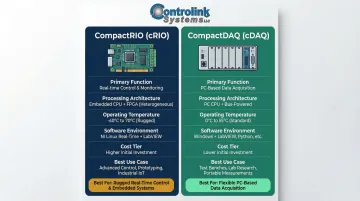
CompactRIO vs CompactDAQ: Quick Comparison
| Specification | CompactRIO (cRIO) | CompactDAQ (cDAQ) |
|---|---|---|
| Primary Function | Standalone real-time control + data acquisition | PC-dependent data acquisition |
| Processing Architecture | FPGA + real-time CPU | NI-STC backplane timing chip, no FPGA |
| Onboard Computing | 667 MHz to 1.6 GHz processor, NI Linux RT | No processor (requires host PC) |
| Software Environment | LabVIEW Real-Time + LabVIEW FPGA | NI-DAQmx (simpler API, familiar PC programming) |
| Operating Temperature | -40°C to 70°C (industrial models) | -20°C to 55°C (standard models) |
| Connectivity | Ethernet, USB, Serial, Wi-Fi, TSN | USB 2.0, Gigabit Ethernet, Wi-Fi |
| Typical Cost Tier | $1,500–$10,000+ (controller + FPGA chassis) | $700–$3,000 (chassis only, no embedded processor) |
| Best Use Case | Industrial control, unattended 24/7 operation | Lab testing, validation, benchtop measurement |
What is CompactRIO (cRIO)?
CompactRIO is a rugged, embedded industrial controller made by NI (now part of Emerson) that integrates three key components into one compact system: a real-time processor, a reconfigurable FPGA, and a C Series I/O chassis. The platform operates entirely independently of a PC, making it the go-to choice for industrial control applications where unattended operation is non-negotiable.
FPGA Architecture: Hardware-Level Determinism
The FPGA allows engineers to execute custom hardware-timed logic at the nanosecond level. Single-Cycle Timed Loops (SCTL) execute within a single cycle of the FPGA clock—25 nanoseconds at the default 40 MHz rate. This enables sub-microsecond timing determinism not achievable with software-based systems, critical for applications like motion control, custom communication protocols, and inline signal processing.
Real-Time CPU Layer
Sitting above the FPGA, the RT processor runs a deterministic real-time OS (NI Linux RT). It handles higher-level control logic, communicates data to the FPGA or network, and runs control algorithms continuously without a host PC.
Processing power scales from dual-core 667 MHz ARM to quad-core 1.6 GHz Intel Atom, depending on the controller model.
Key cRIO Specifications
Representative models:
- cRIO-9068: 667 MHz ARM Cortex-A9 dual-core, Xilinx Zynq 7020 FPGA, -40°C to 70°C operating range, 8-slot chassis
- cRIO-9049: 1.6 GHz Intel Atom E3940 quad-core, Kintex-7 325T FPGA, -20°C to 55°C, TSN-enabled
Environmental ratings:
Industrial models withstand 5 g RMS random vibration (10 Hz to 500 Hz) and 50 g operating shock, with MIL-STD compliance for harsh deployment.
Connectivity:
10/100/1000 Ethernet, USB, serial, and Wi-Fi on select models. TSN-enabled controllers support IEEE 802.1AS synchronization with sub-microsecond accuracy.
Use Cases in Manufacturing and Industrial Settings
cRIO dominates applications requiring embedded control:
- Eliminates control latency in closed-loop motion control via direct FPGA access
- Monitors vibration on bucket-wheel excavators using NI 9234 modules for machine condition analysis
- Controlled a SpaceX Hyperloop pod prototype (EPFLoop, cRIO-9042) where strict time determinism was required for hardware-in-the-loop (HIL) testing
- Powers the ELCOM ENA-450 power quality analyzer for parallel electric measurements compliant with IEC and EN standards
What connects these deployments: each runs continuously in environments with extreme temperatures, vibration, or power instability—conditions that rule out standard PC-based hardware.
What is CompactDAQ (cDAQ)?
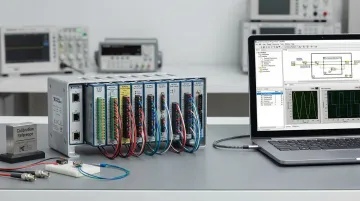
CompactDAQ is a modular, portable data acquisition platform designed to connect directly to a host PC via USB, Ethernet, or Wi-Fi. It integrates signal conditioning into C Series I/O modules, eliminating the need for external signal conditioning hardware and simplifying sensor interfacing.
Two cDAQ Variants
- Chassis-only (no controller): Acts as a PC extension for acquiring data—the most common configuration
- Chassis with integrated controller: Runs NI Linux RT or Windows Embedded for some standalone capability, but without a programmable FPGA. Note: CompactDAQ Controllers are now end-of-life and no longer sold by NI.
NI-STC Backplane: The Timing Engine
The cDAQ chassis uses NI's System Timing Controller (NI-STC3) as its backplane timing engine, handling hardware-timed tasks, DMA transfers, and synchronization between modules. The cDAQ-9178 stores 127 samples per slot in its input FIFO, critical for sustained high-rate acquisition without data loss during USB bus contention.
Key cDAQ Specifications
Representative model (cDAQ-9178):
- Timing accuracy: 50 ppm of sample rate
- Input FIFO: 127 samples per slot
- Maximum analog output: 1.6 MS/s aggregate update rate
- Operating temperature: -20°C to 55°C
- Connectivity: USB 2.0 Hi-Speed
- Slot count: 8-slot (1-, 4-, 8-, and 14-slot chassis available)
All CompactDAQ chassis include four independent 32-bit counters for PWM generation, event counting, and quadrature encoder measurements.
Use Cases in Test and Validation Environments
cDAQ excels in lab and validation settings:
- Automotive validation: Radius Teknologies used cDAQ-9178 for durability testing on automotive starter motors, capturing high-load operational data within five-second run-time windows
- Academic labs: Tecnológico de Monterrey utilized CompactDAQ for remote electrical machines laboratories, allowing students to control test benches and collect data remotely
- Portable field measurement: Federal University of Santa Catarina deployed a DC-powered, 32-channel CompactDAQ system for acoustic beamforming in vehicle pass-by noise tests
These applications share a common thread: the host PC handles analysis and decision-making, so the NI-DAQmx programming model keeps development time short — a practical advantage when your priority is getting data flowing, not programming custom hardware logic.
CompactRIO vs CompactDAQ: Key Specification Differences Explained
Backplane Architecture: FPGA vs NI-STC
The cRIO FPGA directly controls timing, triggering, and data movement at the hardware level—enabling custom timing loops down to tens of nanoseconds. Modules connect directly to the FPGA rather than through a bus, resulting in almost no control latency.
The cDAQ backplane routes these functions through the NI-STC3 chip and then to the host PC. The NI-STC3 provides timing and data transfers between modules and a host computer, using onboard FIFOs to buffer data before the NI-DAQmx driver transfers it to PC RAM.
Timing and Synchronization Specs
cRIO timing:
FPGA Single-Cycle Timed Loops execute within 25 ns at 40 MHz. FPGA-derived clock rates can be specified between 5 MHz and 800 MHz, though some code may not compile at rates above 40 MHz due to FPGA timing constraints.
cDAQ timing:
Analog timing accuracy is 50 ppm with an input FIFO of 127 samples per slot. Timing is bounded by the NI-STC clock and PC communication latency.
Practical consequence: For applications requiring microsecond-level event response, cRIO is the only viable choice. cDAQ excels at high-fidelity measurement where millisecond-level response is sufficient.
Operating Temperature and Ruggedization
cRIO environmental envelope:
The cRIO-9068 operates from -40°C to 70°C, while the cRIO-9049 operates from -20°C to 55°C. Most industrial cRIO models include MIL-STD shock/vibration compliance.
cDAQ environmental envelope:
Standard models like the cDAQ-9178 and cDAQ-9174 operate from -20°C to 55°C. Select TSN-enabled models (cDAQ-9185/9189) extend to -40°C to 70°C.
For outdoor installations, mobile test rigs, or factory floors with extreme thermal cycling, the cRIO's extended range frequently determines platform selection before any other spec is evaluated.
I/O Module Compatibility: cRIO-Only Modules
Both platforms accept C Series modules, but several modules require LabVIEW FPGA and are strictly incompatible with cDAQ:
- NI-9512 / NI-9514: Stepper and servo motor drive interface modules
- NI-9350 / NI-9351: Functional safety modules
- NI-9881: CANopen interface module
If your application requires motion control, functional safety, or specific industrial protocols, module compatibility creates a hard constraint—cRIO is mandatory.
Software Programming Model and Development Complexity
Hardware constraints drive platform selection — but software complexity determines how long development actually takes. The two platforms differ sharply here.
| cDAQ | cRIO | |
|---|---|---|
| Primary API | NI-DAQmx | LabVIEW Real-Time + FPGA Modules |
| Supported Languages | LabVIEW, Python, C#, C, C++ | LabVIEW (required) |
| Complexity | Low — most engineers productive within days | High — both RT and FPGA modules required |
| Development Time | Fast | Longer; FPGA code has compile-time constraints |
| Best For | Standard measurement tasks | Custom timing, closed-loop control, safety logic |
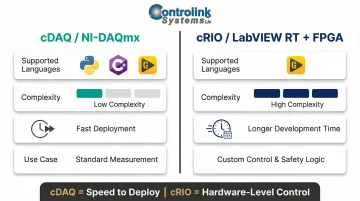
cDAQ wins on speed-to-deployment. cRIO wins when the application demands hardware-level control that no high-level API can deliver.
Which NI Platform Is Right for Your Application?
Choose CompactRIO When:
- Standalone operation: The application must run without a host PC
- Real-time deterministic control: Response times under 1 ms are required
- Harsh industrial deployment: Wide temperature range, shock/vibration exposure
- Custom hardware-level timing: FPGA-based protocol implementation or inline signal processing
- Motion control or functional safety: Application requires cRIO-only modules
Choose CompactDAQ When:
- PC-based analysis: A host computer handles data processing and decision-making
- Rapid deployment: Minimal software development time is critical
- Portable or benchtop measurement: Lab testing, validation, or field data logging
- Budget-sensitive multi-channel logging: Lower per-channel cost than cRIO
- NI-DAQmx programming: Team is familiar with Python, C#, or high-level LabVIEW
Hybrid Approach: TSN-Synchronized Systems
CompactRIO controllers with NI-DAQmx are TSN-enabled and can synchronize multiple cDAQ chassis using IEEE 802.1AS. Typical synchronization accuracy is less than 1 µs, reducible to hundreds of nanoseconds depending on network configuration.
This architecture combines cRIO's determinism with cDAQ's simpler setup and lower per-channel cost. It suits distributed manufacturing test applications that need large channel counts with real-time coordination. Key advantages of the hybrid approach:
- Maintains sub-microsecond synchronization across chassis
- Reduces per-channel hardware cost compared to all-cRIO deployments
- Simplifies high-level data handling via NI-DAQmx on the cDAQ side
- Preserves deterministic control where the application demands it
Selecting the right architecture depends on your channel count, latency requirements, and deployment environment — the tradeoffs above apply whether you're building a benchtop validation rig or a distributed shop-floor monitoring system.
As an NI Partner Network member since 2000, Controlink Systems has helped manufacturers across automotive, aerospace, and industrial sectors specify the right NI hardware for process monitoring, end-of-line testing, and shop-floor automation. If you're unsure which platform fits your application, reach out at (800) 838-3479 for a hardware selection consultation.
Conclusion
cRIO and cDAQ are not competing products—they are purpose-built for different tiers of an instrumentation architecture. The choice comes down to whether the application demands standalone deterministic control (cRIO) or high-quality PC-integrated data acquisition (cDAQ), with temperature range, timing architecture, software environment, and module compatibility determining which fits your specific deployment.
Selecting the right platform from the start reduces redesign costs, shortens development timelines, and ensures the system can meet both current measurement requirements and future automation demands. If your application sits at the boundary—requiring both precision acquisition and real-time control—consulting with an NI Partner like Controlink Systems before finalizing hardware selection can prevent costly mid-project pivots.
Frequently Asked Questions
What is the difference between CompactRIO (cRIO) and CompactDAQ (cDAQ)?
cRIO is an autonomous embedded controller with a built-in FPGA and real-time CPU that operates independently, while cDAQ is primarily a PC-connected data acquisition platform that relies on a host computer for processing and decision-making.
What is NI CompactRIO (cRIO)?
cRIO is a rugged, modular embedded controller combining a real-time processor and reconfigurable FPGA with C Series I/O slots, designed for industrial control and standalone data acquisition applications requiring hardware-level determinism.
What is NI CompactDAQ (cDAQ)?
cDAQ is a portable, modular data acquisition platform that connects to a host PC via USB, Ethernet, or Wi-Fi, using NI-DAQmx software for high-fidelity sensor measurement and data logging in lab and validation environments.
What is the difference between PXI and CompactRIO?
PXI is a PC-based instrumentation platform offering the broadest range of high-performance test instruments with throughput up to 24 GB/s and forced-air cooling, while cRIO is a compact, ruggedized embedded controller suited for industrial environments where PXI's size or environmental limitations are prohibitive.
What is the difference between NI-DAQ and NI-DAQmx?
NI-DAQmx is the current, actively maintained driver software for NI data acquisition hardware (including cDAQ), offering a simplified API across multiple programming languages. NI-DAQ was the legacy driver it replaced in 2003. Most users today should be running NI-DAQmx.
How does NI DAQ work?
NI DAQ systems use modular I/O modules to condition and sample signals from sensors, then transfer that data through the chassis backplane to a host PC or onboard controller via DMA. The NI-DAQmx driver API then makes that data available to software applications for analysis, logging, or control actions.