
Introduction
An engineer finishes revising a CNC program at 7:45 a.m. She saves it to a USB drive, walks to Machine 12, and digs through a folder of similarly named files. Ten minutes later, she learns the operator already loaded a different revision, one left over from last week's setup.
That ten-minute walk isn't the real cost. The USB drive itself might run less than $20. The expensive part is everything wrapped around it: the walking, the waiting, the wrong file, and the scramble to fix parts already cut to the wrong spec.
This article breaks down where manual file transfer creates risk, shows how to estimate what it actually costs your shop, and explains how a controlled CNC/DNC workflow can replace the walk-and-guess routine with something more predictable.
Key Takeaways
- True USB transfer cost is labor, walking, waiting, downtime, and rework—not the drive itself
- Multiple drives, messy filenames, and local machine copies make the running revision nearly impossible to prove
- A controlled CNC/DNC workflow centralizes approved files, cuts floor trips, and shows which revision ran
Where the USB Workflow Breaks Down
Picture the full sequence: an engineer generates or revises a program, saves it to removable media, carries it to the machine, hunts for the right file, transfers it, verifies it loaded correctly, then runs the job. Sometimes the drive has to make a return trip for another update.
Each handoff in that chain is a place things go wrong.
Common failure points:
- Mislabeled or unlabeled USB drives mixed in with a dozen others in a drawer
- Duplicate filenames across different jobs or machines
- Incomplete file copies caused by a yanked drive or corrupted transfer
- Forgotten drives left in a machine, a jacket pocket, or another building
- Damaged media that fails silently, corrupting critical program data
- Old files left on a machine controller's local memory after a revision is released
The Problem Compounds With Scale
A single machine and one operator can usually manage this by memory. Add more machines, a second shift, an outside programmer, or a handful of engineering changes in the same week, and memory stops being a control system.
USB drives still have a legitimate role as a backup for a networked machine, a way to move a one-off program during a network outage, or a stopgap on a machine that isn't networked yet.
The real failure mode is treating USB as the primary, routine method for distributing production programs across a shop running multiple machines, shifts, and revisions at once.
The Hidden Cost of Walking, Waiting, and Interruptions
The visible line item is the drive. The invisible one is labor, and it adds up faster than most shops assume.
Who's Actually Making the Trip
Every USB transfer pulls someone away from other work. Depending on your shop, that might be:
- An engineer stepping away from a process change review
- A setup technician interrupting a job changeover
- A supervisor pulled off the floor to resolve a file mismatch
- An operator waiting at an idle machine instead of cutting parts
A Simple Way to Estimate the Cost
Skip the industry-wide averages. Your shop's numbers are more accurate. Use this formula:
(Trips per shift) × (average minutes per trip) × (loaded labor rate per minute) × (number of shifts) × (operating days) = weekly walking cost
Here's a hypothetical example with clearly labeled assumptions: two shifts, four trips per shift, averaging 6 minutes per round trip, at a $35/hour loaded rate ($0.58/minute), across 5 operating days.
4 trips × 6 minutes × 2 shifts × 5 days = 240 minutes/week 240 minutes × $0.58/minute = roughly $139 per week, per machine

Run your own numbers with actual trip counts. At this rate, 10 machines land near $1,390 per week in walking labor alone—before scrap or downtime.
The Cost Beyond the Wage
Walking time has an opportunity cost a labor rate doesn't capture. An engineer walking to Machine 12 isn't reviewing a quality issue. An operator waiting on a file isn't cutting parts. Failed transfers, missing files, and "did the machine actually get the new program?" checks add delay on top of the walk itself.
This matters more given current staffing realities. The Manufacturing Institute projects U.S. manufacturers may need as many as 3.8 million new employees by 2033, with up to 1.9 million skilled positions at risk of going unfilled.
When skilled people are hard to find, avoidable movement—like walking a drive across the floor—is time you can't easily replace with more headcount.
How Wrong Revisions Create Quality and Production Risk
Here's the scenario that keeps quality managers up at night: engineering approves a program change. Somewhere, on a USB drive or in a machine's local memory, an older version survives. The operator picks a filename that looks right, because it is the file used for months. There's no reliable way to confirm it's actually the approved version.
The Downstream Damage
One wrong revision can trigger a chain reaction:
- Incorrect tool paths or offsets cutting parts out of spec
- Scrap and rework consuming material and machine time
- Inspection delays while quality investigates what actually ran
- Missed delivery commitments
- Documentation gaps for customer or regulatory audits
Why Filenames and Timestamps Aren't Enough
Most revision confusion traces back to a handful of habits:
- Filenames that don't include meaningful revision data
- Copied files with no record of who created or approved them
- Local edits made at the machine that never make it back to engineering
- An uncontrolled "final_v2_REALFINAL" file floating around
- Verbal instructions substituting for a documented approval
A timestamp tells you when a file was saved, not whether it was approved, by whom, or for which machine. A workflow needs to identify the approved source, the person who released it, the intended process, and the revision actually loaded on the controller. Those requirements define a governance gap that filenames alone cannot close.
Quality-cost frameworks back this up. ASQ classifies scrap and rework as internal failure costs, yet only 31% of organizations feel they fully understand the financial impact of their quality costs. Most shops likely underestimate what revision errors actually cost them.
Warning Signs Worth Watching For
- Operators regularly ask, "Which file is the current one?"
- Engineers keep personal USB drives as a workaround
- Files get copied machine-to-machine instead of pulled from a controlled source
- Quality can't quickly identify which program actually produced a rejected part
The Business Case: How to Measure the Full Cost
Before you pitch a change, build a cost model that separates what you can measure directly from what shows up later:
| Direct costs | Indirect costs |
|---|---|
| Labor spent transferring files | Engineering interruptions |
| Machine downtime during transfer | Expedited production or shipping |
| Scrap and rework from wrong revisions | Investigation and audit time |
Collect baseline data over a representative period:
- Number of transfers per week
- Average time per transfer, walk included
- Revision-related incidents and rejected parts
- Machine interruptions tied to file issues
- Time spent locating or validating the correct program
Calculate avoidable cost conservatively. Use documented incidents and measured workflow times. Don't assign every quality problem to USB use just because a drive was involved somewhere upstream.
Scale makes the same gaps expensive. NIST's 2023 Annual Report on the U.S. Manufacturing Economy estimates downtime consumes roughly 8.3% of planned production time, totaling around $245 billion across discrete manufacturing. That figure isn't USB-specific, but it shows how much room exists to recover time lost to avoidable process gaps.

Before-and-after metrics to track:
- Average transfer time per program
- Number of manual trips per shift
- First-pass yield
- Program-related stoppages
- Time to locate an approved revision
- Percentage of machines connected to a controlled source
Weigh those gains against the cost of change—implementation, training, integration, and support.
Ametek, Inc. found its earlier DNC setup still required operators to make several trips between machine and computer, and corrected programs sometimes weren't saved back into the program library, so the same fix had to happen twice. That is the kind of recurring cost a baseline audit catches.
If the numbers show transfer labor, wrong-revision scrap, and repeat fixes dominating the model, the business case usually points toward a controlled program source rather than another round of USB process rules.
Replacing the USB Workflow with a Controlled CNC/DNC Process
A CNC/DNC communications setup manages approved programs from a controlled location and transfers them to the intended machine over a network, rather than relying on someone to carry the correct file by hand.
What to Evaluate
Not every DNC product includes every capability automatically. Treat these as questions to ask, not guarantees:
- Central file management and revision visibility
- Machine-specific routing so files go to the right controller
- Operator permissions and transfer confirmation
- Audit history and backup or recovery
- Compatibility with your existing network, SQL databases, PLC hardware, or MES/ERP systems
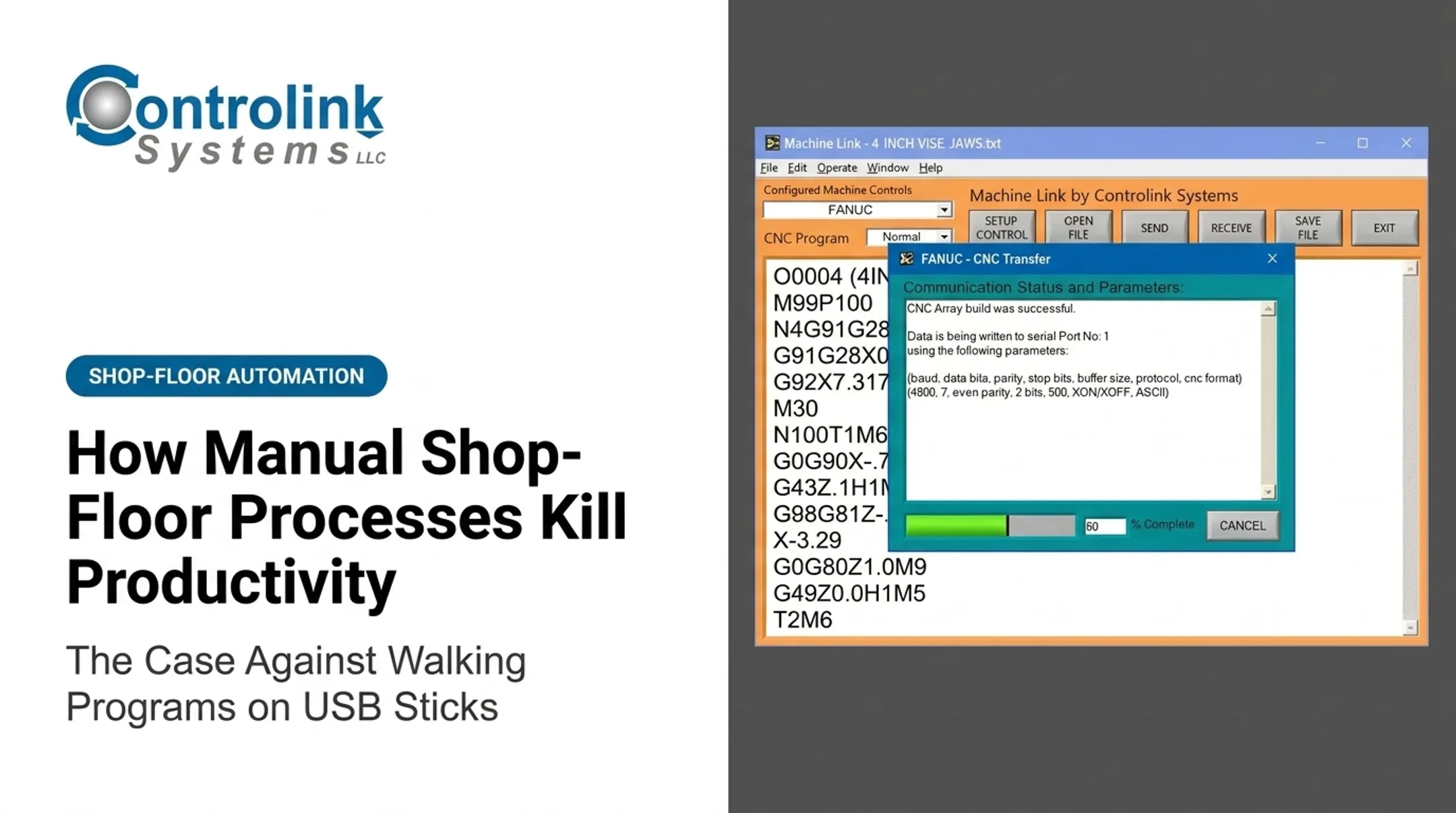
Those criteria describe a controlled DNC setup, not another USB handoff. Controlink Systems LLC has built CNC/DNC and shop-floor automation software since 1998, and its Machine Link™ line puts that reduce-the-walking idea into practice:
- Machine Link™ — talks to any CNC with standard RS-232 serial, starting at $195
- Machine Link™ PLUS — drives up to six machines at once for $395
- QUICK Serve — operators request files remotely, stay at the machine, and get the latest engineering-approved program; scales from 3 machines to 64 with QUICK Serve PRO
Engineering keeps release control. The machinist stops walking for files.
USB vs. DNC: A Side-by-Side Look
| Factor | USB Drive | Controlled DNC |
|---|---|---|
| Access | Manual, one drive at a time | Networked, on demand |
| Revision control | Depends on manual discipline | Centralized approval source |
| Traceability | Limited, hard to audit | Transfer and access history |
| Labor movement | Requires walking each transfer | Minimal, request from machine |
| Scalability | Harder as machines and shifts grow | Built for multi-machine environments |
The right fit depends on your machine age, network availability, production risk, and how much integration your existing systems need. A quick environment assessment, checking controller compatibility, network reach, and cybersecurity requirements, beats assuming any solution works everywhere.
A Practical Transition Plan for Manufacturers
Moving off a USB-dependent process doesn't require ripping out everything at once. A staged approach reduces risk and builds internal buy-in.
- Audit the current workflow - Map where programs originate, who approves them, how files are named, and how obsolete versions get removed or quarantined.
- Pick a pilot area - Choose a cell or machine group with measurable transfer volume, then document baseline performance before changing anything.
- Define governance rules - Cover file ownership, approval steps, revision naming, operator permissions, and what happens during an outage.
- Test the technical environment - Confirm CNC control interfaces, network reliability, authentication, and logging behavior.
- Train the team - Bring operators and engineers up to speed while keeping a documented contingency plan for machines that can't be networked yet.
- Track metrics and expand - Use pilot results to decide whether to roll out to additional machines or facilities.
That pilot-first path matters most in mixed-control shops. Snavely's Machine, a shop working with Controlink Systems, runs more than 30 CNC machine tools across 10 different control types. Forty operators need the correct program routed to the correct machine—complexity a staged rollout is built to handle before scaling further.

Where a shop needs CNC/DNC, database, or PLC connectivity beyond a single product, Controlink Systems can serve as the integration partner for that broader shop-floor connection.
Conclusion
The USB drive was never the expensive part. The real cost sits in the walking, the waiting, and the exposure created any time file control depends on a person remembering which drive holds the right version.
USB still has a place for occasional service work or contingency situations. But when routine transfers, revision mix-ups, traceability gaps, or walking time start showing up as measurable losses, that's the signal to evaluate a controlled CNC/DNC workflow instead.
A practical next step: track one week of transfers, trips, delays, and revision checks on your floor. Those numbers, not assumptions, will tell you whether a connected workflow can improve your productivity, quality, and machine utilization.
Frequently Asked Questions
How much does a USB drive cost?
Purchase price varies by capacity, speed, and durability, typically $15 to $80 for common sizes. In manufacturing, the bigger question is the total workflow cost of using that drive for repeated CNC file transfers.
How is a flash drive made?
A flash drive combines NAND flash memory, a controller, a connector, and protective housing. For production CNC files, reliability and controlled access matter far more than how the drive was assembled.
What is the lifespan of a USB stick?
Consumer USB drives typically handle around 10,000 to 100,000 write/erase cycles, depending on NAND and controller quality. Given that limited lifespan, a USB stick should not be your only long-term system of record for CNC programs.
Why is using USB drives for CNC programs risky?
Risks include loading outdated revisions, lost or damaged media, untracked copies, and manual selection errors with little ability to audit what actually ran. Weak file governance multiplies every one of those failure points.
What is a DNC system in manufacturing?
A DNC system manages and transfers CNC programs from an approved source to machine tools over a network, replacing manual media transfer. Core capabilities include revision control, access management, transfer confirmation, and less walking between machines.