What types of rotating equipment can be monitored with your services?
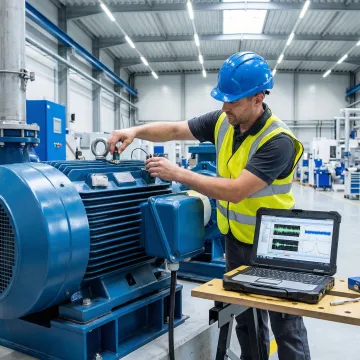
Our condition monitoring solutions are suitable for a wide range of rotating assets, including electric motors, pumps, compressors, fans, blowers, gearboxes, and turbines. Using iMonitor software with NI accelerometer hardware, we can capture and analyze vibration signatures from virtually any rotating machine in your facility, regardless of speed or size.
What is vibration analysis and why is it important for rotating equipment?
Vibration analysis measures the oscillation patterns of rotating machinery to detect mechanical faults such as imbalance, misalignment, bearing wear, looseness, and resonance. By identifying these issues early—before they cause catastrophic failure—vibration analysis prevents unplanned downtime, reduces repair costs, and significantly extends the operational life of your critical assets.
How does iMonitor software work for condition monitoring?
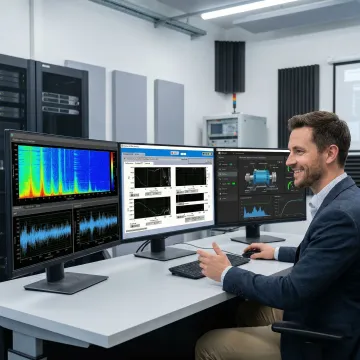
iMonitor is a real-time data acquisition software package that works with NI hardware to collect time-domain and frequency-domain measurements from accelerometers and voltage sensors. It provides continuous monitoring of vibration levels, frequency spectra, and process parameters, automatically flagging anomalies so your maintenance team can act before failures occur.
What NI hardware is required to run iMonitor?
iMonitor requires compatible National Instruments (NI) data acquisition hardware, available in three configurations: iMonitor DAQ for real-time voltage measurements, iMonitor VIBS for voltage and accelerometer measurements, and iMonitor LAB & MODAL for real-time frequency response measurements. We can advise on the right hardware configuration for your specific monitoring requirements during initial consultation.
Can your monitoring system integrate with our existing plant infrastructure?
Yes. Controlink specializes in linking systems together across a broad range of industrial communication protocols, including Modbus, Serial, CAN, UDS, Profinet, and EtherCAT. We routinely interface with SQL databases, PLC hardware, and single- and multi-axis motion controllers, ensuring our monitoring solution fits seamlessly into your existing manufacturing environment without requiring a full infrastructure overhaul.
What is the difference between condition monitoring and traditional preventive maintenance?
Traditional preventive maintenance follows fixed time-based schedules, servicing equipment whether or not it needs attention—often wasting resources or missing developing faults between service intervals. Condition monitoring is data-driven: it tracks actual equipment health in real time and triggers maintenance only when measurable indicators show that action is needed, maximizing uptime and reducing unnecessary maintenance costs.
How long does it take to implement a condition monitoring system?
Implementation timelines vary based on the number of assets, facility size, and existing infrastructure. A focused single-asset installation can typically be completed in days, while a comprehensive multi-machine monitoring program may take several weeks from initial assessment through full deployment. We define a clear project scope and timeline during our initial assessment so you always know what to expect.
Do you provide ongoing support after the monitoring system is installed?
Yes. Controlink provides ongoing technical support, system refinement, and analysis guidance after installation. Our engineering team is available by phone at (800) 838-3479 and email at support@controlinksystems.com during business hours, Monday through Friday, 9AM–5PM. We treat every deployment as a long-term partnership, continuously improving your monitoring program as your facility evolves.